Let $a,b,c$ be positive integers such that $a^2+b^2=c^2$, where $0\lt a\lt b\lt c$. The ordered triple $(a,b,c)$ is called a Pythagorean triple. For example, $(3,4,5)$ is a Pythagorean triple. How many Pythagorean triples $(a,b,c)$ are there such that $a+b+c=120$?
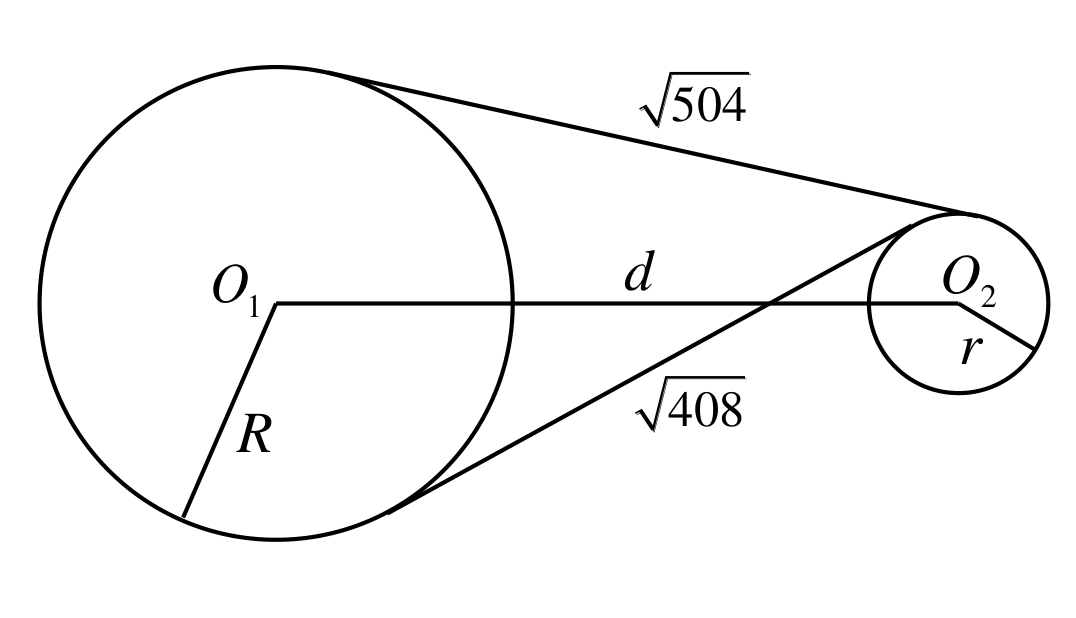
Let $O_1$ and $O_2$ be two disjoint circles with integer radii $R$ and $r$, in cm, respectively, where $R\gt r$. The distance $d$, in cm, between their centres is also an integer. The length of each external common tangent segment is $\sqrt{504}$ cm, and the length of each internal common tangent segment is $\sqrt{408}$ cm. What is the value of $d$?
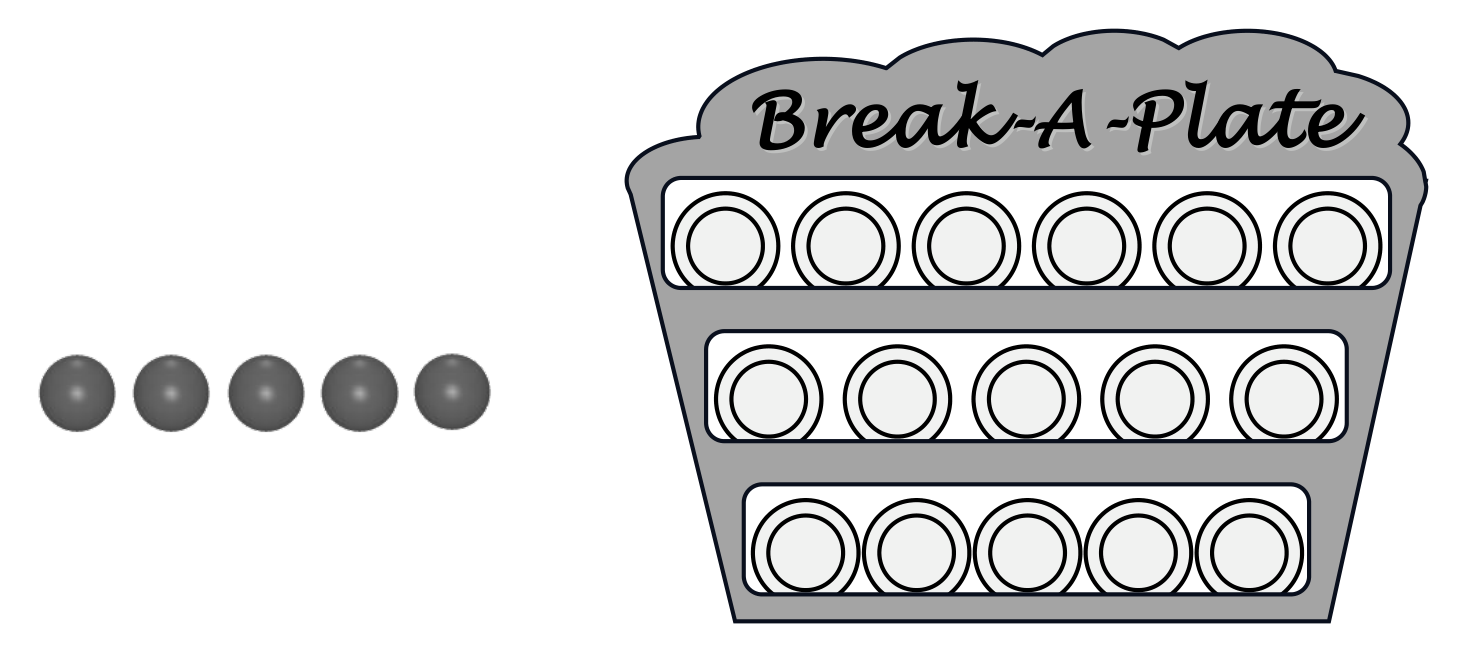
In the carnival game Break-A-Plate, a player throws five softballs at plates from a distance. If the player successfully breaks plates on any two consecutive throws among the five throws, the player wins a prize.
Suppose that for each throw, Charlie has a $\frac23$ chance of breaking a plate, and that all throws are independent of each other. What is the probability that Charlie wins a prize?
Students are divided into many teams to participate in a contest in two different halls. If 120 students have exactly two teammates in the other hall, 160 students have at least one other teammate in each of the two halls and no three teammates are in the same hall, how many students have exactly one other teammate in each hall?
Remove the trailing zeros from $2025!$ and $2026!$ and let the resulting numbers be $A$ and $B$, respectively. Let $a$ and $b$ be the remainders when $A$ and $B$ are divided by 100, respectively. What is the value of $|a-b|$?
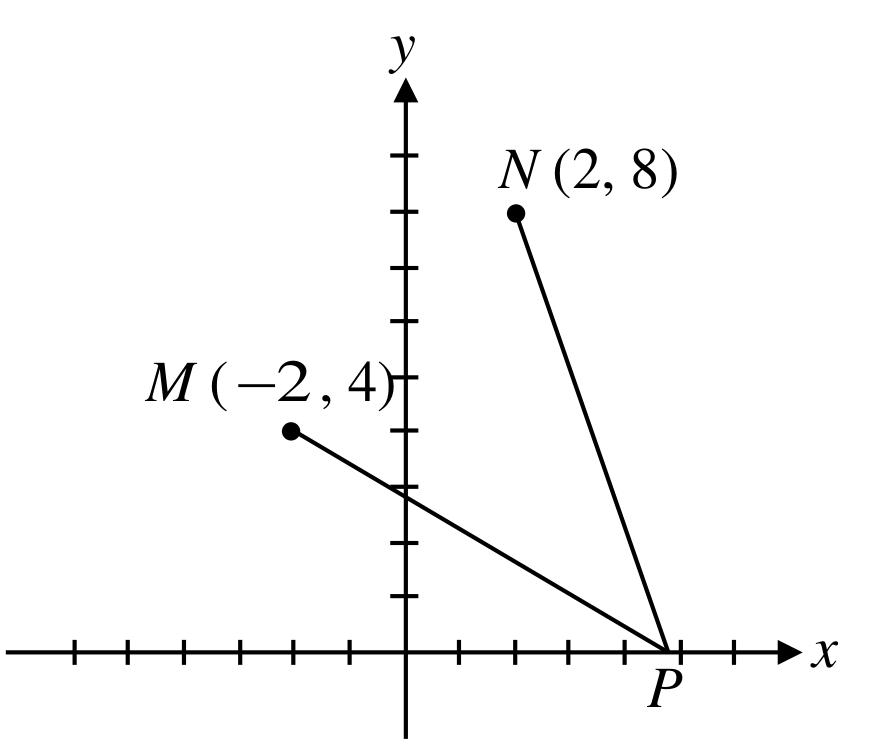
Let $P$ be a point on the $x$-axis such that $\angle MPN$ attains its maximum possible value, where $M=(-2,4)$ and $N=(2,8)$. What is the $x$-coordinate of $P$?
Let $a,b$ be positive integers such that $\frac1a+\frac1b\gt \frac15$. If $a\ge6$ and $b\ge6$, what is the minimum possible value of $\frac1a+\frac1b$?
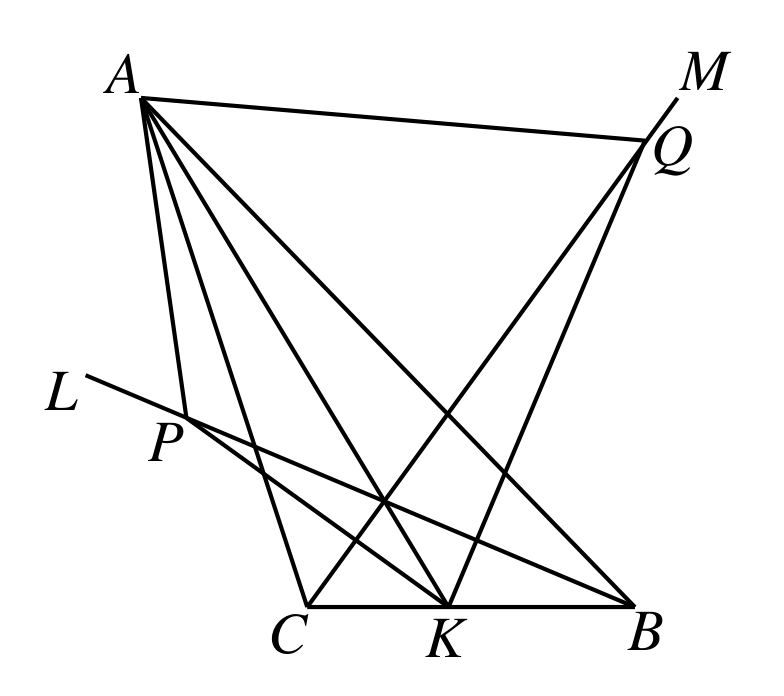
As shown below, $AK,BL,CM$ are the angle bisectors of triangle $ABC$, with $K$ lying on side $BC$. Points $P,Q$ are on lines $BL,CM$, respectively, such that $AP=PK$ and $AQ=QK$. If $\angle BAC=26^\circ$, what is the angle measure, in degrees, of $\angle PAQ$?
In three-dimensional space, $ABC$ is an equilateral triangle with side length 1 cm. Let $D$ be a point in space such that $AD=10$ cm and the lengths, in cm, of both $BD$ and $CD$ are integers. What is the sum of the lengths, in cm, of $BD$ and $CD$?
Every positive integer $n$ can be uniquely written as a sum of one or more non-consecutive Fibonacci numbers $F_2=1,F_3=2,F_4=3,F_5=5,\ldots$, excluding $F_0$ and $F_1$. For example, $30=1+8+21=F_2+F_6+F_8$. Let $a_n$ be the number of terms in the Fibonacci representation of $n$; for example, $a_{30}=3$. What is $a_1+a_2+\cdots+a_{54}$?
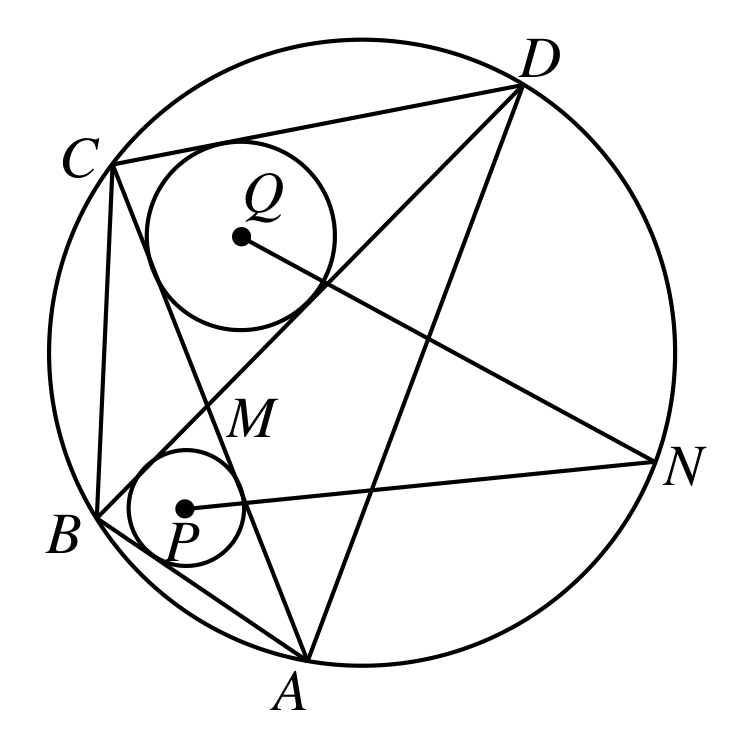
As shown below, $ABCD$ is a cyclic quadrilateral, where diagonals $AC$ and $BD$ intersect at $M$. Let $N$ be the midpoint of arc $AD$. If $P,Q$ are the incentres of triangles $ABM,CDM$, respectively, and $PN=3\sqrt3$ cm, what is the length, in cm, of $QN$? Give a detailed solution.
Five cards, numbered 1 to 5, are arranged randomly in a row. They are sorted from smallest to largest using the “Bubble Sort” algorithm: starting from the left, compare the first two adjacent cards and swap them if the left card is bigger; then move one position to the right and repeat until reaching the end of the row. Repeat this procedure from the beginning until the cards are fully sorted.
Count every swap made during the entire process. For example, $(4,5,3,2,1)$ requires 9 swaps:
$$(4,5,3,2,1)\to(4,3,5,2,1)\to(4,3,2,5,1)\to(4,3,2,1,5)$$
$$\to(3,4,2,1,5)\to(3,2,4,1,5)\to(3,2,1,4,5)\to(2,3,1,4,5)$$
$$\to(2,1,3,4,5)\to(1,2,3,4,5).$$
How many initial arrangements require exactly 5 swaps to be fully sorted? Give a detailed solution.