Every time Joãozinho goes to the cinema, he drinks 2 soft drinks. He spent his entire allowance of $R\$ 50,00$ going to the cinema 6 times and drinking a total of 20 soft drinks, including the ones he drank when he went to the cinema. If Joãozinho had only had one soda each time he went to the cinema, with this savings he could have gone to the cinema one more time, drinking a soda on that occasion as well. Regarding the price of cinema tickets and the price of soft drinks, we can say that:
A) the ticket price is triple the price of the soft drink.
B) the ticket price is four times the price of the soft drink.
C) the ticket price is five times the price of the soft drink.
D) the ticket is $R \$ 6,00$ more expensive than the soda.
E) the ticket is $R \$ 5,00$ more expensive than the soda
Between 1986 and 1989, our country's currency was the Cruzado ($\mathrm{Cz\ \$}$). Since then, we have had the Cruzado Nova, Cruzeiro, Cruzeiro Novo and, today, we have the Real. To compare values from the time of the Cruzado and today, economists calculated that 1 real is equivalent to 2,750,000,000 Cruzados.
Imagine that the currency had not changed and that João, who currently earns 640 reais per month, had to receive his salary in 1-cruz notes each. If a stack of 100 1-cross notes is $1{,}5\ \mathrm{~cm}$ high, how tall would João's salary be?
4 apparently identical coins are given, 3 of which are real and therefore have the same weight; one is false and therefore has different weight. It is not known whether the counterfeit coin is lighter or heavier than the others. Show that it is possible to determine the different currency using only two weighings on a plate balance. Note: In this type of scale, we can compare the weights placed on the two plates, that is, the scale can be balanced or tip towards the heavier side.
In a car race, a driver covered three sections: one of $240~\mathrm{km}$, one of $300~\mathrm{km}$ and one of $400~\mathrm{km}$. The pilot knows that the average speeds in these sections were $40~\mathrm{km}/\mathrm{h}$, $75~\mathrm{km}/\mathrm{h}$ and $80~\mathrm{km}/\mathrm{h}$, but he does not remember which of these speeds corresponds to each of these sections. We can guarantee that the total time in hours spent by the pilot to cover the three sections was:
A) less than or equal to 13 hours
B) greater than or equal to 13 hours and less than or equal to 16 hours
C) greater than or equal to 16 hours and less than or equal to 17 hours
D) greater than or equal to 15 hours and less than or equal to 18 hours
Luíza, Maria, Antônio and Júlio are brothers. Two of them are the same height. It is known that:
- Luíza is bigger than Antônio
- Maria is smaller than Luíza
- Antônio is bigger than Júlio
- Julio is smaller than Maria.
Which of them are the same height?
Sign of a product and sign of a quotient: $a$, $b$, $c$ and $d$ are four non-zero numbers such that the quotients $\frac{a}{5}$, $\frac{-b}{7 a}$, $\frac{11}{a b c}$, $\frac{-18}{a b c d}$ are positive. Determine the signs of $a$, $b$, $c$ and $d$.
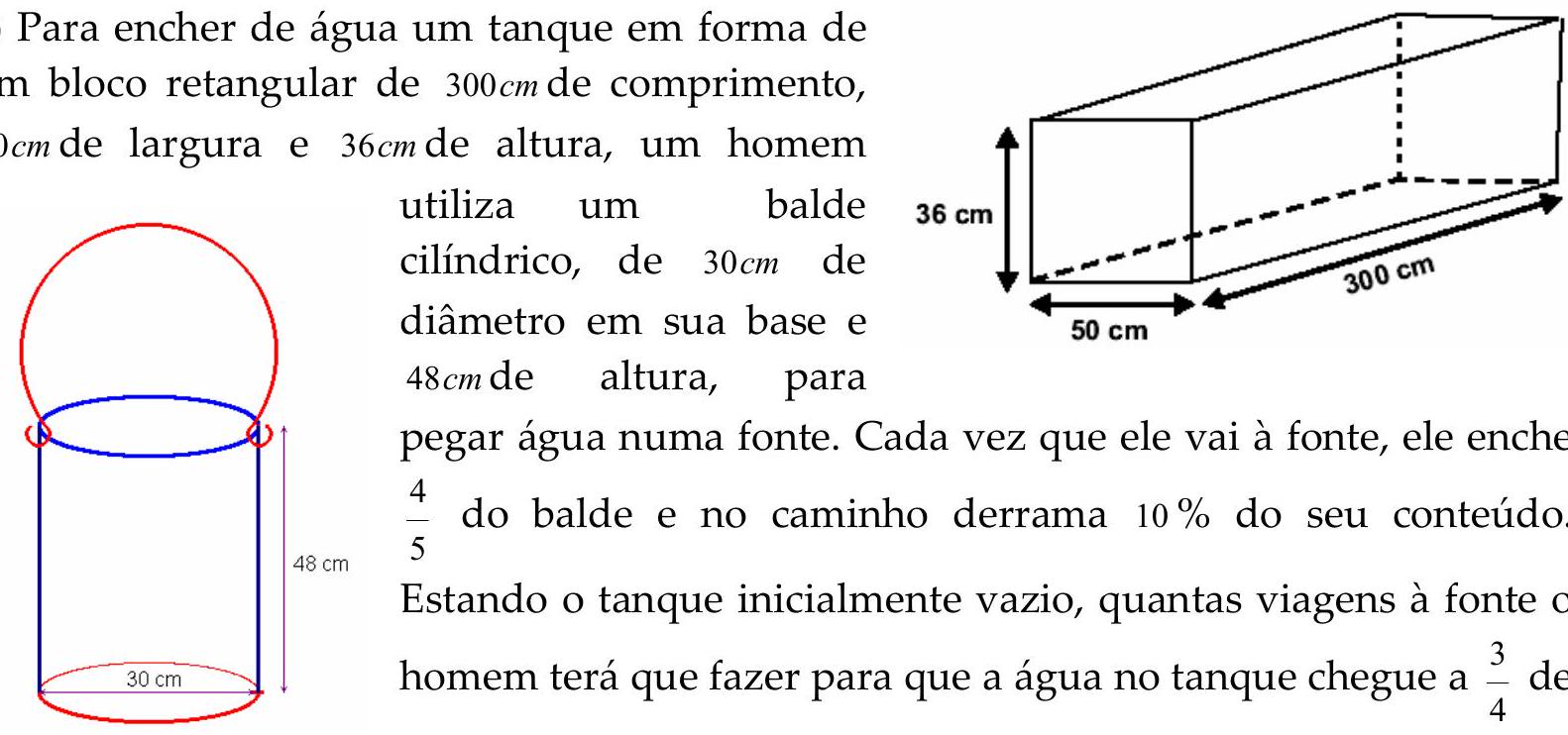
To fill with water a tank in the shape of a rectangular block $300~\mathrm{cm}$ long, $50~\mathrm{cm}$ wide and $36~\mathrm{cm}$ high, a man
uses a cylindrical bucket, $30~\mathrm{cm}$ in diameter at its base and $48~\mathrm{cm}$ in height, to collect water from a fountain. Each time he goes to the fountain, he fills $\frac{4}{5}$ from the bucket and on the way spills $10\%$ of its contents. If the tank is initially empty, how many trips to the source will the man have to make for the water in the tank to reach $\frac{3}{4}$ of its height?
If an arc of $60^{\circ}$ on circle I has the same length as an arc of $45^{\circ}$ on circle II, then the ratio of the area of circle I to that of circle II is:
Let $P$ be a convex $2006$-gon. The $1003$ diagonals connecting opposite vertices and the $1003$ lines connecting the midpoints of opposite sides are concurrent, that is, all $2006$ lines have a common point. Prove that the opposite sides of $P$ are parallel and congruent.
An athlete runs $5000~\mathrm{m}$ per week on a sports court, which has a short track and a long track. In one week he trained six days, each day running once on the long track and twice on the short track. The following week he trained seven days, each day running once on each track. We can then say that:
A) the long track is three times longer than the short one.
B) the long track is four times longer than the short one.
C) the long track is five times longer than the short one.
D) the long track is $600~\mathrm{m}$ longer than the short one.
E) the long track is $500~\mathrm{m}$ longer than the short one.
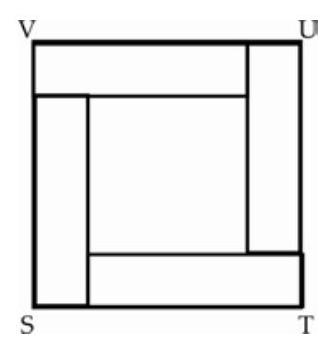
The square $STUV$ is made up of a square bounded by 4 equal rectangles. The perimeter of each rectangle is $40~\mathrm{cm}$. What is the area, in $\mathrm{cm}^2$, of square $STUV$?
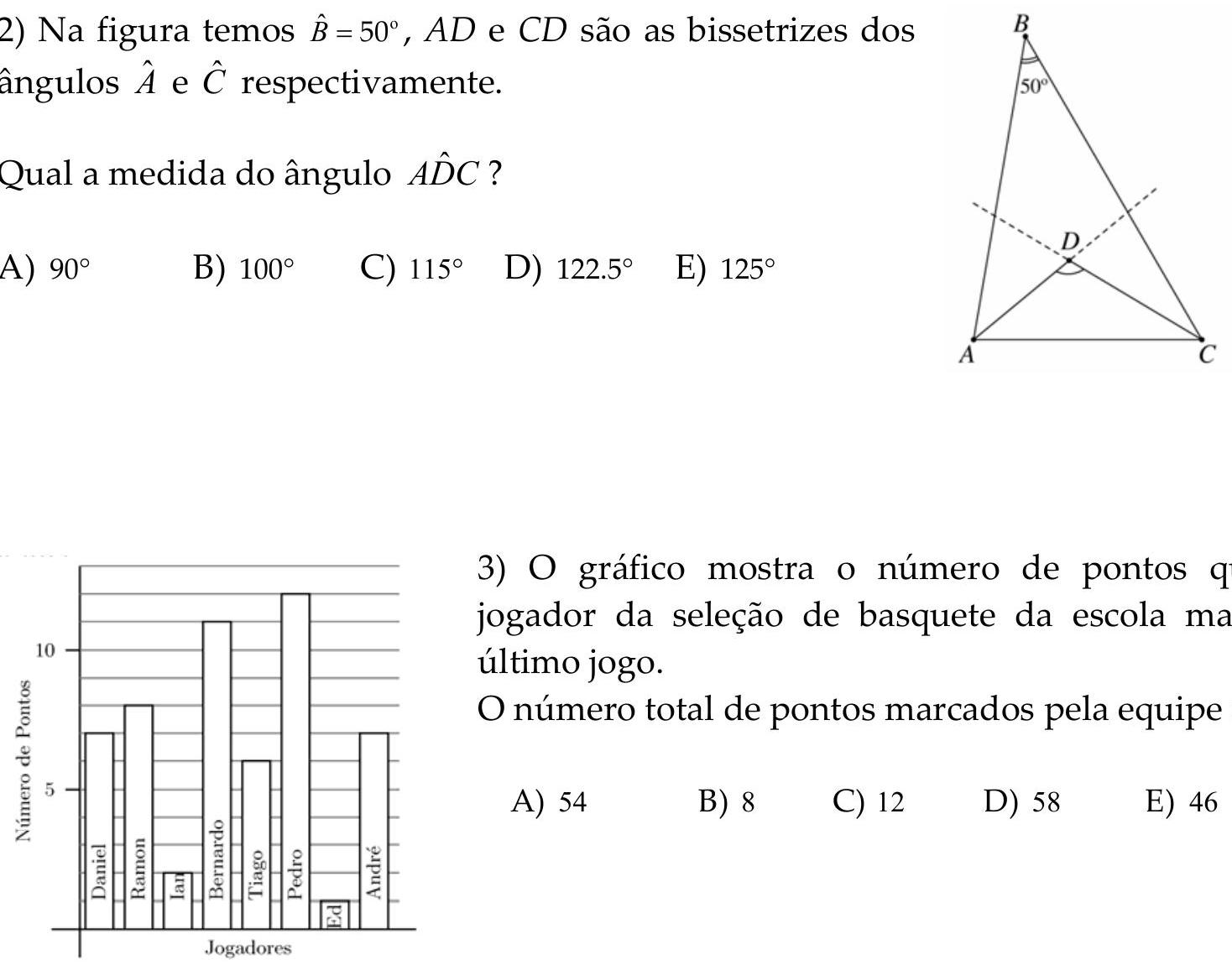
In the figure we have $\hat{B}=50^{\circ}$, $AD$ and $CD$ are the bisectors of the angles $\hat{A}$ and $\hat{C}$ respectively.
What is the measurement of the angle $A \hat{D} C$?