Skip to content / Đến nội dung
ThichHocToan.com

ITOT 45 Spring 2024 · THCS · A (Advanced)

Question 1

Twelve students have pairwise different strengths. The coach divides them into two teams of six on ten occasions, with a different division each time. Could all ten tug-of-war games be draws, meaning that the total strengths of the two teams are equal each time?


Question illustration

Question 2

Prove that among the vertices of any convex nonagon there are three forming an obtuse triangle, none of whose sides is a side of the nonagon.

Question illustration

Question 3

Two players take stones from a pile of100. On move1 the first player takes1; on move2 the second takes1 or2; on move3 the first takes1,2 or3; and so on, with at most the move number taken each time. Whoever takes the last stone wins. Which player can force a win?

Question illustration

Question 4

Tom chooses a positive reduced fraction$x=m/n$. You may choose a positive rational$y\lt 1$, and Tom reports only the numerator of$x+y$ after reduction. How can you determine$x$ with certainty using two such queries?

Question illustration

Question 5

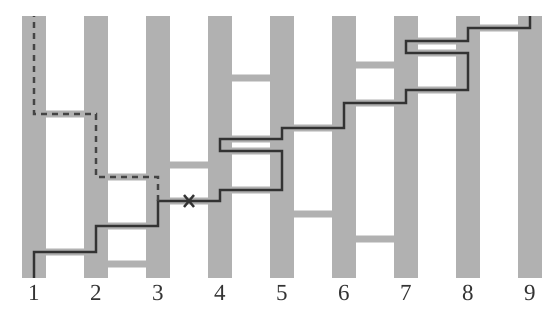
Nine vertical pillars stand in a row, with horizontal sticks between neighboring pillars at pairwise different heights. A beetle climbs upward; whenever it meets a stick it crosses to the neighboring pillar and continues upward. Starting at the bottom of pillar1, it finishes at the top of pillar9. Can one always remove a single stick so that a beetle starting at pillar1 finishes at pillar5?

In the source example, the original route is solid; removing its third encountered stick gives the dotted route.

Question illustration

Question 6

On the circumcircle of triangle$ABC$, let$M,N,P,Q$ be the midpoints of arcs$BAC,CBA,BC,AC$, respectively; the two-letter arcs are the arcs not containing the third vertex. The$A$-excircle touches$BC$ at$A_1$ and the extensions of$AC,AB$. The$B$-excircle touches$AC$ at$B_1$ and the extensions of$BA,BC$. Suppose$A_1$ lies on segment$NP$. Prove that$B_1$ lies on segment$MQ$.

Question illustration

Question 7

Distinct real numbers are written on99 cards, and their total sum is irrational. An ordering is called unfortunate if, for every$k=1,\ldots,99$, the sum of its first$k$ cards is irrational. What is the smallest possible number of unfortunate orderings?

Question illustration