One hundred friends, including Alice and Bob, live in several cities. Alice adds the distances from her city to the cities of the other 99 friends and obtains 1000 km. What is the greatest possible sum Bob can obtain in the same way? Regard cities as points of a plane; two friends in the same city have distance zero.
For each of the numbers $1,19,199,1999,\ldots$, one card is made and labeled with that number. (a) Can at least three cards be selected so their sum has all digits equal to 2 except one? (b) If some cards have such a sum, what can its digit different from 2 be? Original weights: (a) 2 points, (b) 3 points.
Baron Munchausen claims that he can draw a polygon and a point inside it such that every straight line through this point divides the polygon into three polygons. Can he be right?
Let $n>1$ be an integer. A rook stands on an infinite white square board. In each move it travels exactly $n$ cells vertically or horizontally and colors the traversed cells black. After some moves, without passing any cell twice, it returns to its initial position. The black cells form a closed contour. Prove that the number of white cells inside the contour has remainder 1 on division by $n$.
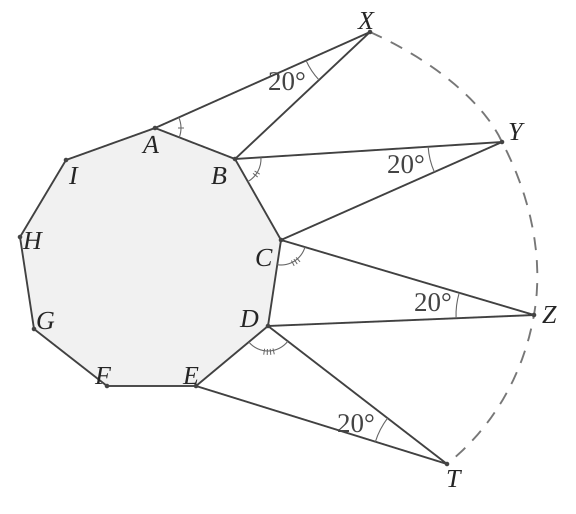
Outside regular nonagon $ABCDEFGHI$, triangles $XAB,YBC,ZCD,TDE$ are constructed. Their angles $AXB,BYC,CZD,DTE$ all equal $20^\circ$, and $\angle XAB+60^\circ=\angle YBC+40^\circ=\angle ZCD+20^\circ=\angle TDE$. Prove that $X,Y,Z,T$ are concyclic.
Peter adds a positive integer $M$ to a positive integer $N$ and finds that the result has the same digit sum as $N$. He continues adding $M$ repeatedly. Must he eventually obtain another number with the same digit sum as $N$?
Among some banknotes with pairwise distinct positive-integer denominations, exactly $N$ are counterfeit. In one test a detector reports the sum of the denominations of the genuine notes in any chosen subset. Prove that all counterfeit notes can be identified in $N$ tests if (a) $N=2$; (b) $N=3$. Original weights: (a) 3 points, (b) 8 points.