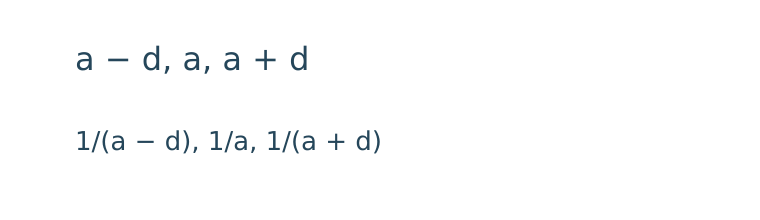
Alice writes an arithmetic progression of $n>2$ distinct numbers. Bob writes their reciprocals in some order and also obtains an arithmetic progression. Which values of $n$ are possible? The reciprocals require all original numbers to be nonzero, as stated explicitly in the official original. (5 points)
Neutral editorial illustration.
Practice scoring adds all whole-question scores (maximum 56). Official ITOT scoring adds only the three highest whole-question scores (maximum 30), after summing subparts within each question. The importer does not enforce best-three scoring. Duration: 300 minutes from historical organizer general rules, not an individually printed duration on this paper.
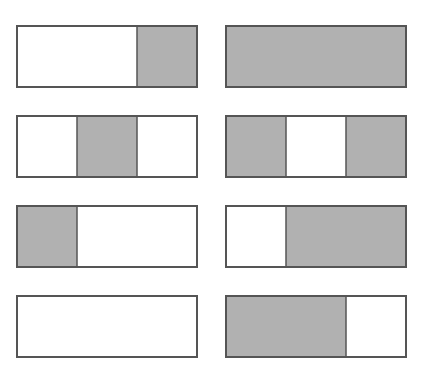
Eight horizontal $1\times3$ strips have their unit squares coloured white or grey as shown. They may be translated in any direction by any distance, but not rotated, reflected or overlapped. Can they be arranged so that the white part is one polygon bounded by a closed non-self-intersecting line, and the grey part is also such a polygon? (6 points)
A right triangle has hypotenuse length 1. The line through the two points where its incircle touches its legs cuts a chord from the circumcircle. What is the chord length? (7 points)
Initially the digit 7 is on a board. Alice and Bob alternate turns, Alice first. A turn inserts one digit at the beginning (nonzero there), between any two existing digits, or at the end. Whoever leaves a perfect square after their move wins. Does either player have a strategy guaranteeing victory? (8 points)
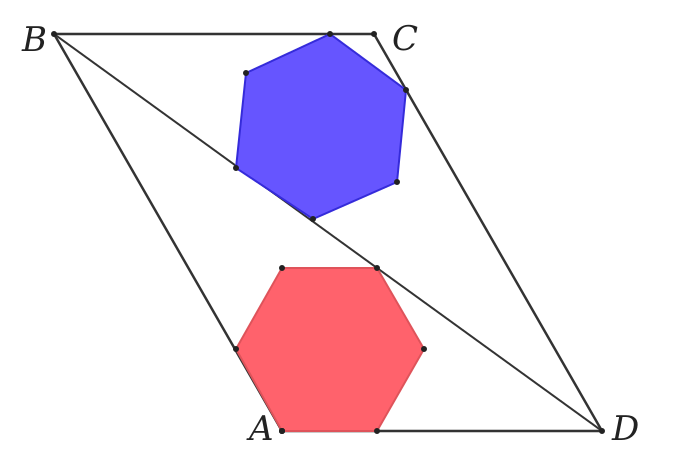
Diagonal $BD$ divides parallelogram $ABCD$ into two equal triangles. A regular hexagon in $ABD$ has two consecutive sides on $AB,AD$ and one vertex on $BD$. Another regular hexagon in $BCD$ has two consecutive vertices on $BC,CD$ and one side on $BD$. Which hexagon has larger area? (9 points)
The official original explicitly gives $\angle A=120^\circ$; the supplied Vietnamese statement omits this angle. It is also implied by the two consecutive sides of the regular hexagon lying along $AB,AD$ at $A$.
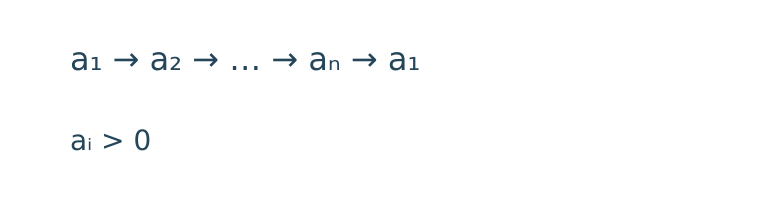
For a real number $x$, let $\lfloor x\rfloor$ be the greatest integer not exceeding $x$. Prove that for all positive integers $a_1,\ldots,a_n$,
$$\left\lfloor\frac{a_1^2}{a_2}\right\rfloor+\left\lfloor\frac{a_2^2}{a_3}\right\rfloor+\cdots+\left\lfloor\frac{a_n^2}{a_1}\right\rfloor\ge a_1+\cdots+a_n.$$
(9 points)
A row consists of 20 savoury buns and 20 sweet buns in an arbitrary order. Alice and Bob alternate taking one bun from either end, Alice first. Alice wants to finish with exactly 10 of each type; Bob wants to prevent that. Can Alice always achieve her goal? (12 points)