A circle cuts a quadrilateral nicely if it intersects each side at exactly two distinct points in the interior of that side. Does every convex quadrilateral admit such a circle?
A pair of distinct positive integers is lovely if both its arithmetic and geometric means are integers. Does every lovely pair have another lovely pair with the same arithmetic mean? Pairs $(a,b)$ and $(b,a)$ are regarded as identical.
On each turn Alice announces an integer $x$. Bob writes either $x$ or $x$ plus the sum of all numbers already on the board. Initially the board is empty. Can Alice force, after finitely many turns, (a) at least 100 occurrences of 5; (b) at least 100 occurrences of 10?
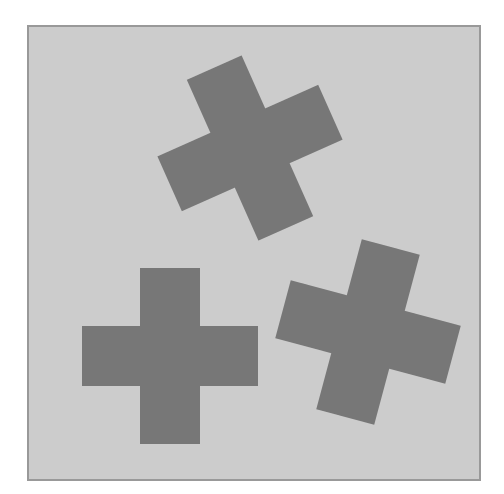
An X-pentomino consists of five unit squares: one central square and one attached along each of its four sides. Can nine such shapes be cut from an 8-by 8 square? Cuts need not follow its grid lines. The source picture only illustrates three shapes.
Two round tables each have $n$ dwarves. Each dwarf is initially friends only with the two neighbours at their own table. A wizard may add 2 n friendships between pairs of dwarves, but a witch then removes n of these new friendships. For which $n$ can the wizard guarantee a seating of all 2 n dwarves at one round table with every adjacent pair friends?
A convex quadrilateral has the property that no three of its side lengths can form a nondegenerate triangle. Prove that at least one of its angles is (a) at most 60 degrees; (b) at least 120 degrees.