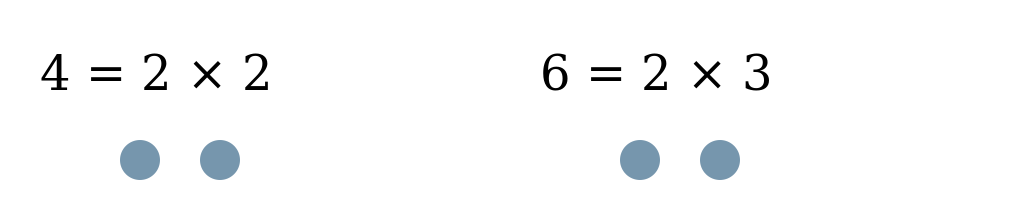
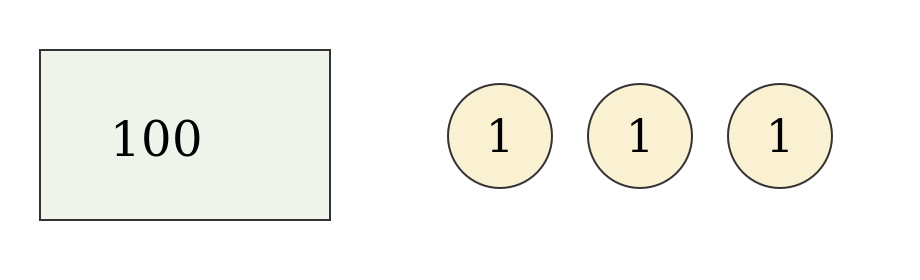
The complexity of an integer $n\gt 1$ is the number of prime factors in its factorisation, counted with multiplicity; for example 4 and 6 both have complexity 2. Find all $n$ for which every integer $m$ strictly between $n$ and $2n$ has complexity (a) no greater than that of $n$; (b) strictly less than that of $n$. Original weights:2+2.
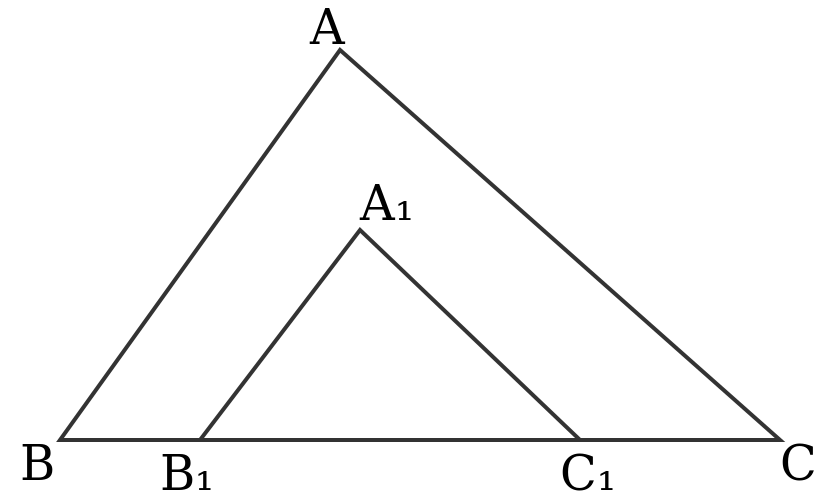
Two acute triangles $ABC,A_1B_1C_1$ satisfy $B_1,C_1\in BC$ and $A_1$ lies inside $ABC$. Their areas are $S,S_1$. Prove $\frac{S}{AB+AC}\gt \frac{S_1}{A_1B_1+A_1C_1}$.
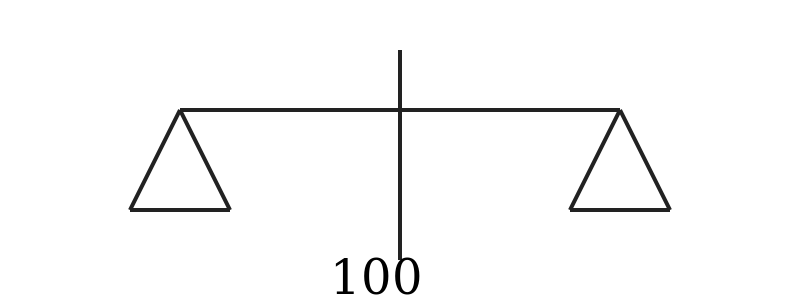
There are 100 visually identical coins, of gold, silver and bronze, at least one of each. Their weights are respectively 3,2,1 grams. Determine every coin’s type using at most 101 weighings on a balance with no weights.
Let $ABC$ have circumcentre $O$. Drop perpendiculars $OP,OQ$ onto the internal and external angle bisectors at $B$. Prove that line $PQ$ bisects the segment joining the midpoints of $CB$ and $AB$.
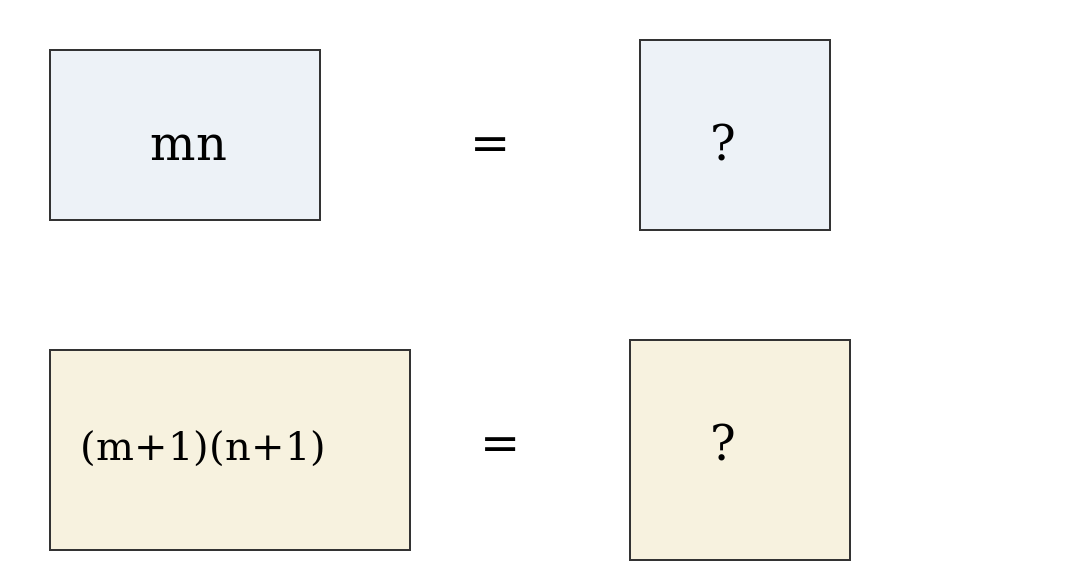
Call distinct positive integers $(m,n)$ nice if $mn$ and $(m+1)(n+1)$ are perfect squares. Prove that for every positive integer $m$ there exists $n\gt m$ making a nice pair.
Peter starts with some 100-ruble notes and no other money. Books have positive integer prices. Change is in 1-ruble coins. For an expensive book (price at least 100), he pays with the fewest 100-ruble notes needed. For a cheap book (price below 100), he pays with coins if he has enough, otherwise with one 100-ruble note. When all notes are gone, he has spent exactly half his initial money. Could he have spent at least 5000 rubles? (The official English original uses dollars; the supplied Vietnamese uses rubles. The arithmetic is unchanged.)
Peter has a wooden square stamp divided into small square cells. He inks 102 cells black and presses the stamp 100 times on white paper, each time printing exactly those 102 cells. Can the result be a101-by 101 square grid with every cell black except one corner cell?