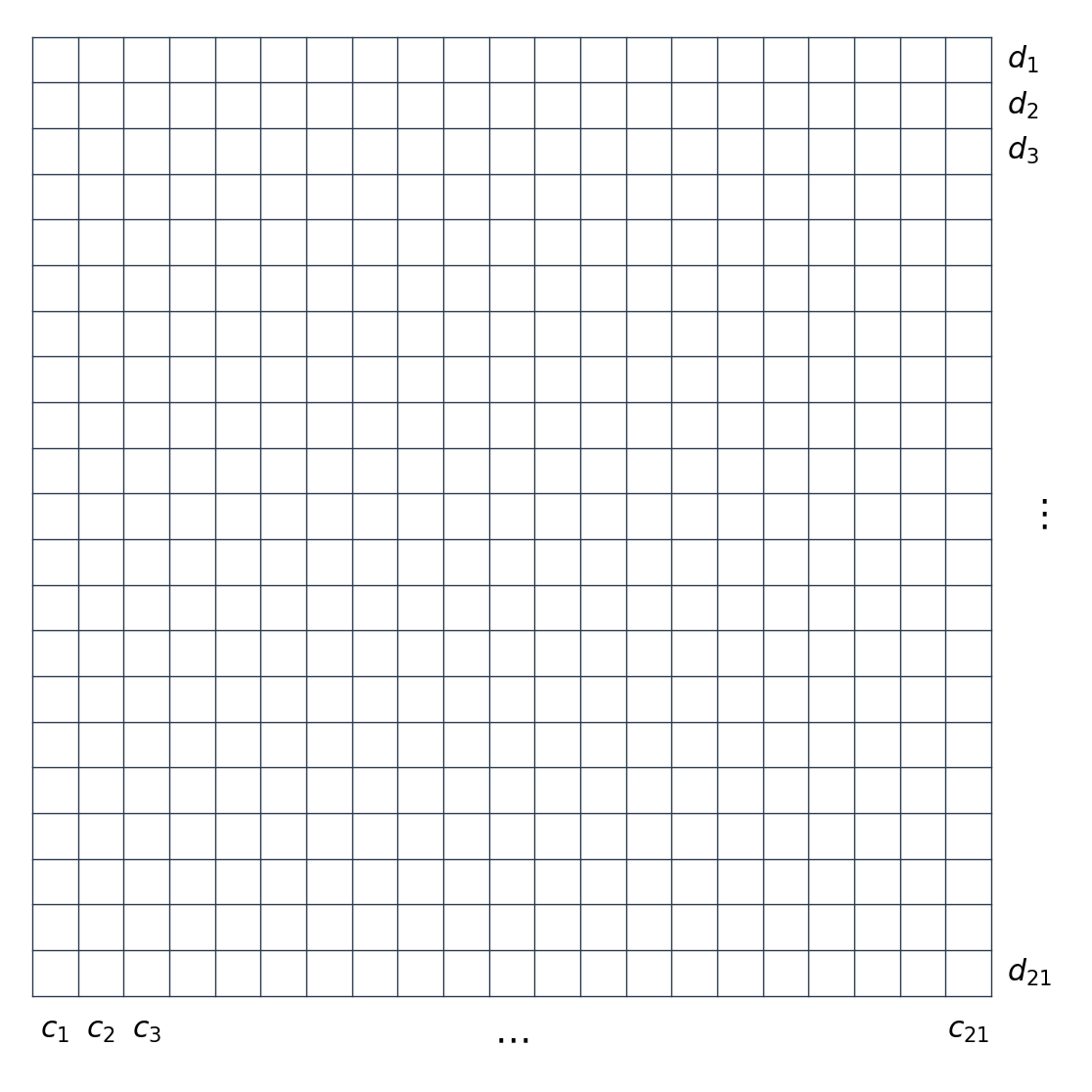
A $21\times21$ square grid is shown. Each cell contains either $1$ or $-1$. Let $d_i$ be the product of the entries in row $i$, and let $c_j$ be the product of the entries in column $j$, for $i,j\in\{1,2,\ldots,21\}$. Set $D=d_1+d_2+\cdots+d_{21}$ and $C=c_1+c_2+\cdots+c_{21}$. Prove that $D+C\ne0$.
A natural number is called “interesting” if it is the product of exactly two primes, which may be equal. Give three consecutive natural numbers that are all interesting. Prove that four consecutive natural numbers cannot all be interesting.
In triangle $ABC$, let $M$ be the midpoint of $BC$ and $N$ the midpoint of $AM$. On the ray opposite to ray $NB$, choose $D$ so that $DN=NB$. Let $E$ be the intersection of rays $CD$ and $BA$.