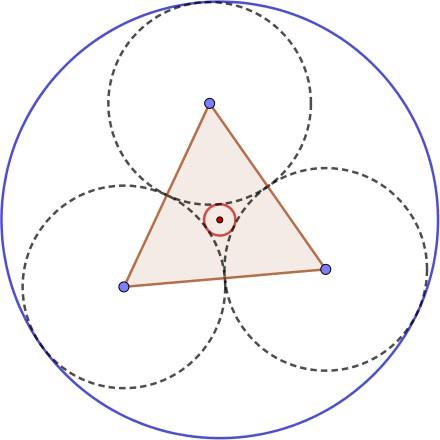
Three mutually externally tangent circles have centres at the vertices of an equilateral triangle. A large circle encloses them and is internally tangent to all three. A small circle in the central gap is externally tangent to all three. What is the ratio of the large radius to the small radius?
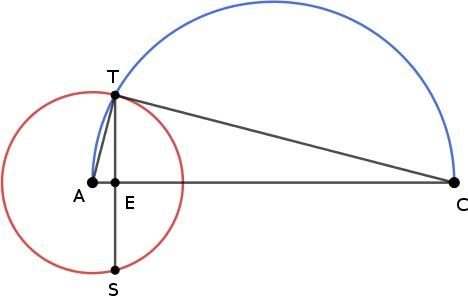
In the figure, A is the centre of the small circle, E is the midpoint of chord ST, and A, E, C are collinear in that order. AC is the diameter of the semicircle passing through T. Given $AT=8$ and $AE=2$, find CT.
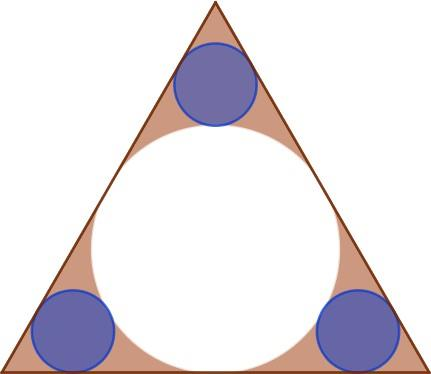
An equilateral triangle has side a and an incircle. In each corner region, a smaller circle is tangent to the two adjacent sides and to the incircle. Find the combined area of the three smaller circles.
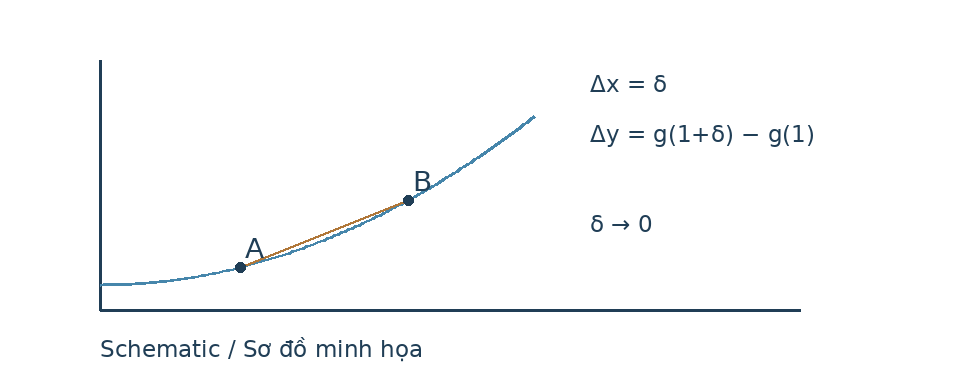
Let $g(x)=2026x^2-2025x+4051$. Points $A=(1,g(1))$ and $B=(1+\delta,g(1+\delta))$ lie on its graph, where $\delta\ne0$. As $\delta$ approaches zero, what does $[g(1+\delta)-g(1)]/\delta$ approach? Source clarification: the printed coordinate of B uses undefined f instead of g, and an extra comma and $\delta$ follow the definition; the graph and displayed ratio specify g as used here.
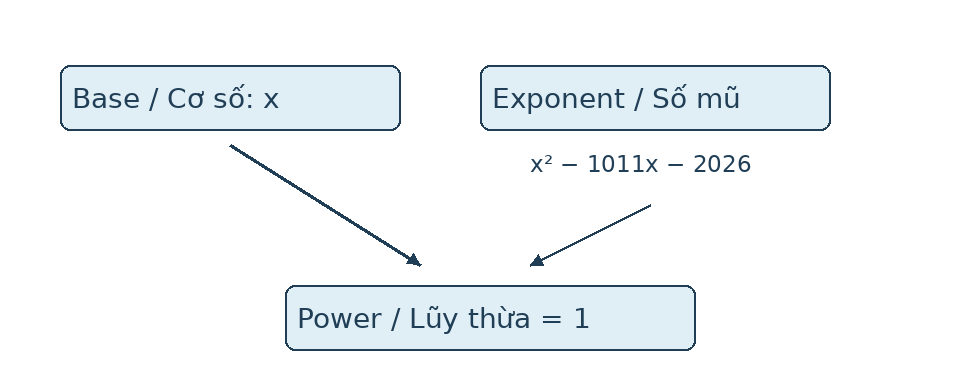
How many distinct real solutions does $x^{x^2-1011x-2026}=1$ have? Interpret real powers wherever they are defined, including negative bases with integer exponents.
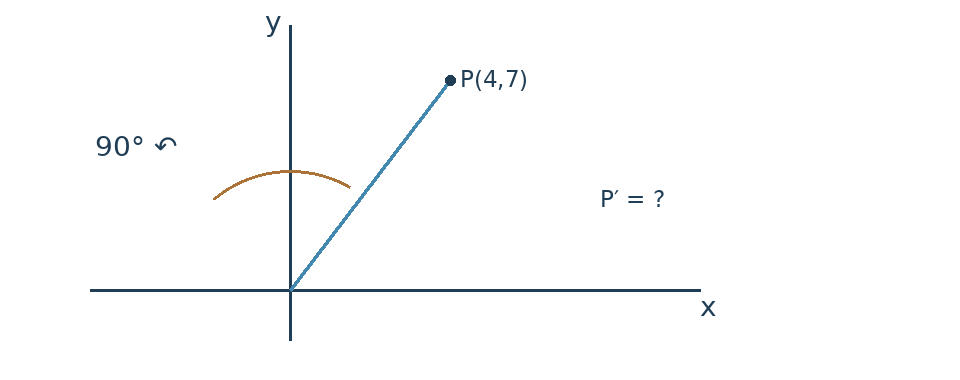
Rotate $P=(4,7)$ counterclockwise about the origin through $\theta=90^\circ$. Use $x^{\prime}=x\cos\theta-y\sin\theta$, $y^{\prime}=x\sin\theta+y\cos\theta$. Find the new coordinates. Source clarification: the printed matrix has lost its row and column layout; these are the standard equations for the stated counterclockwise rotation.