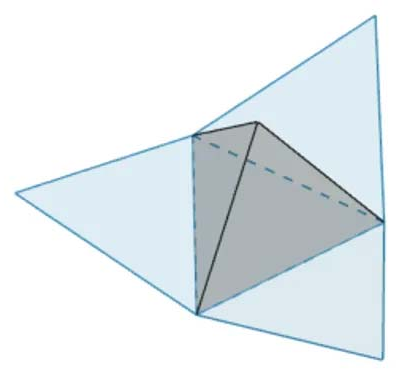
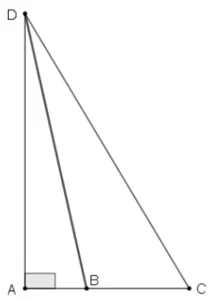
An equilateral triangle of area $36\sqrt3$ square units is divided into four congruent equilateral triangles and folded into a regular tetrahedron as shown. Find its volume in cubic units.
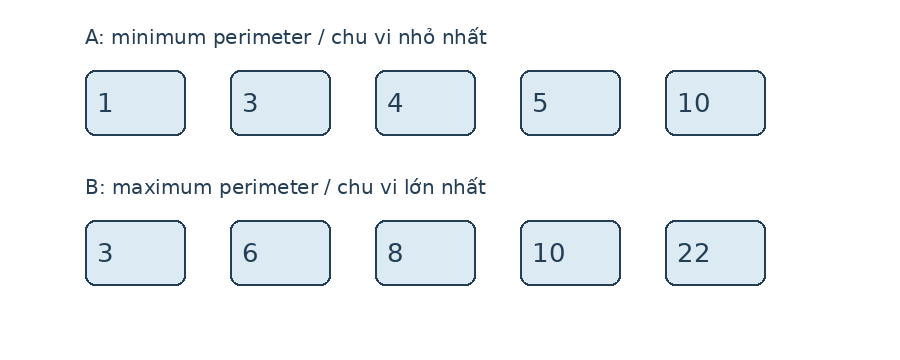
Choose three distinct numbers from $\{1,3,4,5,10\}$ as the sides of triangle A with the least possible perimeter. Choose three distinct numbers from $\{3,6,8,10,22\}$ as the sides of triangle B with the greatest possible perimeter. Find the sum of their areas.
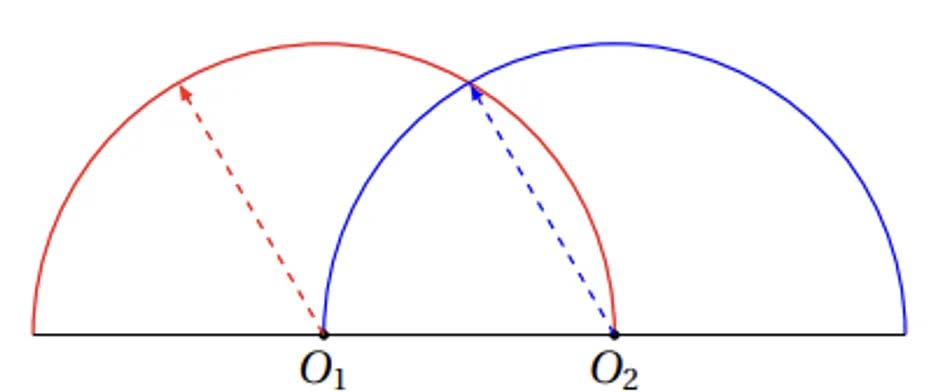
Two windshield wipers each have length $L$ and sweep the upper semicircles shown. Their pivot separation is $O_1O_2=L$. What is the total area swept by at least one wiper?
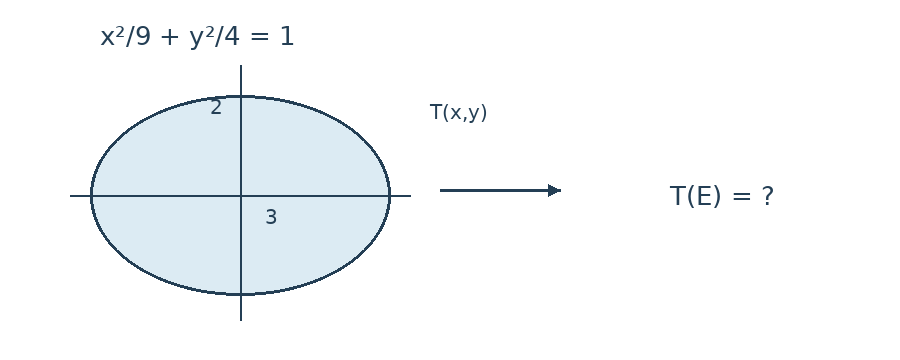
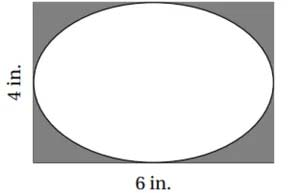
An ellipse is inscribed in a $4$-inch by $6$-inch rectangle as shown. Find the shaded area inside the rectangle and outside the ellipse, in square inches.
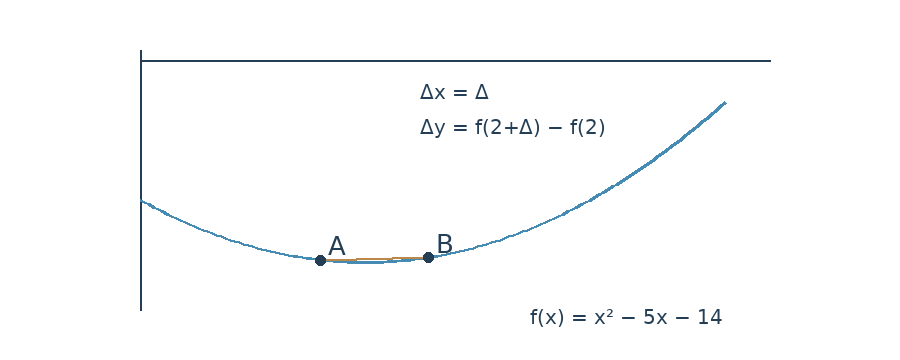
Let $f(x)=x^2-5x-14$. Points $A=(2,f(2))$ and $B=(2+\Delta,f(2+\Delta))$ lie on its graph, where $\Delta\ne0$. As $\Delta$ approaches zero, what value does $R=[f(2+\Delta)-f(2)]/\Delta$ approach?
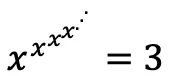
The source displays $x^{x^{x^{\cdot^{\cdot^{\cdot}}}}}=3$. Under its formal repeated-tail interpretation, what value of x follows? Clarification: treat the tail as 3 and solve $x^3=3$; this is a formal algebraic interpretation, not a claim that the usual sequence of finite power towers converges to 3.