SEAMO self-study edition 2027; not an official 2027 paper. Original source years are retained. 25 questions, 90 minutes; Q1–10: 3 points, Q11–20: 4 points, Q21–25: 6 points, total 100. Original response types and all subparts are preserved. Verified is an editorial convention; source defects, necessary assumptions and unresolved mathematical uncertainty are disclosed.
Find the integer part of
$$\frac{1}{\frac1{2015}+\frac1{2016}+\frac1{2017}+\frac1{2018}+\frac1{2019}}.$$
Answer entry: use / for division, ! immediately after an integer for factorial, and - for subtraction, without spaces. Only explicitly listed exact strings are recognized; symbolic simplification is not supported. An equivalent unrecognized expression requires manual checking and must not be treated as wrong or scored zero solely for nonrecognition.
Let $n$ be the smallest positive integer such that moving its leftmost digit to the position after its rightmost digit creates $n/4$. Find the number of digits in $n$.
Source-choice issue: more than one printed choice has the correct numerical value. The original choices are retained below. Select any one correct choice, or give the value; this response is assessed manually. No extra explanation or list of all correct choices is required.
Original choices (retained for manual assessment):
Positive integers $a,b,c$ are selected randomly from $\{1,2,\ldots,2020\}$ with replacement. Find the probability that $abc+ab+2a$ is divisible by 5.
Answer entry: use a reduced fraction a/b or a decimal with a dot, without spaces. Only explicitly listed exact forms are recognized; equivalent forms outside that list require manual checking and must not be treated as wrong or scored zero solely for nonrecognition. No symbolic fraction parser is claimed.
Find the smallest natural number $n$ for which
$$\left\lfloor\frac{10^n}{x}\right\rfloor=1989$$
has an integer solution $x$. Here $\lfloor t\rfloor$ is the greatest integer at most $t$.
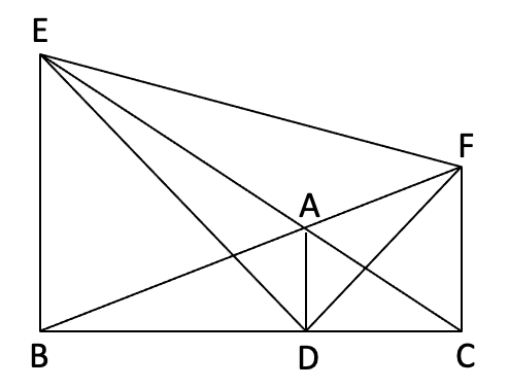
As shown in the figure, $AD\parallel BE\parallel FC$. Find the area of triangle $DEF$ if the area of triangle $ABC$ is 1. The incidences shown are retained: $B,D,C$ are collinear, $E,A,C$ are collinear, and $B,A,F$ are collinear.
Original source figure, preserving all mathematical labels and segments.
The number 25 is expressed as a sum of positive integers $x_1,x_2,\ldots,x_k$, where $k\le25$. What is the largest possible product $x_1x_2\cdots x_k$?
A sequence has terms divisible by 3, each one being a square number minus 1:
$$3,15,24,48,63,\ldots.$$
Find the remainder when its 2018th term is divided by 1000.
Sequence convention for self-study: list all positive integers satisfying the two properties in strictly increasing order, with no omissions, as indicated by the displayed initial terms.