How many distinct 4-letter words can be formed from the letters of MATHS? A word means any ordered arrangement, whether meaningful or not; each letter may be used at most once.
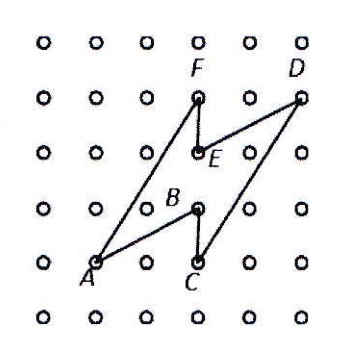
Consider ten points, no three of which lie on a straight line. How many different triangles can be formed by choosing three of these points as vertices?
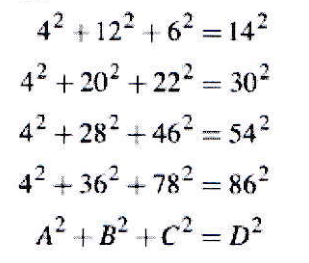
The first five instances of a pattern involving three squares are shown below. Find $B+D-A-C$.
$$4^2+12^2+6^2=14^2$$
$$4^2+20^2+22^2=30^2$$
$$4^2+28^2+46^2=54^2$$
$$4^2+36^2+78^2=86^2$$
$$A^2+B^2+C^2=D^2$$
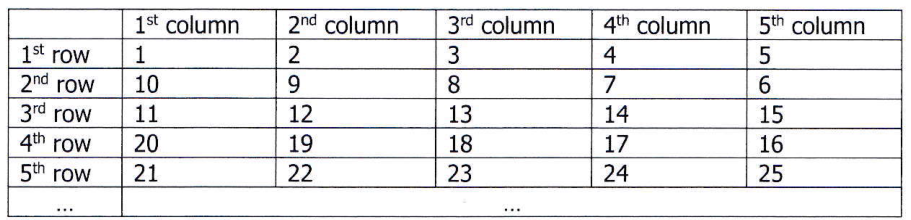
Continue with positive bases: the first column stays constant, the second has constant first differences, and the third and fourth have constant second differences.
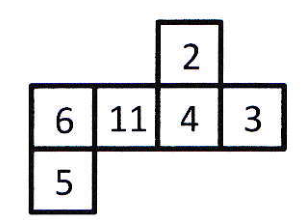
The cardboard pattern shown consists of six numbered squares and is folded into a cube. What is the greatest product of the numbers on three faces that meet at a common vertex? Enter the integer only.
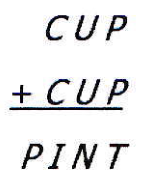
Different letters represent different decimal digits. In the cryptarithm below, $P$ and $C$ are nonzero. Find the first three digits of the least possible four-digit number $PINT$.
Each term after the first in a sequence is the sum of the cubes of the digits of the preceding term. The first term is 244. Find the 2021st term. Enter the integer.
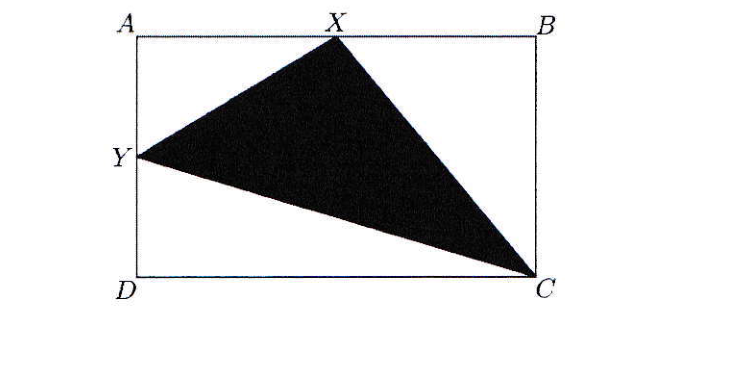
In rectangle $ABCD$, $X$ is the midpoint of $AB$ and $Y$ is the midpoint of $AD$. Find the area of triangle $XYC$, in $\mathrm{cm}^2$, if the rectangle's area is $880\mathrm{\ cm}^2$.
Tom travels the first 25 km at 60 km/h, then slows to $x$ km/h for the rest of his 50 km journey. His average speed for the whole journey is 40 km/h. Find $x$.
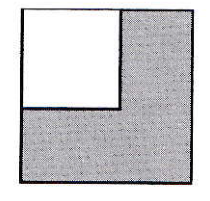
Two squares with positive integer side lengths overlap so that two sides of the smaller square lie along two sides of the larger square, as shown. The L-shaped shaded area is 27 square units. Find the sum of the two possible side lengths of the smaller square. Enter the integer only.
In a three-digit number $\overline{XYZ}$, the nonzero digits $X,Y,Z$, in that order, form an arithmetic progression. If $\overline{XYZ}-\overline{ZXY}=M$, find the largest three-digit value of $M$.
The overline denotes a decimal number, not a product. Enter the integer $M$.