Exercise 18. The ”Euler’s Totient function” $\varphi(n)$ of a positive integer $n$ is defined as the number of positive integers $m$ less than $n$ such that the highest common factor (HCF) of $m$ and $n$ is 1. For example, $\varphi(12)=4$, since there are 4 numbers $(1,5,7,11)$ less than 12 such that the HCF of 12 and each of these five numbers is 1.
What is the value of $\varphi(51)$?
**Editorial input convention:** Use the definition counting positive integers strictly less than 51. The source example contains a wording typo, explained in the solution.
Example 3. Gina’s 6-digit postal code has the following interesting properties:
- It is the same number if your read it from right to left.
- It is a multiple of 9.
- If you remove the first and last digits, the only prime factor of the remaining 4-digit number is 11.
Find the first 3 digits of Gina’s postal code.
**Editorial input convention:** Treat the code as a six-digit integer and the remaining middle as a four-digit integer, with no leading zero in either. Enter only the first three digits of the code that satisfies all stated conditions. The printed source solution has arithmetic errors, disclosed below.
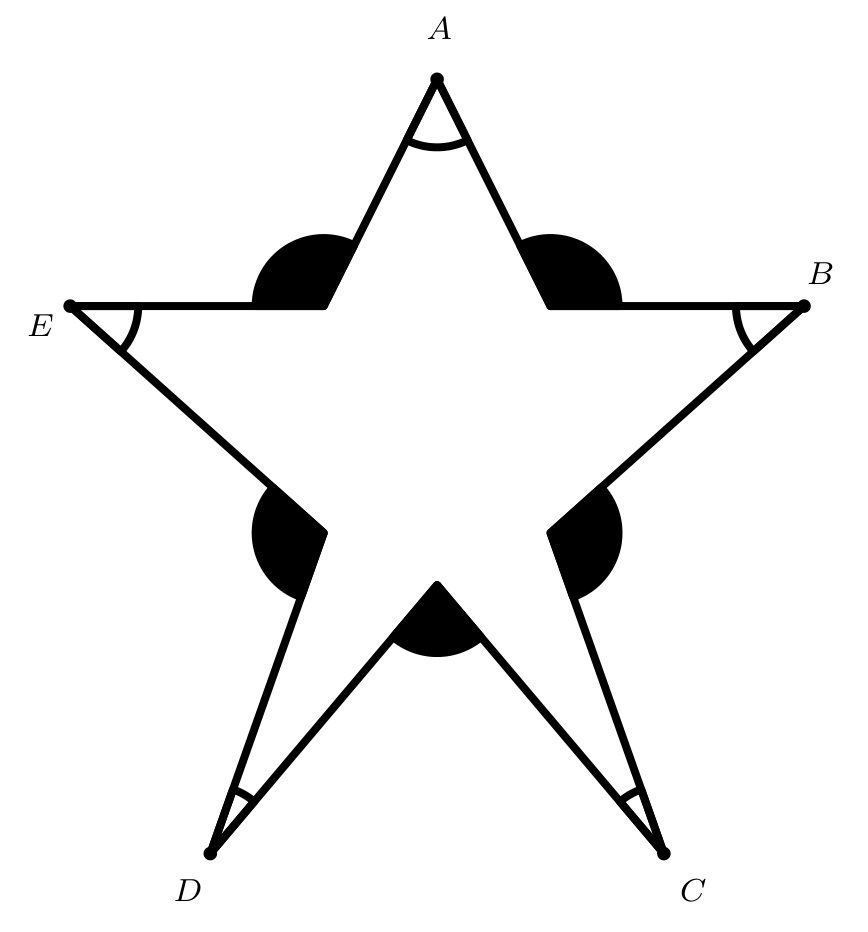
Exercise 22. Given that $\angle A+\angle B+\angle C+\angle D+\angle E=160^\circ$, find the sum of 5 shaded angles.
**Editorial input convention:** Use the simple concave star boundary shown. Each shaded angle is the smaller exterior angle at an inward notch, not its reflex interior angle. Enter their sum in degrees.
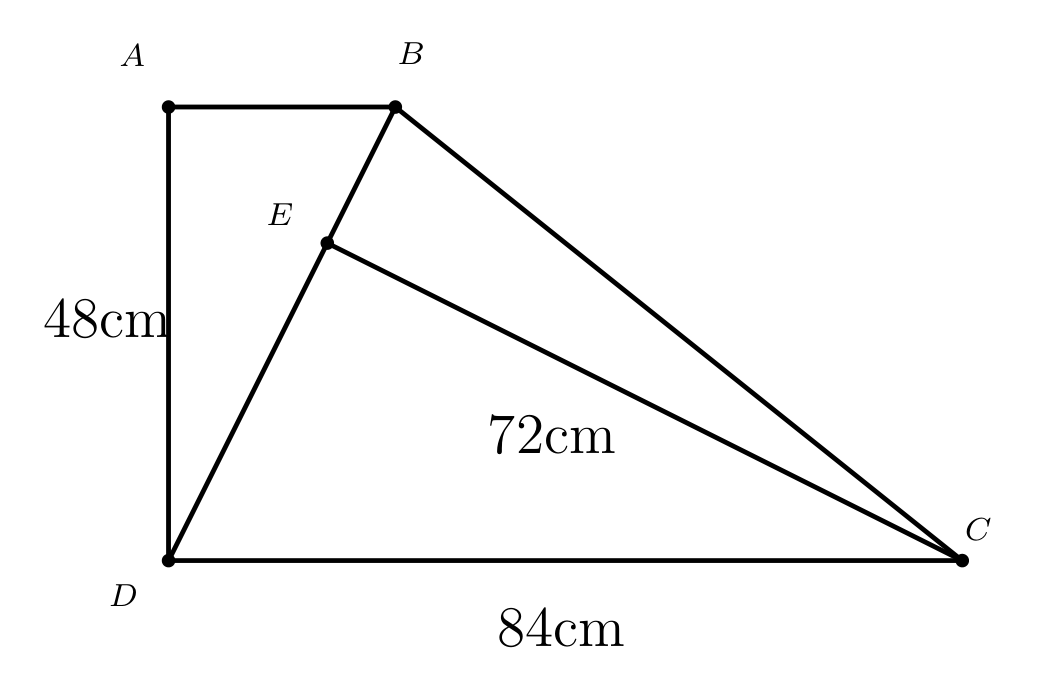
Exercise 2. The figure below shows a quadrilateral $ABCD$ with $\angle BAD=\angle ADC=90^\circ$. The point $E$ is on the diagonal $BD$ for which $\angle CED=90^\circ$. Given that $AD=48$cm, $CD=84$cm and $=CE=72$cm, find the length, in centimeters, of $BD$.
**Editorial input convention:** Read the extra equals sign as a source printing typo: the intended given length is CE = 72 cm, as labelled in the figure. Enter BD in centimetres, as a number only.
Exercise 9. The numbers from 1 to 2017 are listed in the following order: first all numbers not divisible by 3 are listed in increasing order. Then all numbers divisible by 3 but not by $3^2$ are listed in increasing order. Then all numbers divisible by $3^2$ but not by $3^3$ are listed in increasing order, and so on. What is the last number on this list? (Give the entire number, not just its last digit.)
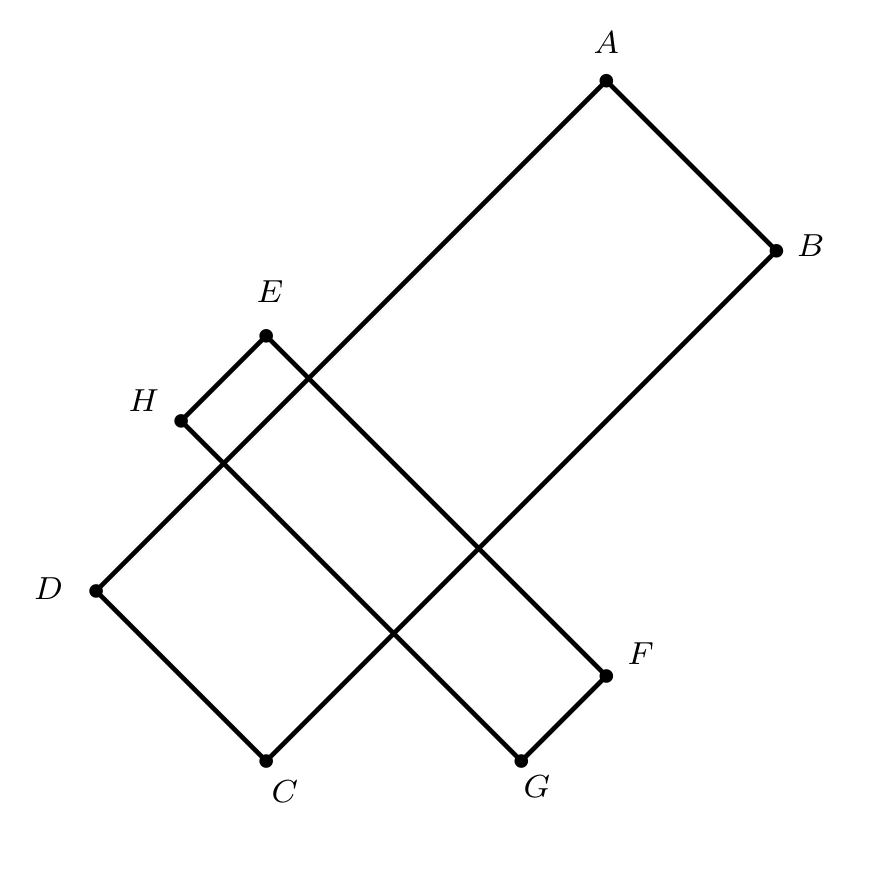
Exercise 5. As shown, the overlap of rectangles $ABCD$ and $EFGH$ is also a rectangle. The area of $ABCD$ is $174\text{cm}^2$ and the area of $EFGH$ is $52\text{cm}^2$, $EF=13$cm and $BC=29$cm. What is the area, in $\text{cm}^2$, of the entire figure?
**Editorial input convention:** Use the complete crossing shown: the two perpendicular rectangular strips each extend beyond the other on both sides of their rectangular overlap. Enter the union area, counting overlap once.
Exercise 21. Point $M$ is placed inside the square $ABCD$ in such a way that
$$\angle MAD:\angle MBA:\angle MCD=2:4:7.$$
What is measure of $\angle MCA$ in degrees?
**Editorial input convention:** Label the square vertices A,B,C,D in cyclic order, with M strictly inside. Enter the angle measure in degrees.
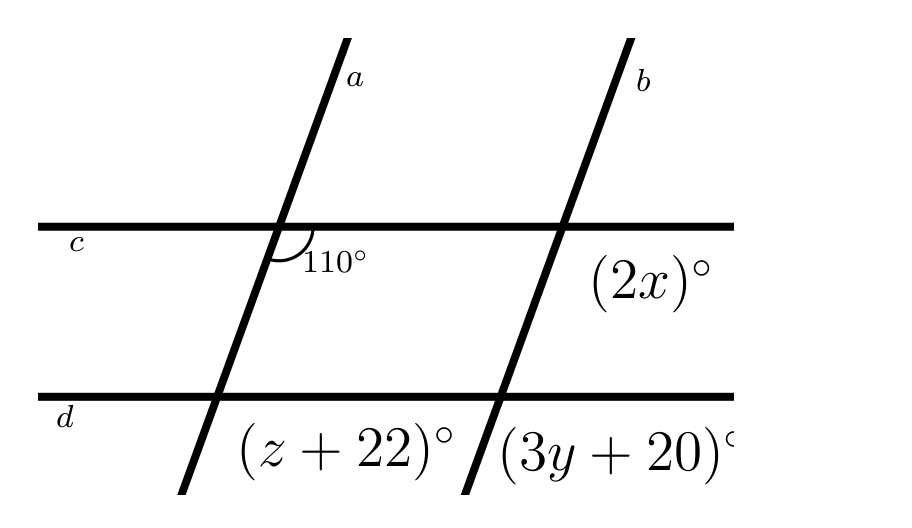
Example 10. In the figure, given that $a\parallel b$ and $c\parallel d$. Find the value of $x$, $y$ and $z$.
**Editorial input convention:** Enter x, then y, then z, separated by semicolons, with no spaces. Format example, not the answer: 1;2;3. The rightmost degree symbol is partially clipped in the original PDF itself; the four labelled angles are $110^\circ$, $(2x)^\circ$, $(z+22)^\circ$, and $(3y+20)^\circ$.
Exercise 4. Trapezoid $ABCD$ has $AB\parallel CD$, $BC=CD=43$, and $AD\perp BD$.
Let $O$ be the intersection of the diagonals $AC$ and $BD$, and let $P$ be the midpoint of $BD$. Given that $OP=11$, the length of $AD$ can be written in the form $m\sqrt n$, where $m$ and $n$ are positive integers and $n$ is not divisible by the square of any prime. What is $m+n$?
**Editorial input convention:** Use the usual convex trapezoid with vertices A,B,C,D in cyclic order. Enter the requested integer m+n.
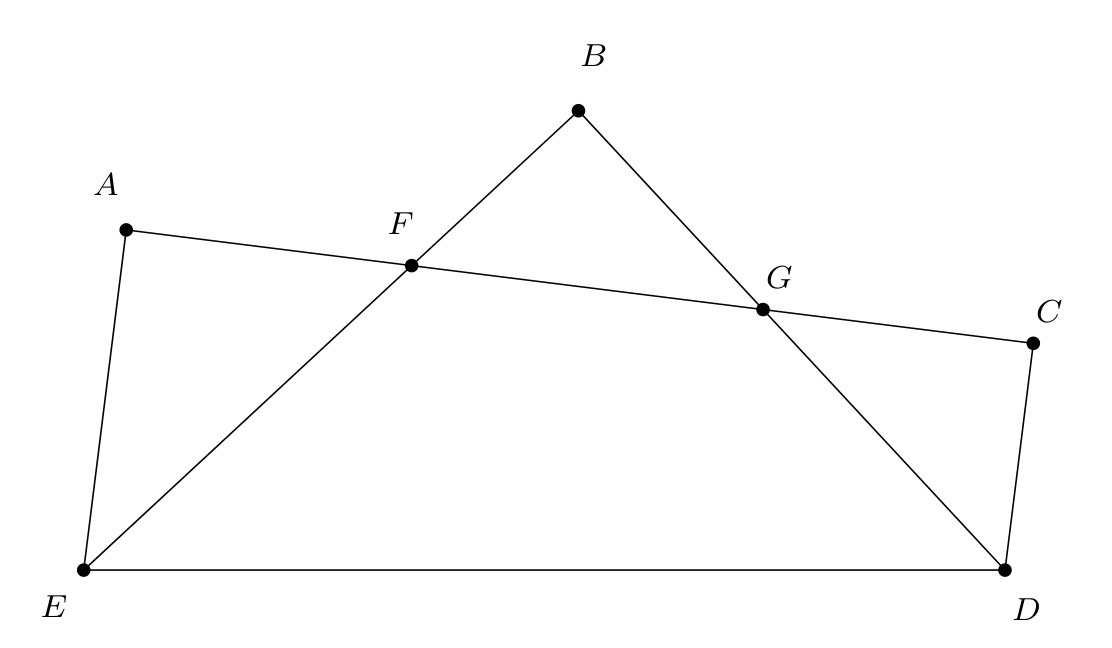
Question 32. In the figure, $\angle A$, $\angle B$, and $\angle C$, are right angles. If $\angle AEB=40^\circ$ and $\angle BED=\angle BDE$, then $\angle CDE=$
**Editorial input convention:** Planned revision repeat from SET 5. Use the ray positions and collinearities in the retained source figure.