**Editorial note for this self-study exercise:** The series contains every odd positive integer from 1 through 199. Enter the numerical sum without an option letter or thousands separators.
When 14, 53 and 79 is divided by a whole number X, each gives the same remainder. What is the largest possible value of X?
**Editorial note for this self-study exercise:** X is a positive integer (division by zero is excluded). Use the usual remainder from 0 through X−1. Enter X.
There are 4 teams in the football tournament. Each team play one match with the others. They get 3 points for a win and 1 point for a draw. In the end of the tournament, the point of three teams are 7, 5 and 2. What is the point of another team?
**Editorial note for this self-study exercise:** A loss earns 0 points, and every pair plays exactly once. Enter the fourth team’s number of points.
**Editorial note for this self-study exercise:** Continue the displayed rules: consecutive products in (a),(b), consecutive odd products in (c), triangular-number denominators in (d), and geometric ratios 1/2 and 1/3 in (e),(f). Enter all six answers in order a,b,c,d,e,f, each as a reduced positive fraction p/q, separated by semicolons with no spaces. Format-only example: 1/2;2/3;3/4;4/5;5/6;6/7.
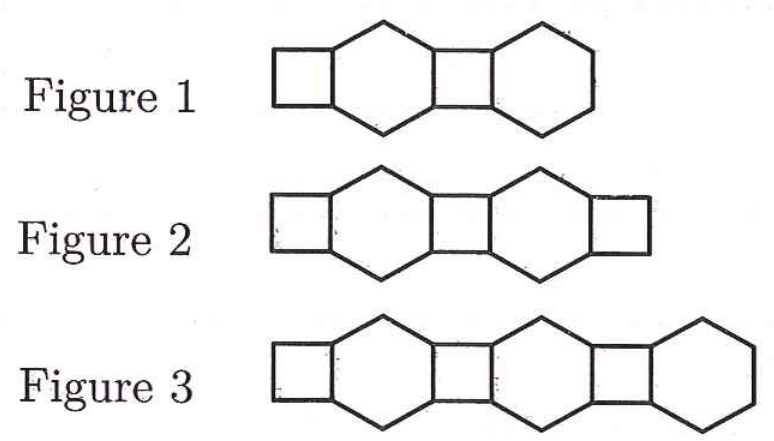
The pictures below are made up of squares and 6-sided shapes, each of which is added one shape at a time. Figure 1 has 17 lines, figure 2 has 20 lines and figure 3 has 25 lines. How many lines will there be in figure 8?
**Editorial note for this self-study exercise:** Continue alternating squares and hexagons to the right, each new shape sharing exactly one whole side with the preceding shape. Count each drawn side once, including shared internal sides. Enter the number of lines.
Given that the product of two numbers is 3240 and their GCD is $2\times3^2$, find the LCM in index notation.
**Editorial note for this self-study exercise:** x and y are positive integers. Enter the prime-factor index form with increasing prime bases, ^ for powers, * for multiplication, no spaces, and omit exponent 1. Format-only example: `2^3*7^2*11`.
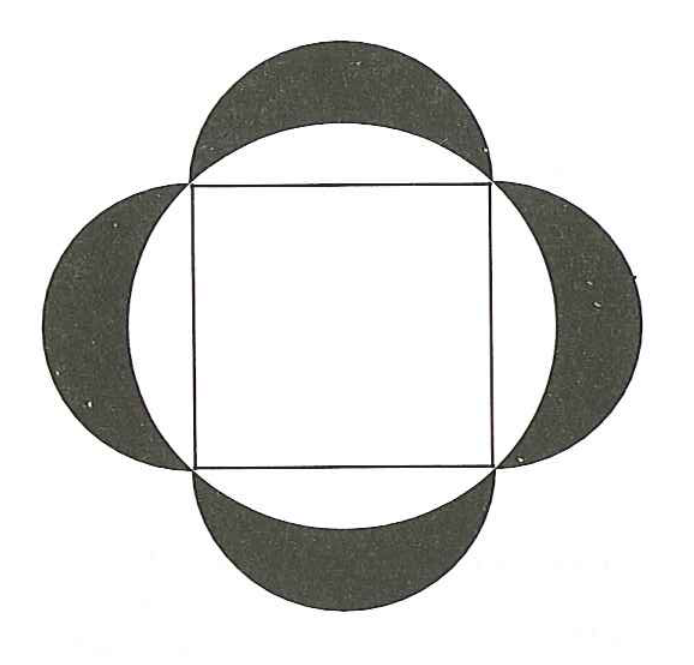
A square is inscribed in a circle with diameter 2. Four smaller circles are then constructed with their diameters on each of the sides of the square. Determine the area of the shaded region.
**Editorial note for this self-study exercise:** Only the four exterior crescent-shaped regions shown are shaded. Enter their total area in square units as a number; the diameter has unspecified length units.
$\overline{AB}$ is a 2-digit number. The digit B is 3 more than A. When $\overline{AB}$ is divided by sum of its digits the quotient is 4 and remainder is 3. Find the 2-digit number.
**Editorial note for this self-study exercise:** A is the tens digit and B is the units digit. The overbar denotes a numeral, not multiplication. Enter the two-digit number.
How many triangles are there that are formed by choosing the vertices from a set of 12 points, seven of which lie on the same line?
**Editorial note for this self-study exercise:** The 12 points are distinct. Apart from triples chosen entirely from the stated seven collinear points, assume no other three points are collinear. Without this additional condition the count is not determined. Enter the number of non-degenerate triangles.
8 rectangular containers, each measuring 12cm by 10cm by 7cm are filled completely with water. If the water from the 8 containers is poured into a big rectangular tank measuring 40cm by 20cm by 15cm, find the fraction of the tank that will be empty.
**Editorial note for this self-study exercise:** Use internal container dimensions and assume no water is lost. Enter the empty fraction of the whole tank, as an exact fraction or exact decimal using a decimal point.
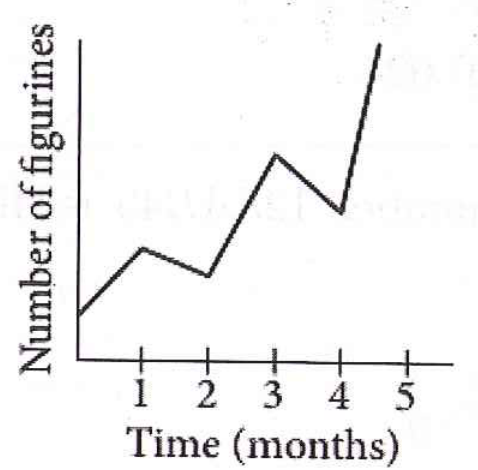
Tracy collects, sells, and trades figurines, and she tracks the number of figurines in her collection on the graph below.
On what interval did the number of figurines decrease the fastest?
A. Between January and February
B. Between February and March
C. Between March and April
D. Between April and May
E. None of the above
**Editorial note for this self-study exercise:** The time labels 1,2,3,4,5 represent January through May. Compare the downward slopes over equal one-month intervals. Enter only the option letter A, B, C, D or E.
From the top of a building, 600m above ground, a ball was dropped vertically downward. The ball rebounded vertically upward to 1/2 of the height from where it had fallen each time it hit the ground. Find the total vertical distance the ball had traveled in the air when it hit the ground for the fifth time.
**Editorial note for this self-study exercise:** The initial fall ends at the first ground impact. Stop counting at the fifth impact, including that last downward journey and excluding any later rebound. Enter the distance in meters without units; use a decimal point if needed.
In a 4-digit perfect square, the first two digits are the same, and the last two digits are also the same. What is the value of this 4-digit number?
**Editorial note for this self-study exercise:** The form is aabb with a in 1–9 and b in 0–9; equality between a and b is not required or excluded. Enter the four-digit number.
**Editorial note for this self-study exercise:** Use these intended rules: (a) alternate ×3 and +2; (b) ×3 then +1 each step; (c) alternate +4 and −3; (d) consecutive odd differences 5,7,9,11,13,… . Enter the two blanks for each part in left-to-right order, parts a,b,c,d, as eight integers separated by semicolons with no spaces. Format-only example: 1;2;3;4;5;6;7;8.