Skip to content / Đến nội dung
ThichHocToan.com

IMSO 2021 Science International - Theory I

Question 1

IMSO 2021 · Science Theory Test 1 · Indonesia · 21 January 2021

Theory 1 — 22 questions | 25 points | 60 minutes

Printed name: ____________________ ID: ____________________.

Instructions (printed on the answer sheet):

(1) Do NOT start answering this paper until you are told to do so.

(2) Be sure that your name and ID are written on spaces provided.

(3) Write only your answers in this ANSWER SHEET.

(4) Write only the letter of the correct answer in UPPERCASE/CAPITAL LETTER.

(5) Use BLACK ink to write on the Answer Sheet.

(6) Diagrams are not drawn to scale. They are intended as aids only.

(7) There are 20 multiple-choice questions and 2 short answer questions printed in 10 pages. There is only one correct answer for each question.

(8) Submit a clear scanned copy of this paper to your team leader within 30 minutes after the end of the session.

Editorial clarification: The letter-only instruction applies to Questions 1–20; Questions 21–22 require short text answers. The historical submission instruction is reproduced for completeness and does not request a submission through this package. Items with a source-key conflict or substantive ambiguity are presented for manual grading.

(1) A boy wanted to find the optimum conditions for his chickens to lay eggs. He divided his 20 chickens into 2 groups, X and Y, and recorded their daily care and egg production for 2 weeks.

| Group | Number of chickens | Daily care: chicken feed for group | Daily care: calcium for group | Results after 2 weeks: number of eggs laid by group |
| --- | --- | --- | --- | --- |
| Group X | 10 | 1,000 grams | 5 grams | 82 |
| Group Y | 10 | 1,300 grams | 10 grams | 104 |

The boy DID NOT do a good job designing this investigation. He should have _____. [1.5 marks]

Question illustration
  1. used more chickens in each group
  2. weighed the chickens each day rather than counting eggs
  3. recorded how much water he gave the chickens
  4. controlled the amount of feed or the amount of calcium

Question 2

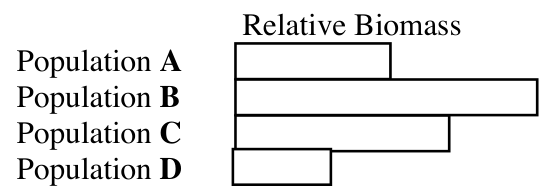
(2) Refer to the following bar graph which shows 4 populations, A-D, involved in the same food chain. [1 mark]

Which population is most likely to have the largest amount of energy available to it?

Question illustration
  1. Population A
  2. Population B
  3. Population C
  4. Population D

Question 3

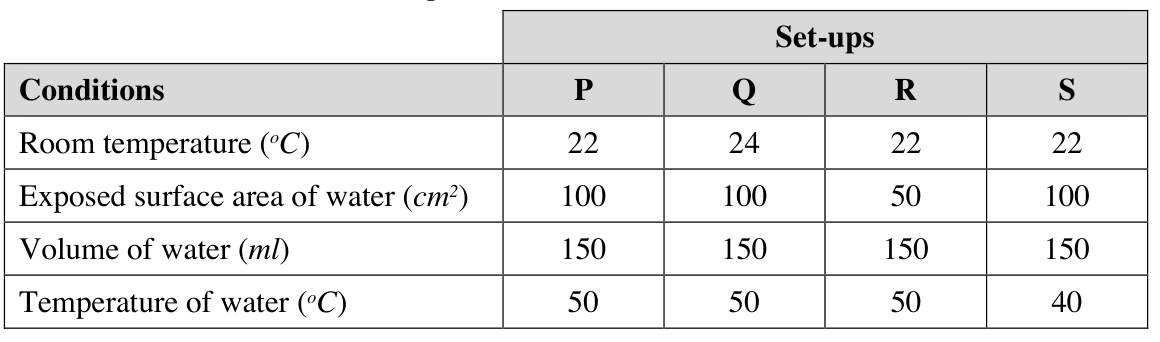
(3) A student conducted an experiment using four (4) different set-ups: P, Q, R and S. All set-ups contain water in containers made of the same materials. The table below shows the different conditions when she started each experiment.

| Conditions | P | Q | R | S |
| --- | --- | --- | --- | --- |
| Room temperature (°C) | 22 | 24 | 22 | 22 |
| Exposed surface area of water (cm²) | 100 | 100 | 50 | 100 |
| Volume of water (ml) | 150 | 150 | 150 | 150 |
| Temperature of water (°C) | 50 | 50 | 50 | 40 |

Which of the following set-ups are the best for the student to use to ensure a fair test to investigate how the rate of evaporation of water was affected by: [1.5 marks]

| Option | Room temperature | Exposed surface area of water | Temperature of water |
| --- | --- | --- | --- |
| A | P and Q | P and R | P and S |
| B | Q and R | R and S | P and Q |
| C | Q and S | P and S | Q and R |
| D | R and S | Q and R | P and R |

Question illustration
  1. P/Q; P/R; P/S
  2. Q/R; R/S; P/Q
  3. Q/S; P/S; Q/R
  4. R/S; Q/R; P/R

Question 4

(4) A child is suffering from a disease caused by a certain nutrient deficiency. The child narrated that he shows the following symptoms: inability to gain weight, edema or swelling of the hand and feet, and stomach bulging. The doctor diagnosed the child of kwashiorkor.

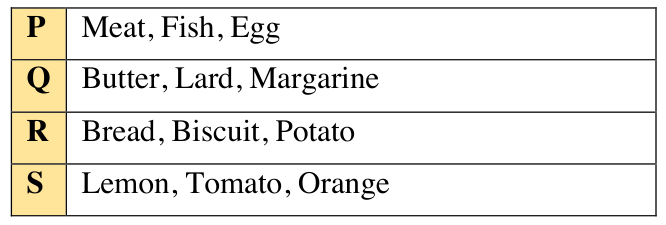
Which groups of nutrient rich foods (P-S) and their corresponding sources will the doctor recommend the child to consume more in order to recover from the said nutrient deficiency? [1 mark]

| Group | Foods |
| --- | --- |
| P | Meat, Fish, Egg |
| Q | Butter, Lard, Margarine |
| R | Bread, Biscuit, Potato |
| S | Lemon, Tomato, Orange |

Question illustration
  1. Nutrient P
  2. Nutrient Q
  3. Nutrient R
  4. Nutrient S

Question 5

(5) Chromobacterium violaceum is a species of bacteria that is used in different biological tests. C. violaceum is able to sense the presence of other cells by releasing and detecting some signaling molecules. When C. violaceum multiplies and reaches a certain population called the quorum population, it begins to release a purple-colored compound called violacein. This mechanism is called quorum-sensing.

A scientist is investigating whether a seaweed extract inhibits the quorum sensing of C. violaceum. She grows C. violaceum together with the seaweed extract in a liquid broth for 24 hours, and then measured the concentration of violacein and the number of cells. In the experiment, methanol is used as negative control, while cinnamaldehyde is used as a positive control. Below is the result that she obtained.

| | Methanol | Cinnamaldehyde | Seaweed extract |
| --- | --- | --- | --- |
| Concentration of violacein (mg/L) | 80 | 40 | 20 |
| Number of cells (×1,000) | 110 | 110 | 110 |

Based on the results, what is the possible effect of the seaweed extract on C. violaceum? [1.5 marks]

A. The seaweed extract is an antibiotic as it does not allow the number of cells to exceed 110,000.

B. The seaweed extract is an antibiotic as it reduces the number of cells producing violacein.

C. The seaweed extract is a quorum-sensing inhibitor as it stops the cells from producing violacein, preventing them to multiply.

D. The seaweed extract is a quorum-sensing inhibitor as it prevents cells to communicate with each other without killing them.

Question illustration

Question 6

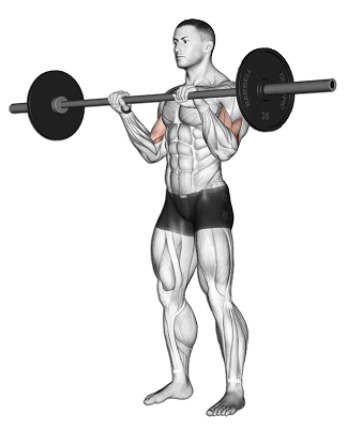
(6) The upper arm has two types of muscles namely triceps and biceps. These muscles work against each other to produce movement. When an athlete lifts weights as illustrated in the picture on the right, what happens to his upper arm muscles? [1 mark]

| Option | Biceps | Triceps |
| --- | --- | --- |
| A | Contract | Contract |
| B | Relax | Relax |
| C | Contract | Relax |
| D | Relax | Contract |

Question illustration
  1. Biceps contract; triceps contract
  2. Biceps relax; triceps relax
  3. Biceps contract; triceps relax
  4. Biceps relax; triceps contract

Question 7

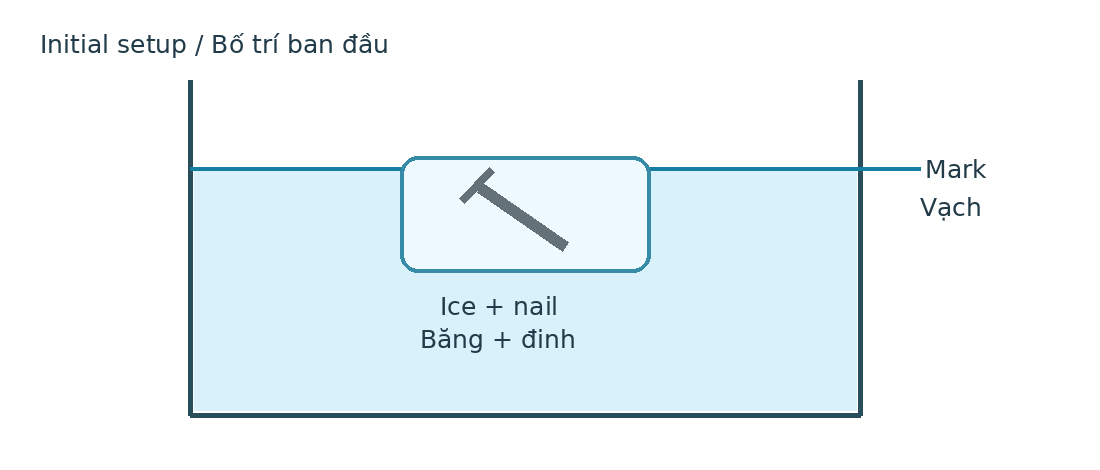
(7) A block of ice with an iron nail embedded inside is floating on water in a beaker. The initial water level is marked on the side of the beaker. When the ice completely melts, the water level will be __________________ the original mark. [1 mark]

Question illustration
  1. below
  2. at
  3. above
  4. cannot be determined

Question 8

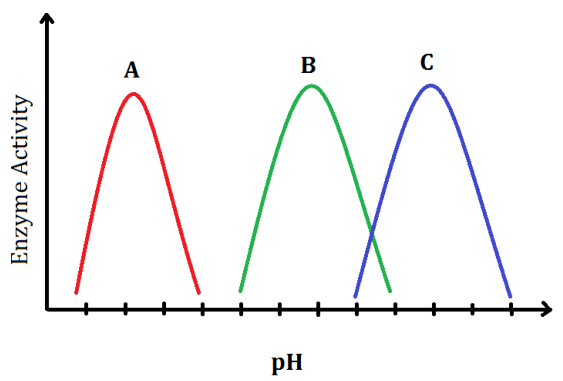
(8) The graph shows the activity of three human enzymes from different regions of the digestive tract with different pH.

Which of the following shows the correct grouping of enzyme and substrate being broken down? [1.5 mark]

| Option | Enzyme A | Enzyme B | Enzyme C |
| --- | --- | --- | --- |
| A | Protein | Lipid | Starch |
| B | Starch | Lipid | Starch |
| C | Protein | Starch | Lipid |
| D | Starch | Protein | Lipid |

Question illustration
  1. Protein; lipid; starch
  2. Starch; lipid; starch
  3. Protein; starch; lipid
  4. Starch; protein; lipid

Question 9

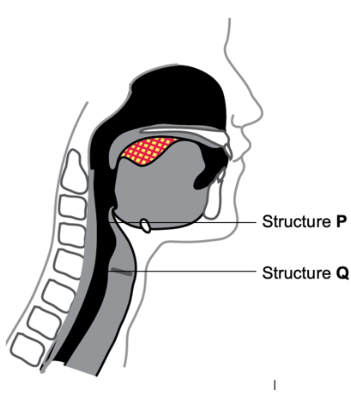
(9) The diagram below shows the structures present between the mouth and the oesophagus.

Which of the following options CORRECTLY describes how Structures P and Q work together to prevent choking during the process of swallowing? [1 mark]

| Option | Structure P | Structure Q |
| --- | --- | --- |
| A | Moves up | Moves up |
| B | Moves down | Moves down |
| C | Moves up | Moves down |
| D | Moves down | Moves up |

Question illustration
  1. P up; Q up
  2. P down; Q down
  3. P up; Q down
  4. P down; Q up

Question 10

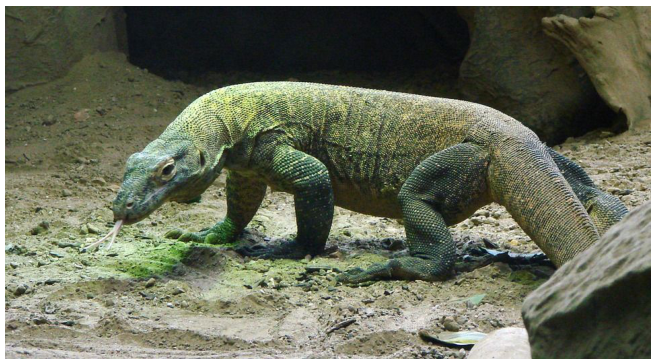
(10) Komodo dragon (Varanus komodoensis), also known as Komodo monitor, is the national animal of Indonesia. It is a species of lizard found in the Indonesian islands of Komodo East Nusa Tenggara. Komodo dragons, the world’s largest lizard, are able to reproduce both sexually and asexually. They are parthenogenetic.

Which of the following statements correctly describe parthenogenetic animals? [1 mark]

Question illustration
  1. They are animals that can produce both sperm cell and egg cell.
  2. They are animals that do not produce egg cells and sperm cells.
  3. They are animals that reproduce from a single sperm cell without fertilizing an egg.
  4. They are animals that reproduce from an egg cell that can develop into an embryo without being fertilized by a sperm.

Question 11

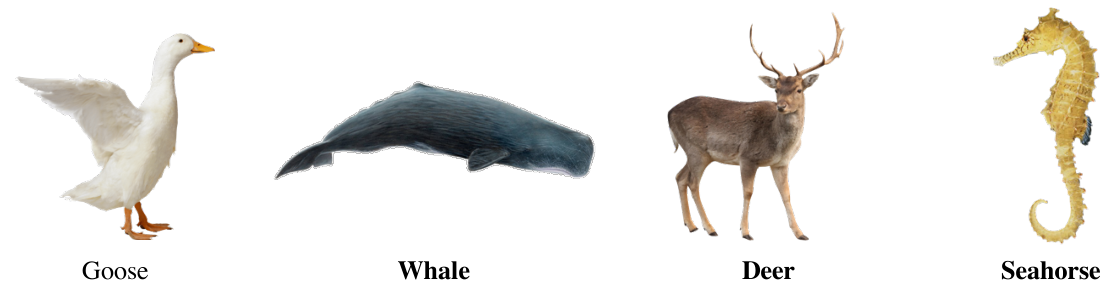
(11) A student was given four pictures of animals as shown below: Goose, Whale, Deer, Seahorse.

He was told to group the animals correctly into the classification table below.

| Animals | Lay eggs: live on land | Lay eggs: live in water | Give birth to young alive: live on land | Give birth to young alive: live in water |
| --- | --- | --- | --- | --- |
| Position | W | X | Y | Z |

Which one of the following rows shows the correct answers for W, X, Y and Z? [1 mark]

| Option | W | X | Y | Z |
| --- | --- | --- | --- | --- |
| A | Goose | seahorse | Whale | Deer |
| B | Goose | Whale | seahorse | Deer |
| C | Deer | seahorse | Goose | whale |
| D | Goose | seahorse | Deer | whale |

A. Goose; seahorse; Whale; Deer

B. Goose; Whale; seahorse; Deer

C. Deer; seahorse; Goose; whale

D. Goose; seahorse; Deer; whale

Question illustration

Question 12

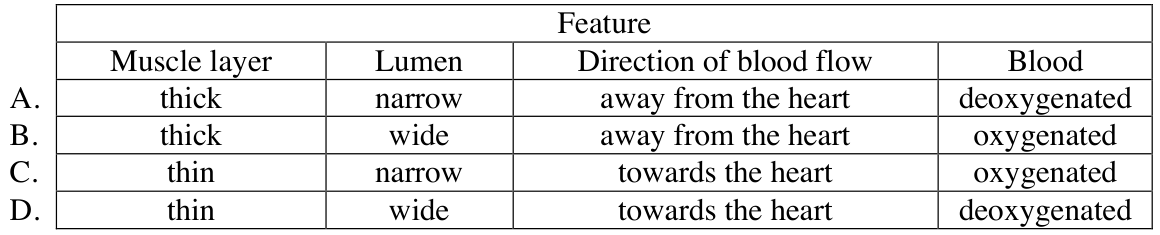
(12) The table shows features of some blood vessels. Which set of features describes the pulmonary artery? [1 mark]

| Option | Muscle layer | Lumen | Direction of blood flow | Blood |
| --- | --- | --- | --- | --- |
| A | thick | narrow | away from the heart | deoxygenated |
| B | thick | wide | away from the heart | oxygenated |
| C | thin | narrow | towards the heart | oxygenated |
| D | thin | wide | towards the heart | deoxygenated |

Question illustration
  1. Thick; narrow; away from heart; deoxygenated
  2. Thick; wide; away from heart; oxygenated
  3. Thin; narrow; towards heart; oxygenated
  4. Thin; wide; towards heart; deoxygenated

Question 13

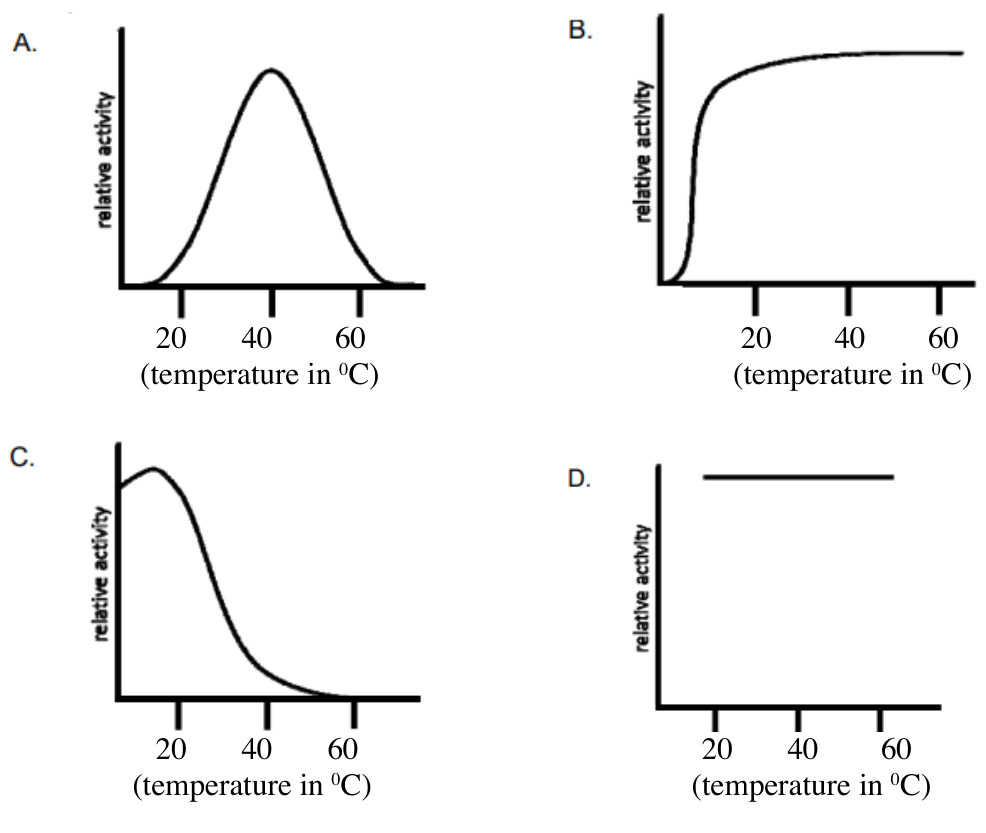
(13) Enzymes are protein substances that digest food completely in the human digestive system. They are produced in various parts of the body such as the salivary glands, gastric glands and pancreas. Enzymes work differently at various temperatures. Which of the following graphs best represents how enzyme activity varies with temperature? [1 mark]

Question illustration
  1. Graph A in the original figure
  2. Graph B in the original figure
  3. Graph C in the original figure
  4. Graph D in the original figure

Question 14

(14) When cyan and yellow paints are mixed together, the result is green. The reason for this is that ______. [1 mark]
  1. cyan light and yellow light make green light.
  2. yellow pigments absorb green light and reflect all the others.
  3. between cyan and yellow pigments, all colors are absorbed except green.
  4. cyan absorbs yellow light and yellow absorbs cyan light.

Question 15

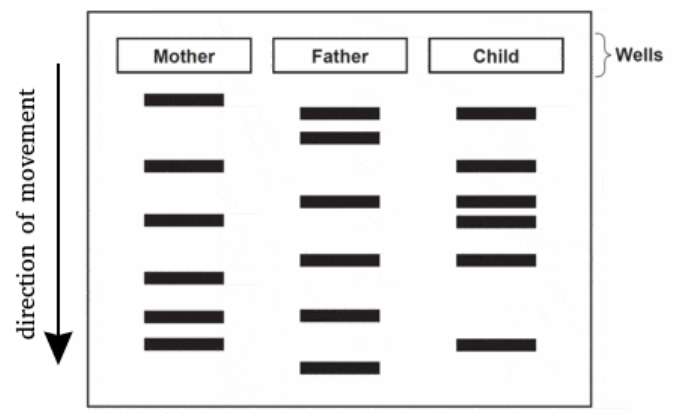
(15) Agarose gel electrophoresis is a laboratory method used to separate DNA by size. In a gel electrophoresis, DNA molecules migrate from one end of the gel to the other end, where lighter molecules migrate faster than the heavier ones.

The parents of a new baby believe they brought the wrong child home from the hospital. Gel electrophoresis was performed using DNA samples from the parents and the child. A section of the gel electrophoresis results is shown below.

Which conclusion is valid based on the results? [1 mark]

Question illustration
  1. They have the correct child, because her genetic information is identical to that of the father.
  2. They have the wrong child, because her genetic information does not match that of either parent.
  3. They have the correct child, because her genetic information came from both parents.
  4. They have the wrong child, because her genetic information matches only that of the mother.

Question 16

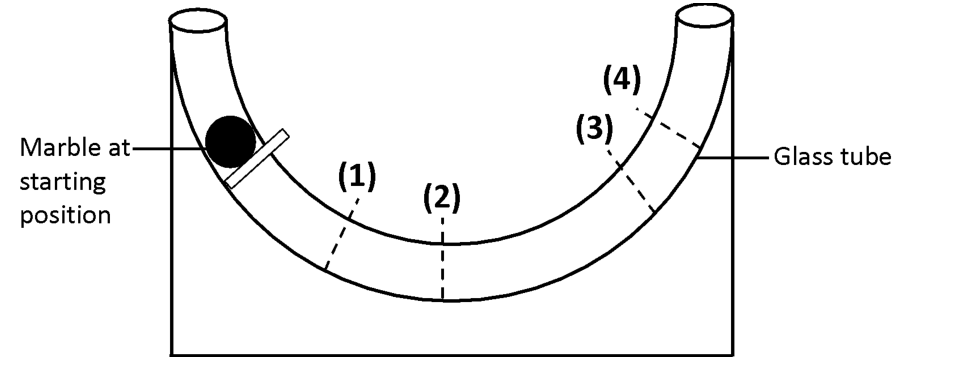
(16) A student placed a marble in a glass tube. She observed that when she released the marble it rolled to the other end of the tube before rolling back downwards.

At which position will the marble reach before it rolls back downwards? [1 mark]

Question illustration
  1. (1)
  2. (2)
  3. (3)
  4. (4)

Question 17

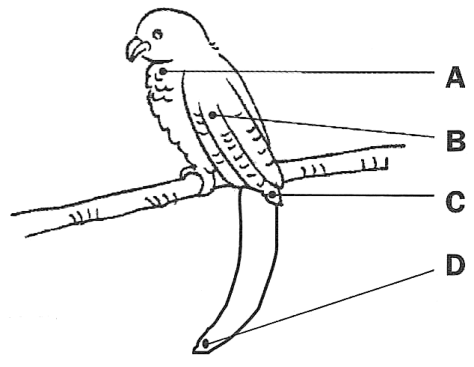
(17) The diagram shows a toy bird pivoted on a support and in stable equilibrium. When designing the toy bird, the manufacturer needs to plan the position of its center of gravity. Which position, A, B, C or D, should the center of gravity be? [1 mark]

Question illustration
  1. Position A
  2. Position B
  3. Position C
  4. Position D

Question 18

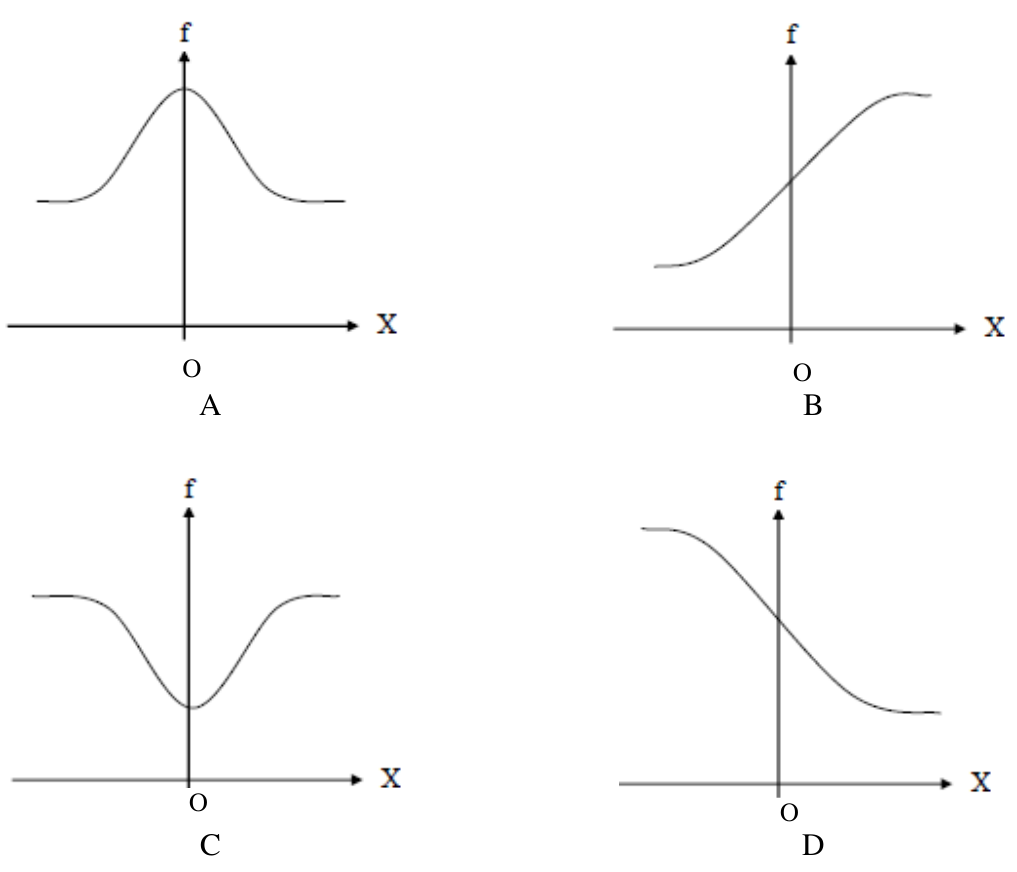
(18) An ambulance moves through a street along the positive X direction and a person who stands beside the street hears the sound of the ambulance siren. Which option represents the frequency (f) received by the person? X is the position of the ambulance; the person stands at the origin. [1 mark]

A. Graph A in the original figure

B. Graph B in the original figure

C. Graph C in the original figure

D. Graph D in the original figure

Question illustration

Question 19

(19) The table below shows what happens in the chemical equation, $A+B\rightarrow C+D$, and the time it takes for the reaction to take place.

| Reaction | Reactant A (gram) | Reactant B (gram) | Product C (gram) | Product D (gram) | X (gram) | Time (minute) |
| --- | --- | --- | --- | --- | --- | --- |
| 1 | 10 | 15 | 18 | 7 | - | 20 |
| 2 | 10 | 15 | 18 | 7 | 1 | 12 |

What is substance X? [1 mark]

Question illustration
  1. catalyst
  2. inhibitor
  3. enzyme
  4. conductor

Question 20

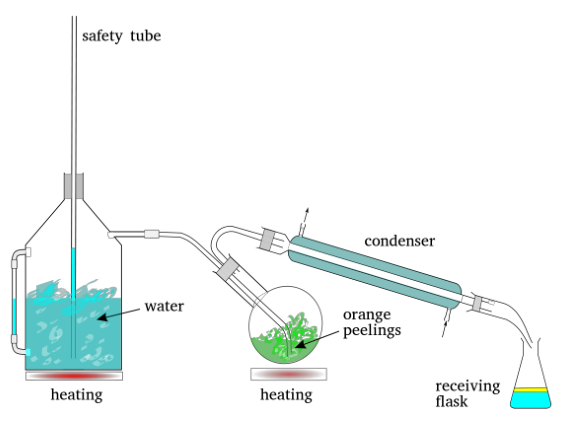
(20) Steam distillation is used to extract limonene, a volatile essential oil, from oranges. In steam distillation, a flask containing water is heated to form steam. The steam then enters another flask with the orange peelings. Finally, limonene and water are collected at the receiving flask. Steam allows the limonene to boil at a lower temperature and carries its vapor with it.

Which of the following statements is the main reason why steam distillation is used to extract limonene? [1.5 marks]

Question illustration
  1. Because steam has greater kinetic energy than water, steam distillation can extract limonene faster than in simple distillation.
  2. Because the initial amount of water is greater in the first flask, steam distillation can extract more limonene than in simple distillation.
  3. Because limonene and water is immiscible, the distillate can be separated easily.
  4. Because the peelings contain both volatile and non-volatile compounds, steam distillation only extracts limonene without extracting the rest of the non-volatile materials.