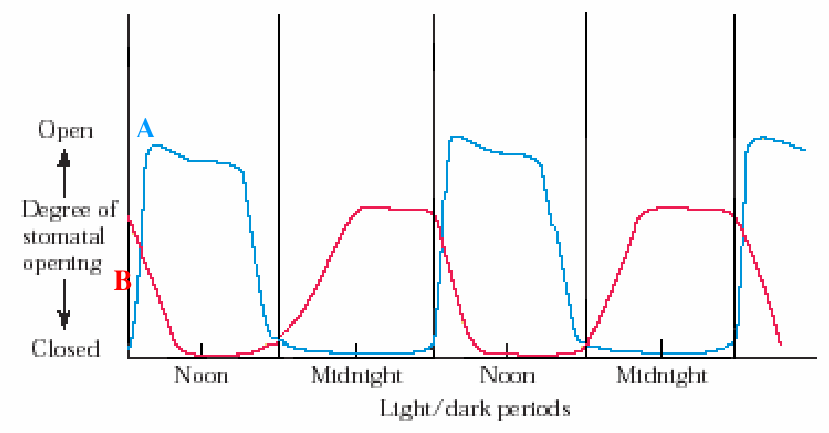
Total solar eclipse occurs more frequently than total lunar eclipse. However, more people have seen total lunar eclipse than total solar eclipse. Explain why!
The diameter of a crater on the Moon is (1/30)°. If the distance between the Earth and the Moon is 384 000 km, what is the linear diameter of the crater?
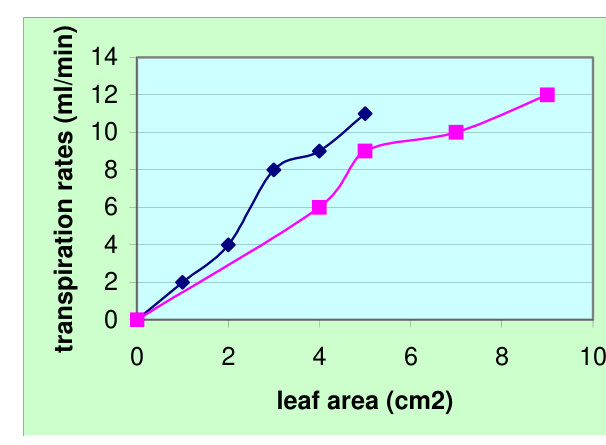
Tuti conducted the experiment concerning the relationship between transpiration and leaf area in two different plants (plant A and plant B). She wrote the result of the experiment in a form of graph shown below.
From the graph above:
A. Explain how leaf’s area influences the transpiration of plant A and plant B.
B. Which plant respirates faster?
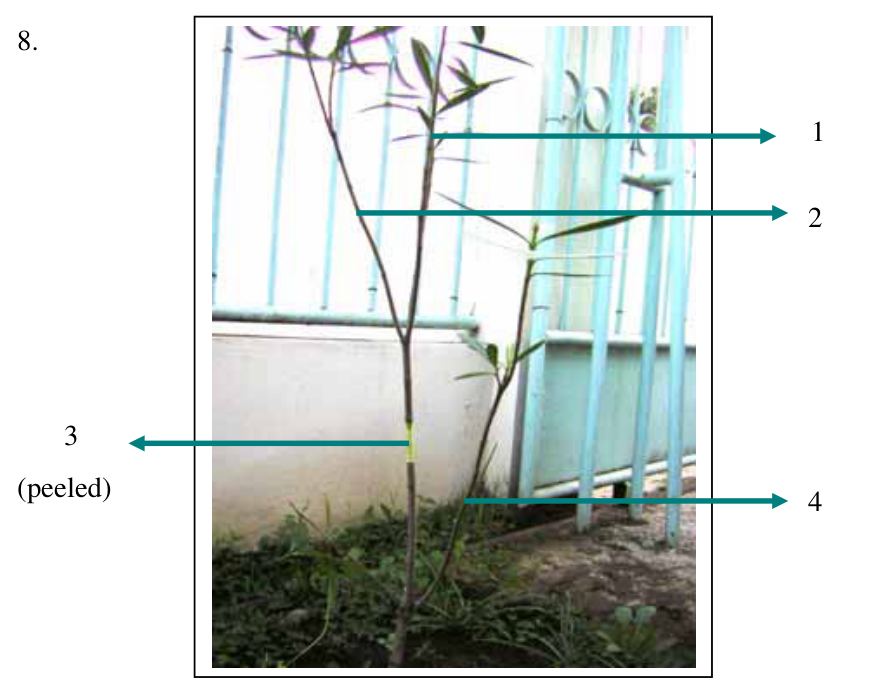
The figure above show plant ringed in part 3.
A. Do branch 1 and 2 will still alive? Give reason to your answer!
B. Does branch 4 still can get photosynthesis product from leaves in branch 1, 2? Give explanation to your answer.
Donny conducts the experiment in the laboratory. He grows corn plants in two different environments. He sets up the plant A in an environment with low CO2 and plant B in a high CO2. He writes the result of his experiment as shown in a table below.
A. Change the table above into a graph. Time on the horizontal axis and growth rates in the vertical axis
B. How does carbon dioxide influence growth of the corn plants?
C. Which plants has a higher growth rate?
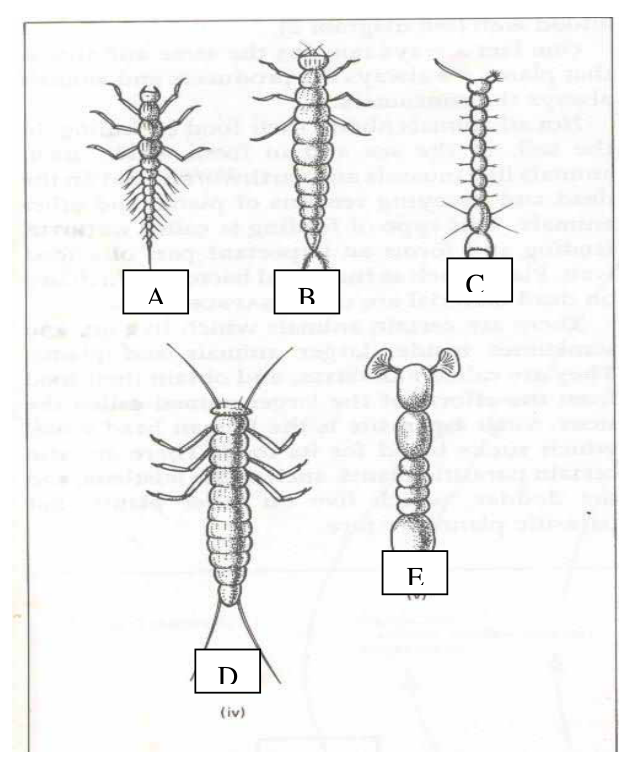
Look at the drawings 1 to 5 of the larvae of common freshwater insects (the drawing is not drawn to scale):
Identify each one in turn by using the key.
1) No legs: go to no. 2. Three pairs of legs present: go to no. 3.
2) Bristles on all segments: Culex. Bristles not present on all segment: Simulium.
3) One tail fillament: Sialis. Two tail fillament present: go to no 4.
4) Long fillament on head: Perla. Short fillament on head: Dyctisus.
From the table above answer these following questions:
A. Which food is the richest protein?
B. Which food is a highest value in bone formation
C. Which food would you recommend for someone suffering from aptha/mouth ulcer?
D. How many calories would you obtain if you ate a cheese sandwich containing 100 g of bread, 50 g of cheese and 2,5 g of butter?
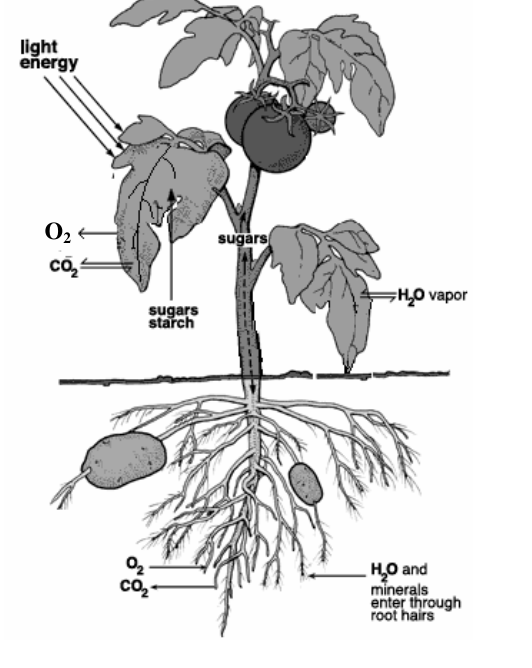
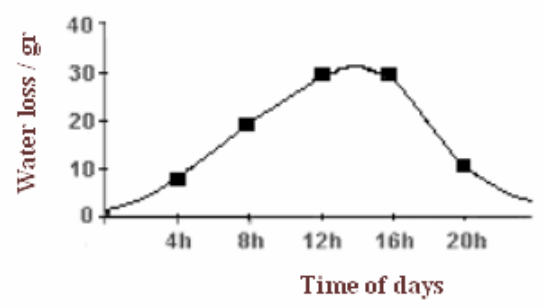
Plants lose water through their leaves by transpiration. The graph below is the result of transpiration experiment using Hibiscus rosa-sinensis. Answer the questions based on the graph!
When did the plant lose the most water and how much water evaporate from the plant?
Plants lose water through their leaves by transpiration. The graph below is the result of transpiration experiment using Hibiscus rosa-sinensis. Answer the questions based on the graph!
Plants lose water through their leaves by transpiration. The graph below is the result of transpiration experiment using Hibiscus rosa-sinensis. Answer the questions based on the graph!
Plants lose water through their leaves by transpiration. The graph below is the result of transpiration experiment using Hibiscus rosa-sinensis. Answer the questions based on the graph!
Science of the amphibian (no. 20 – 22)
Pandu is a little boy who loves playing with his father in the paddy field. The frog makes specific sounds during mating season and each species may have different songs. Frog songs are magic dominating the night sounds in the paddy field.
Why the frogs songs some time produces baritones or tenor sounds. The sounds may be very loud or very soft. Use your knowledge on the characteristics of sounds wave for explanation.