Answer all ten questions and show detailed solutions. Printed time 60 minutes; each question 4 points. Subcriterion allocations are editorial.
Sarah and her younger brother Stephen earn pocket-money by mowing lawns for neighbors. Sarah uses the lawn mower and wants to earn 5 dollars per hour for herself. Stephen removes cuttings and tidies up. They agree Stephen receives 20% of the total payment. It takes them four hours to mow a nearby large garden. How much must the owner pay for Sarah to earn exactly 5 dollars per hour?
Answer all ten questions and show detailed solutions. Printed time 60 minutes; each question 4 points. Subcriterion allocations are editorial.
John cycles to Jane’s house and back on a flat straight road, a round trip of 32 km. Throughout the journey the wind has constant speed and direction. Outward, it blows directly behind John and its speed is added to his normal bicycle speed; returning, its speed is subtracted. Total travel time is 2 hours, with the return taking twice the outward time. Find the wind speed in km/hour.
Answer all ten questions and show detailed solutions. Printed time 60 minutes; each question 4 points. Subcriterion allocations are editorial.
In the first stage of a baseball competition, teams are divided into groups of four. Each team plays each other team once. A group table records wins, draws, defeats, runs scored and runs against. A win earns 3 points, a draw 1 and a defeat 0. Here is part of a group table:
| Team | Runs scored | Runs against | Points |
|---|---:|---:|---:|
| A |2|2|4|
| B |4|4|6|
| C |2|1|4|
| D |1|2|2|
Find the result and score of all six matches: A:B; A:C; A:D; B:C; B:D; C:D. Use the source's stated draw/scoring rules.
Answer all ten questions and show detailed solutions. Printed time 60 minutes; each question 4 points. Subcriterion allocations are editorial.
The number 132 has three distinct digits and equals the sum of all different two-digit numbers made from those digits: $132=13+12+21+23+31+32$. Find all other three-digit numbers with this property.
Answer all ten questions and show detailed solutions. Printed time 60 minutes; each question 4 points. Subcriterion allocations are editorial.
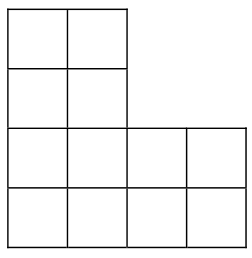
Color the twelve small squares in the L-shaped diagram using three colors, so that:
(a) Squares sharing an edge have different colors.
(b) Each color is used in exactly four squares.
(c) Every 2 × 2 block of four small squares contained in the diagram uses all three colors.
Do not mix colors or use different colors in one square. Use B,G,R for the three colors. Show your detailed solution as instructed on the cover.
Answer all ten questions and show detailed solutions. Printed time 60 minutes; each question 4 points. Subcriterion allocations are editorial.
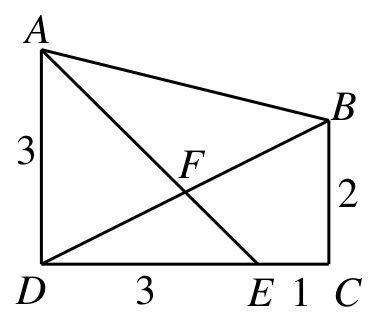
In quadrilateral $ABCD$, $AD\parallel BC$ and $AD\perp DC$. The lengths are $AD=3$, $BC=2$. Point E lies between D and C with $DE=3$ and $EC=1$. Lines AE and BD meet at F. Find the exact area of triangle ABF.
Answer all ten questions and show detailed solutions. Printed time 60 minutes; each question 4 points. Subcriterion allocations are editorial.
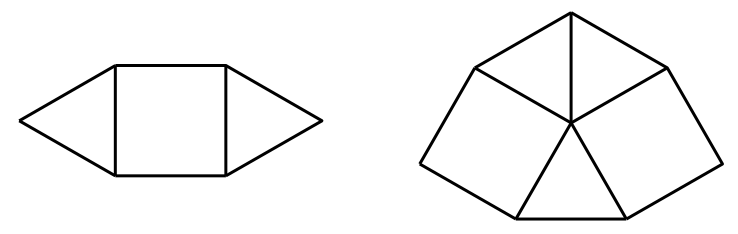
Unit equilateral triangles and unit squares can be joined to construct convex polygons, completely covering the enclosed region with no gaps or overlaps. The source examples use two triangles and one square for a hexagon, and three triangles and two squares for a 7-sided polygon. How can this process construct a convex polygon with 11 sides?