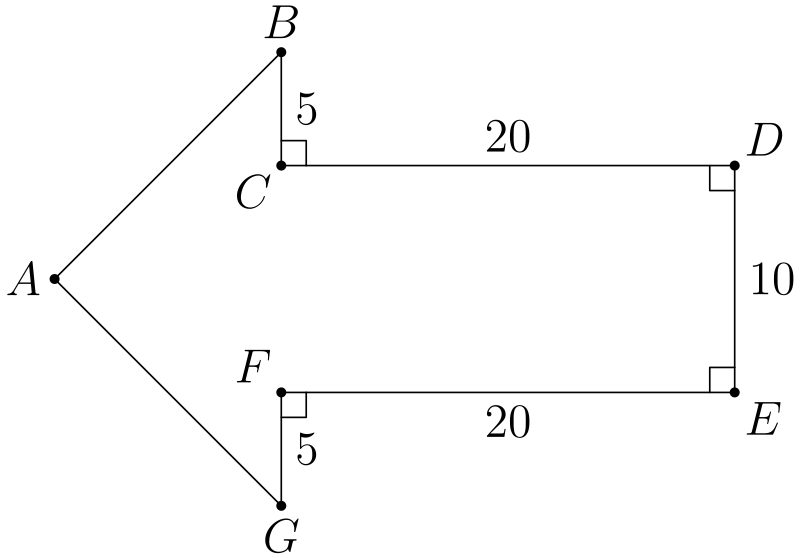
In the arrow-shaped polygon shown, the angles at vertices $A,$ $C,$ $D,$ $E,$ and $F$ are right angles, $BC=FG=5,$ $CD=FE=20,$ $DE=10,$ and $AB=AG.$ The area of the polygon is closest to
Liquid $X$ does not mix with water. Unless obstructed, it spreads out on the surface of water to form a circular film $0.1$ cm thick. A rectangular box measuring $6$ cm by $3$ cm by $12$ cm is filled with liquid $X.$ Its contents are poured onto a large body of water. What will be the radius, in centimeters, of the resulting circular film?
From time $t=0$ to time $t=1$ a population increased by $i\%,$ and from time $t=1$ to time $t=2$ the population increased by $j\%.$ Therefore, from time $t=0$ to time $t=2$ the population increased by
Jack and Jill run $10$ kilometers. They start at the same point, run $5$ kilometers up a hill, and return to the starting point by the same route. Jack has a $10$-minute head start and runs at the rate of $15$ km/hr uphill and $20$ km/hr downhill. Jill runs $16$ km/hr uphill and $22$ km/hr downhill. How far from the top of the hill are they when they pass going in opposite directions?
The measures (in degrees) of the interior angles of a convex hexagon form an arithmetic sequence of positive integers. Let $m^\circ$ be the measure of the largest interior angle of the hexagon. The largest possible value of $m^\circ$ is
Horses $X,$ $Y,$ and $Z$ are entered in a three-horse race in which ties are not possible. If the odds against $X$ winning are $3$-to-$1$ and the odds against $Y$ winning are $2$-to-$3,$ what are the odds against $Z$ winning? (By “odds against $H$ winning are $p$-to-$q$” we mean that the probability of $H$ winning the race is $\frac{q}{p+q}.$)
A circular table has exactly $60$ chairs around it. There are $N$ people seated at this table in such a way that the next person to be seated must sit next to someone. The smallest possible value of $N$ is
One hundred students at Century High School participated in the AHSME last year, and their mean score was $100.$ The number of non-seniors taking the AHSME was $50\%$ more than the number of seniors, and the mean score of the seniors was $50\%$ higher than that of the non-seniors. What was the mean score of the seniors?
A positive integer $N$ is a palindrome if the integer obtained by reversing the sequence of digits of $N$ is equal to $N.$ The year $1991$ is the only year in the current century with the following two properties:
(a) It is a palindrome.
(b) It factors as a product of a $2$-digit prime palindrome and a $3$-digit prime palindrome.
How many years in the millennium between $1000$ and $2000$ (including the year $1991$) have properties (a) and (b)?
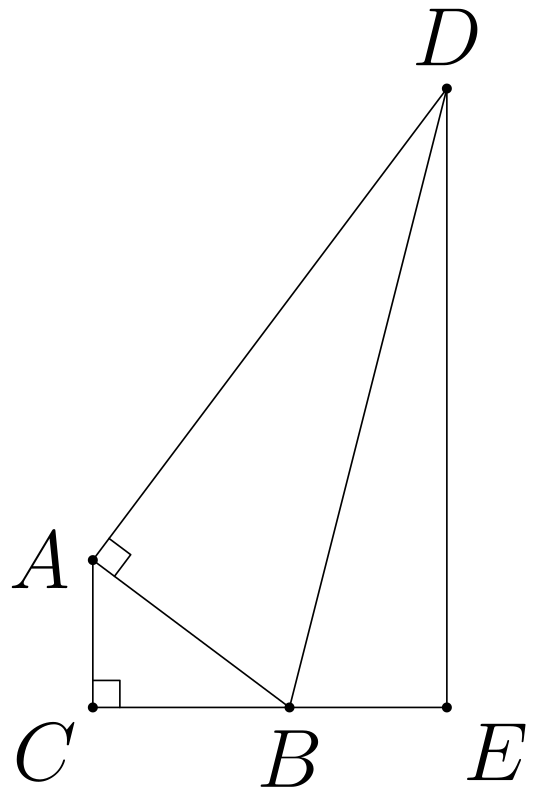
Triangle $ABC$ has a right angle at $C,$ $AC=3,$ and $BC=4.$ Triangle $ABD$ has a right angle at $A$ and $AD=12.$ Points $C$ and $D$ are on opposite sides of $AB.$ The line through $D$ parallel to $AC$ meets $CB$ extended at $E.$ If $$
\frac{DE}{DB}=\frac mn,
$$ where $m$ and $n$ are relatively prime positive integers, then $m+n=$