Skip to content / Đến nội dung
ThichHocToan.com

IKMC 2027 - Grades 11-12 - Self-study SET 2 - Thematic Batch 3

Question 1

A square is inscribed in triangle ABC as shown. The square divides the triangle’s midline into three segments AP, PQ and QM satisfying AP/1=PQ/2=QM/2. What is the ratio of the area of triangle ABC to that of the square?
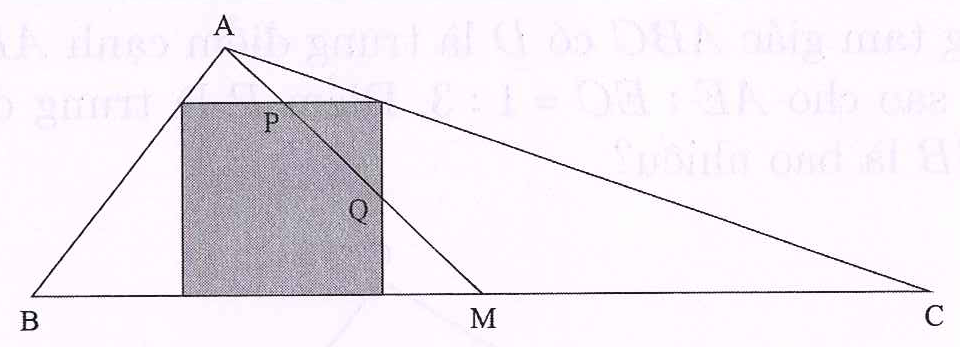
Question illustration
  1. 25/16
  2. 16/9
  3. 25/8
  4. 16/6
  5. 5/2

Question 2

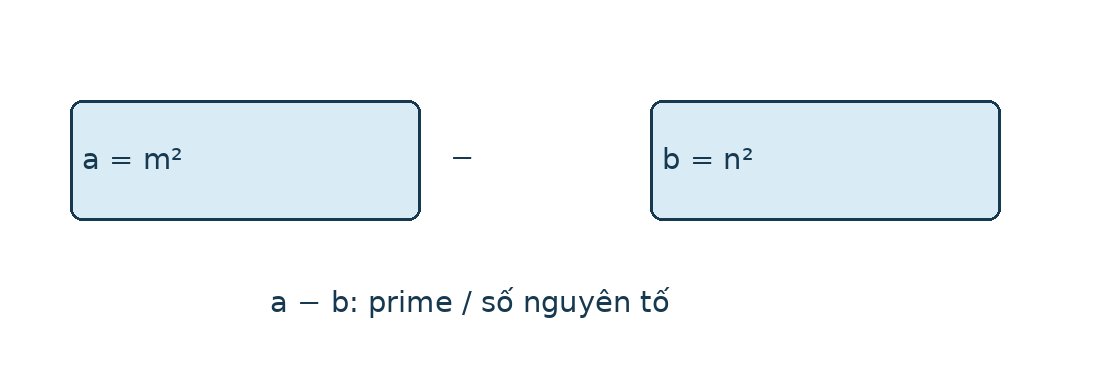
Let a and b be perfect squares such that a−b is prime. Which value below can neither of the two squares have?

Question illustration
  1. 100
  2. 144
  3. 400
  4. 625
  5. 2500

Question 3

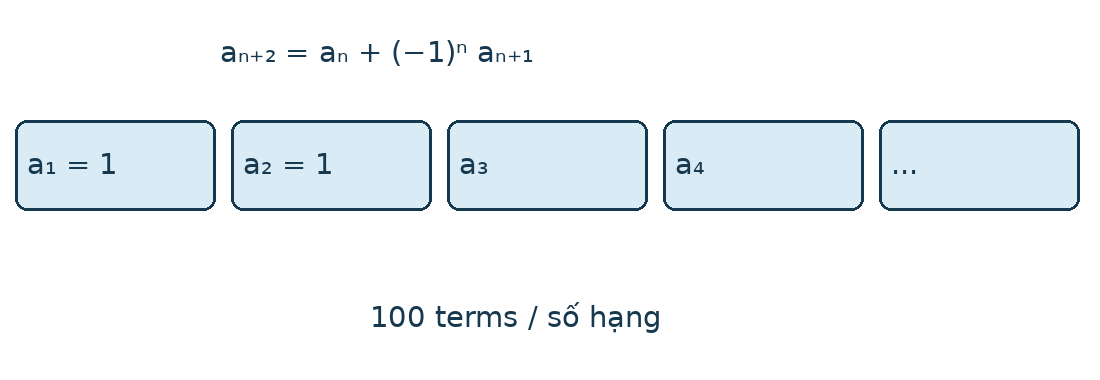
A sequence begins with $a_{1}$=$a_{2}$=1. Its later terms satisfy $a_{n+2}$=$a_{n}$+$(−1)^{n}$ $a_{n+1}$. For example, $a_{3}$=$a_{1}$−$a_{2}$, $a_{4}$=$a_{2}$+$a_{3}$, $a_{5}$=$a_{3}$−$a_{4}$, and so on. What is the sum of its first 100 terms?

Question illustration
  1. 0
  2. 3
  3. −21
  4. 100
  5. −1

Question 4

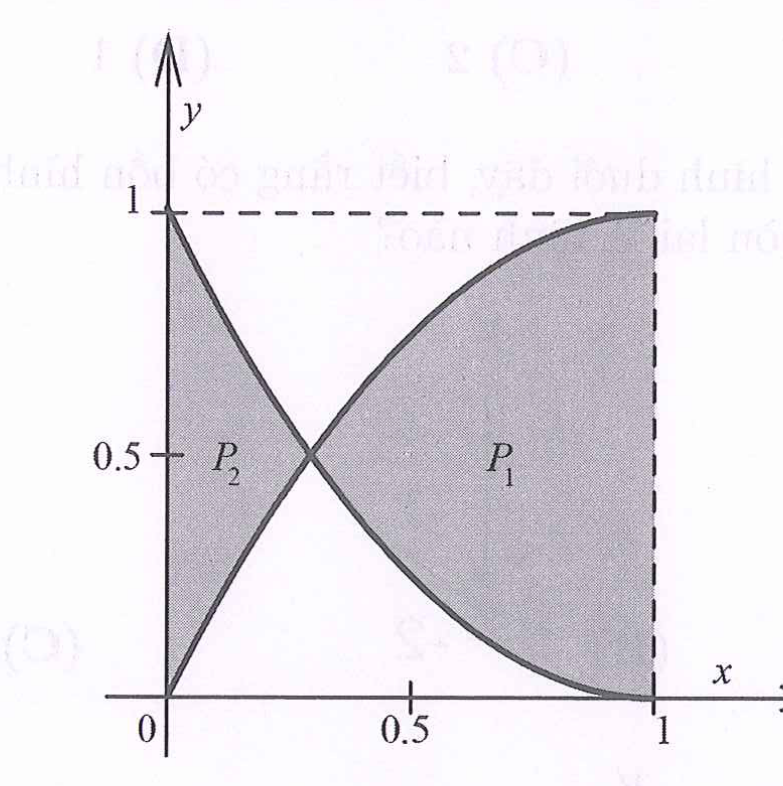
In the diagram, the grey regions are bounded by a unit square and the parabolas y=x (2−x) and y=(x−1)². The region between y=x (2−x) and the horizontal axis has area 4/3. What is P₁−P₂?

Question illustration
  1. 1/3
  2. 2/3
  3. 1/4
  4. 1/2
  5. Cannot be determined

Question 5

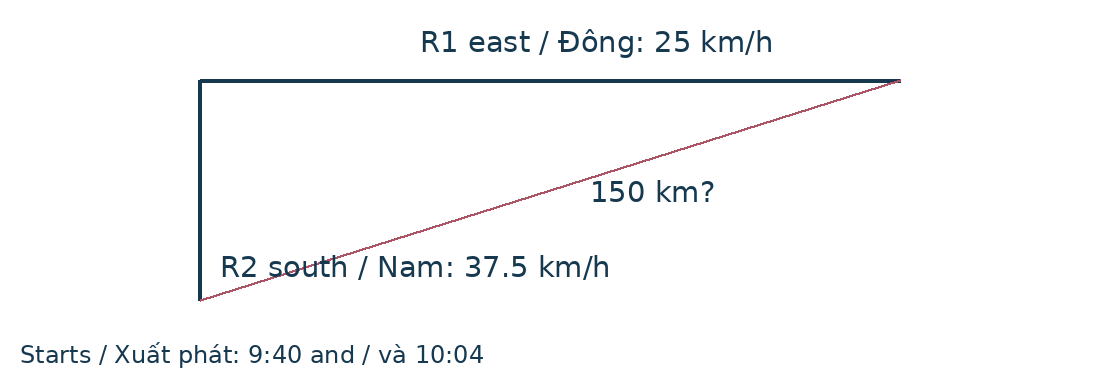
At 9:40 robot R 1 leaves a laboratory, travelling due east along a very long straight road at 25 km/h. At 10:04 robot R 2 leaves the same laboratory, travelling due south along a very long straight road at 37.5 km/h. At what time is their straight-line distance exactly 150 km?

Question illustration
  1. 12:40
  2. 12:45
  3. 12:50
  4. 13:04
  5. 13:16

Question 6

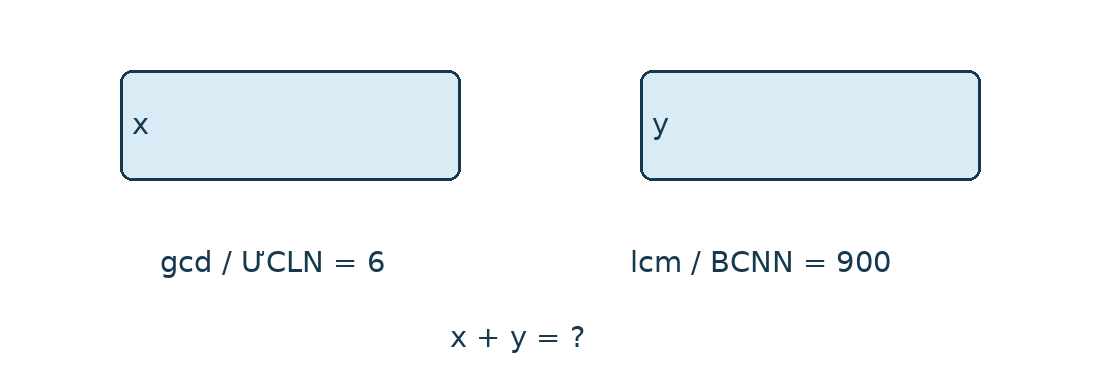
Two natural numbers have greatest common divisor 6 and least common multiple 900. Which of the following cannot be their sum?

Question illustration
  1. 318
  2. 270
  3. 186
  4. 462
  5. 906

Question 7

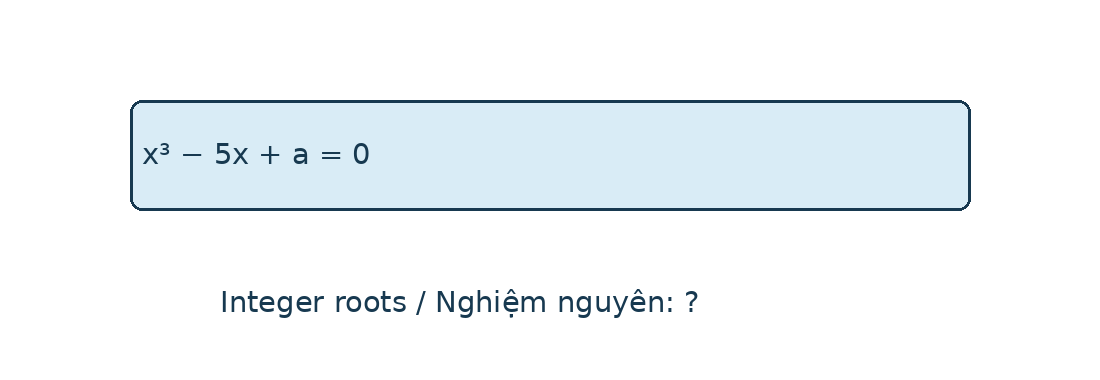
Consider equation (E): x³−5 x+a=0, where a is real. Which assertion below is certainly true?

Question illustration
  1. Equation(E) has at most one integer root for every real a.
  2. There exists a real a for which(E) has two integer roots.
  3. There exists a real a for which(E) has three integer roots.
  4. For every real a, equation(E) has no integer root.
  5. For every real a, equation(E) has only irrational roots.

Question 8

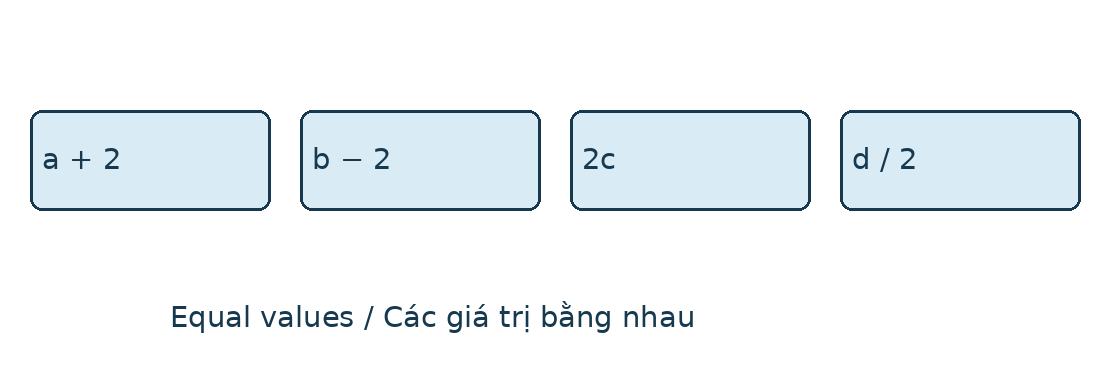
Positive integers a, b, c, d satisfy a+2=b−2=2 c=d÷ 2. Which of the four is largest?

Question illustration
  1. a
  2. b
  3. c
  4. d
  5. Cannot be determined

Question 9

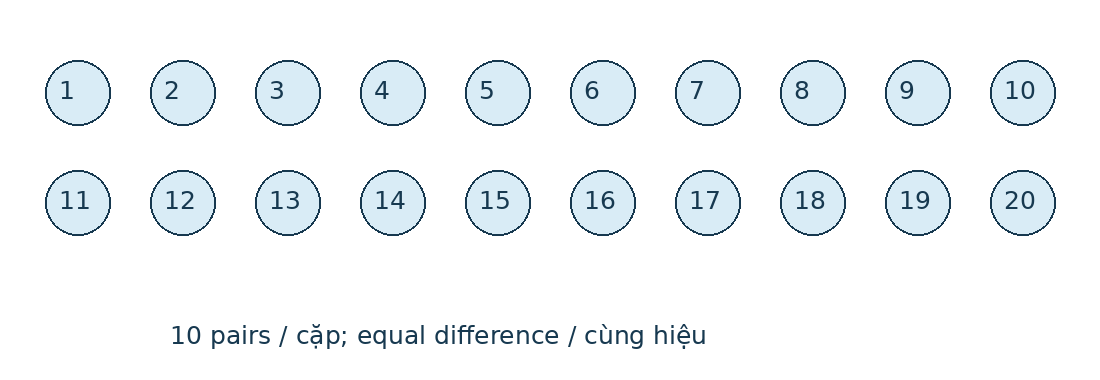
The positive integers 1 through 20 are to be divided into ten pairs, with the same difference between the two numbers in every pair. Order within each pair is irrelevant. How many such divisions are possible?

Question illustration
  1. 0
  2. 3
  3. 4
  4. 5
  5. More than five divisions meet the requirements.

Question 10

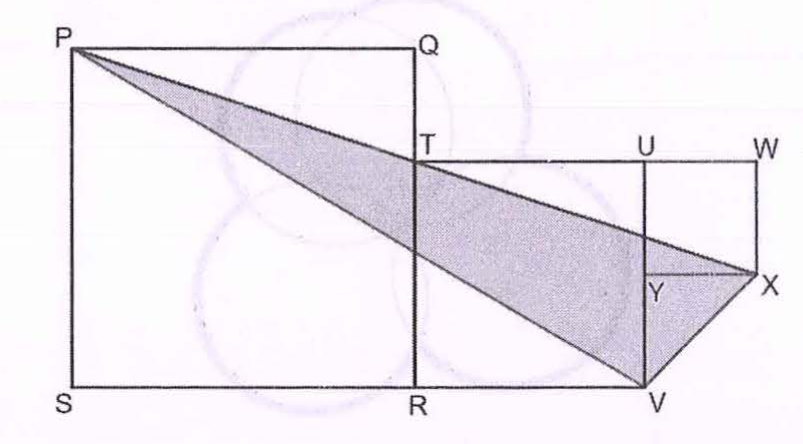
In the diagram, PQRS, TUVR and UWXY are squares, and P, T, X are collinear. The first two squares have areas 36 and 16 respectively. What is the area of triangle PXV?

Question illustration
  1. 14 2/3
  2. 15 1/3
  3. 16
  4. 17 2/3
  5. 18

Question 11

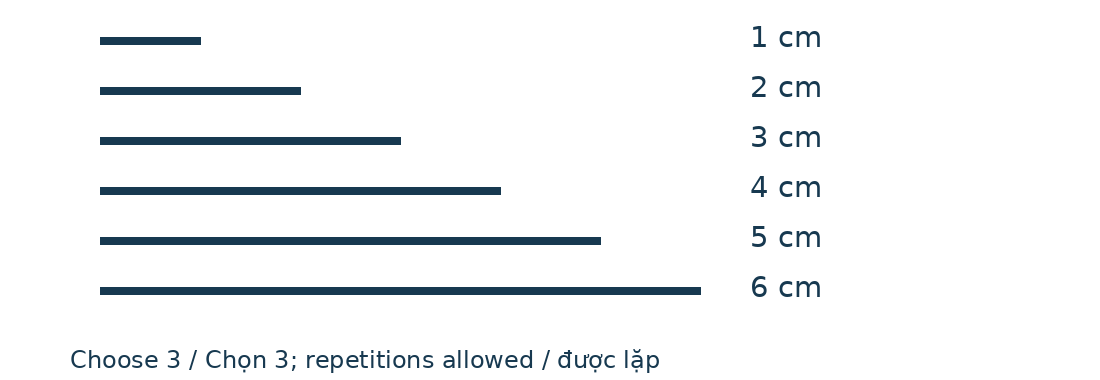
There are many wooden sticks of each length 6,5,4,3,2,1 cm. By selecting three sticks, how many different triangle sizes can be formed?

Question illustration
  1. 12
  2. 18
  3. 24
  4. 30
  5. 34

Question 12

A piece of string lies on a table with parts hidden as shown. At each hidden crossing it can have either of the two pictured over-under arrangements Question illustration and Question illustration. If its ends are pulled, what is the probability that it has a knot?
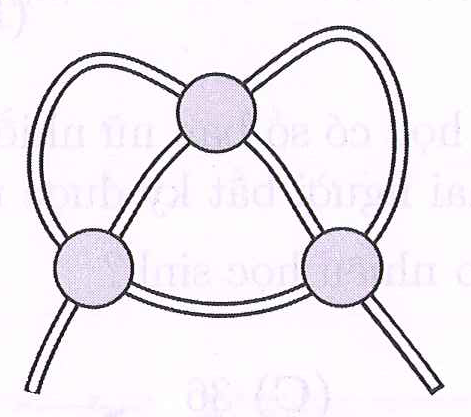
Original printed choices: A) 1/2; B) 1/4; C) 1/8; D) 3/4; E) 3/8

Editorial note: Explain whether the printed question and choices are consistent. Give the literal mathematical result and distinguish any intended correction.

Question illustration

Question 13

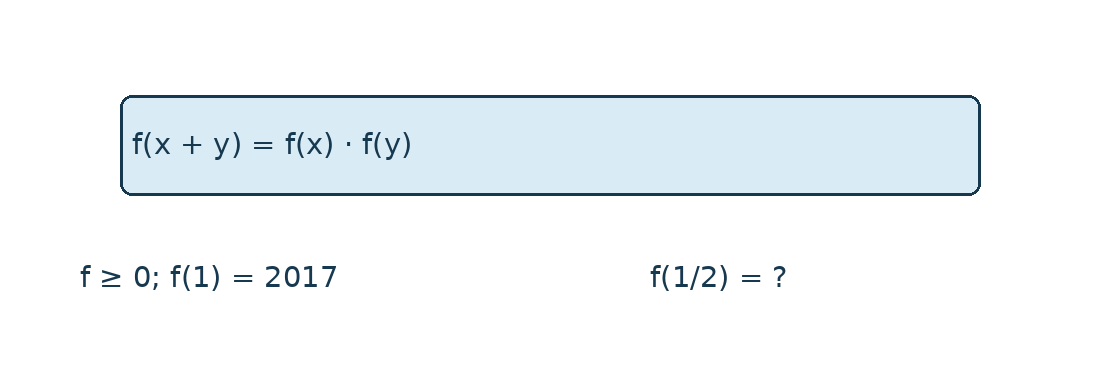
A function f: R→R satisfies f (x)≥0 for all real x, f (1)=2017, and f (x+y)=f (x)f (y) for all real x, y. What is f (1/2)?

Question illustration
  1. 2017/2
  2. 1
  3. 0
  4. 4034
  5. √2017

Question 14

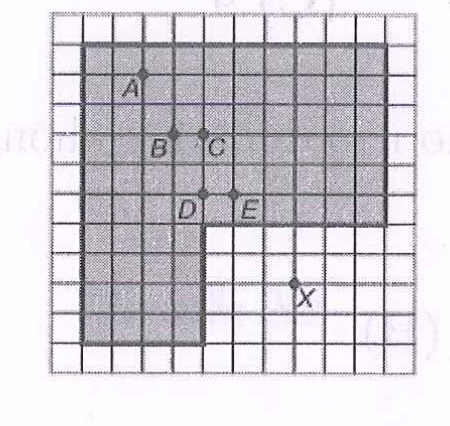
A straight line through X bisects the area of the grey region. Through which of the points A, B, C, D, E does it pass?

Question illustration
  1. A
  2. B
  3. C
  4. D
  5. E

Question 15

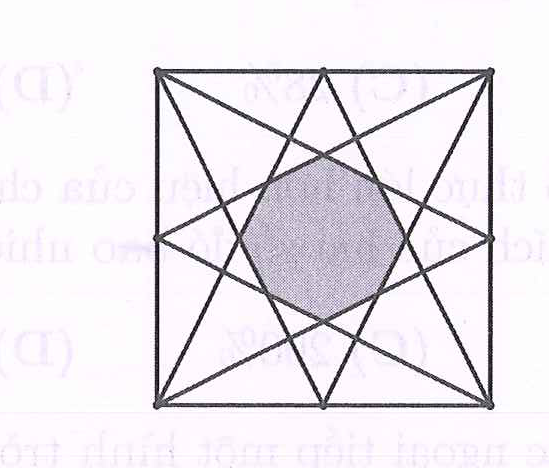
Tom draws a square and joins each vertex to the midpoints of the two nonadjacent sides. This produces the inner octagon shown. What is the ratio of the octagon’s area to the square’s area?

Question illustration
  1. 1/6
  2. 3/14
  3. 2/11
  4. 1/5
  5. 1/8

Question 16

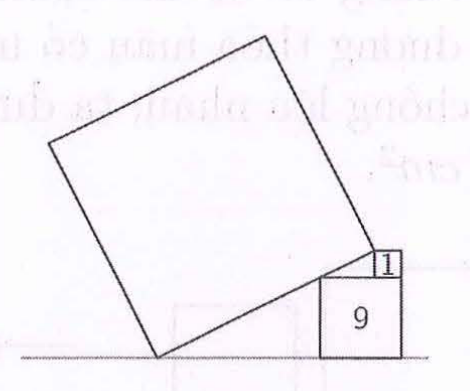
In the diagram, the smallest square shares a vertex with each of the other two squares. The numbers inside two squares are their respective areas. What is the largest square’s area?

Question illustration
  1. 60
  2. 70
  3. 80
  4. 90
  5. 100

Question 17

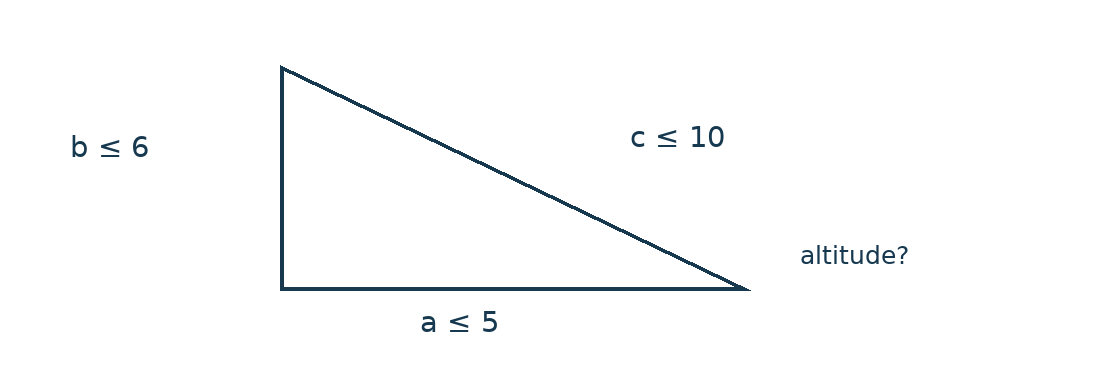
A triangle has side lengths a≤5 cm, b≤6 cm and c≤10 cm. What is the greatest possible length of an altitude, in centimetres?

Question illustration
  1. 5,5 cm
  2. 6 cm
  3. 6,5 cm
  4. 8 cm
  5. 9,5 cm

Question 18

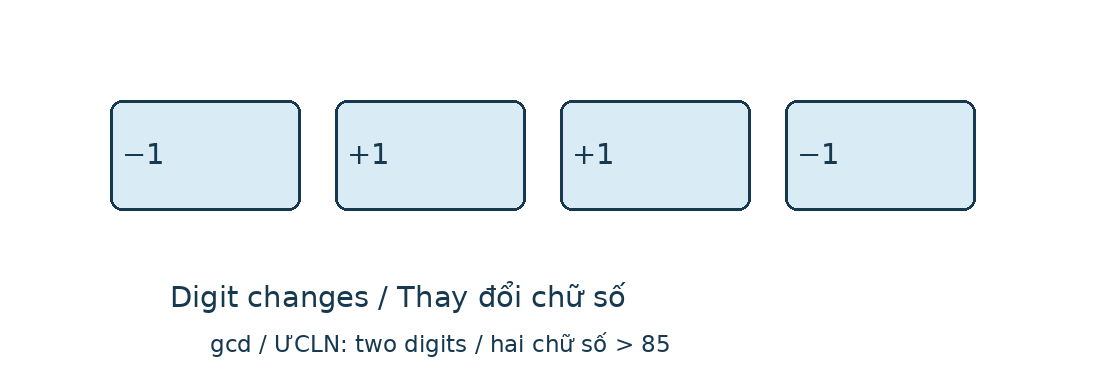
A four-digit number has no digit 0 or 9. Decrease its first and last digits by 1 and increase each middle digit by 1 to form a new number. The greatest common divisor of the old and new numbers is the two-digit number ab, greater than 85. What is a+b?

Question illustration
  1. 10
  2. 12
  3. 15
  4. 17
  5. 18

Question 19

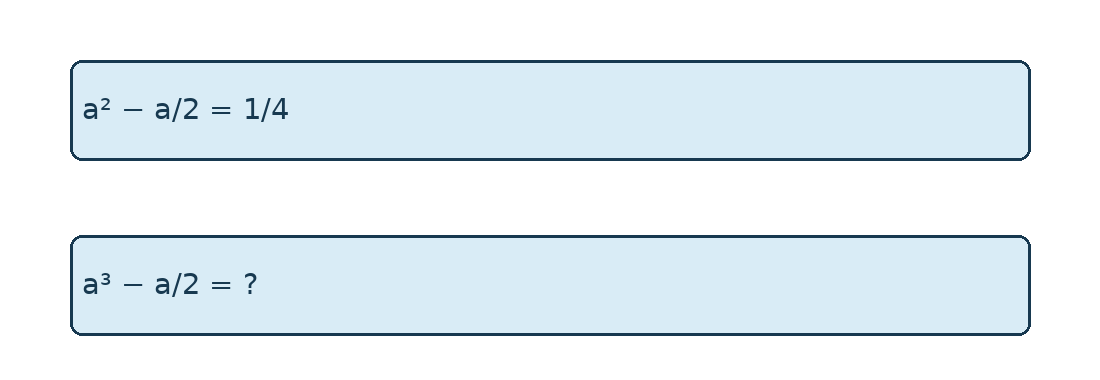
A number a satisfies a²−a/2=1/4. What is a³−a/2?

Question illustration
  1. −1/4
  2. 1/4
  3. 1/2
  4. 4
  5. 1/8

Question 20

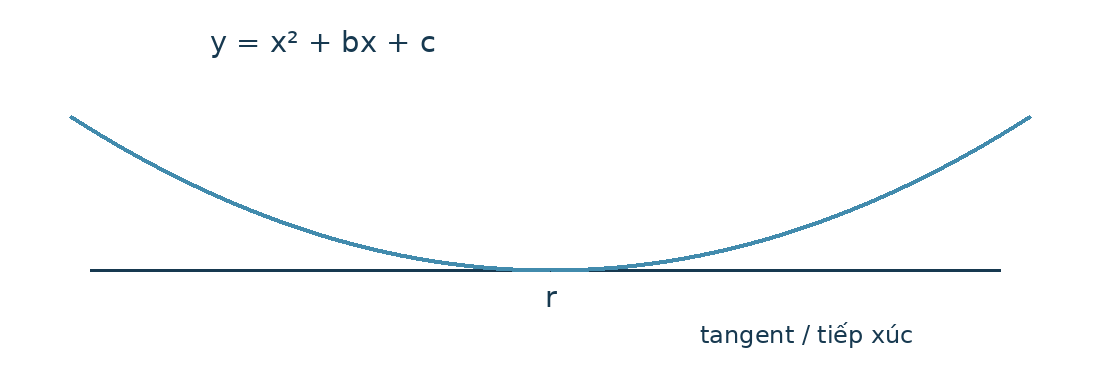
The graph of f (x)=x²+bx+c is tangent to the horizontal axis at (r,0). Which of the following must equal b?

Original printed choices: A) r; B) 2r; C) ±√c; D) bc/r; E) c/r

Editorial note: Explain whether the printed question and choices are consistent. Give the literal mathematical result and distinguish any intended correction.

Question illustration