Skip to content / Đến nội dung
ThichHocToan.com

1987 AMC 12

Question 1

$(1+x^2)(1-x^3)$ equals
  1. $1-x^5$
  2. $1-x^6$
  3. $1+x^2-x^3$
  4. $1+x^2-x^3-x^5$
  5. $1+x^2-x^3-x^6$

Question 2

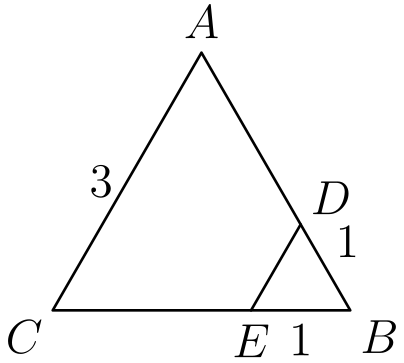
As shown in the figure, a triangular corner with side lengths $DB=EB=1$ is cut from equilateral triangle $ABC$ of side length $3.$ The perimeter of the remaining quadrilateral $ADEC$ is

Question illustration
  1. $6$
  2. $6\frac12$
  3. $7$
  4. $7\frac12$
  5. $8$

Question 3

How many primes less than $100$ have $7$ as the ones digit? (Assume the usual base $10$ representation.)
  1. $4$
  2. $5$
  3. $6$
  4. $7$
  5. $8$

Question 4

$$
\frac{2^1+2^0+2^{-1}}{2^{-2}+2^{-3}+2^{-4}}
$$ equals
  1. $6$
  2. $8$
  3. $\frac{31}{2}$
  4. $24$
  5. $512$

Question 5

A student recorded the exact percentage frequency distribution for a set of measurements, as shown below. However, the student neglected to indicate $N,$ the total number of measurements. What is the smallest possible value of $N?$ measured value percent frequency $0$ $12.5$ $1$ $0$ $2$ $50$ $3$ $25$ $4$ $12.5$ $100$
  1. $5$
  2. $8$
  3. $16$
  4. $25$
  5. $50$

Question 6

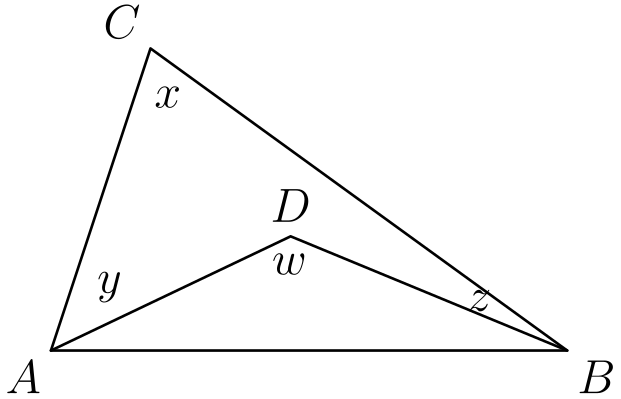
In the $\triangle ABC$ shown, $D$ is some interior point, and $x,$ $y,$ $z,$ $w$ are the measures of angles in degrees. Solve for $x$ in terms of $y,$ $z,$ and $w.$

Question illustration
  1. $w-y-z$
  2. $w-2y-2z$
  3. $180-w-y-z$
  4. $2w-y-z$
  5. $180-w+y+z$

Question 7

If $a-1=b+2=c-3=d+4,$ which of the four quantities $a,$ $b,$ $c,$ $d$ is the largest?
  1. $a$
  2. $b$
  3. $c$
  4. $d$
  5. no one is always largest

Question 8

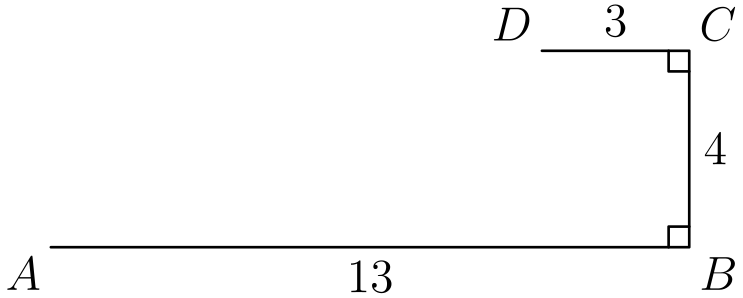
In the figure the sum of the distances $AD$ and $BD$ is

Question illustration
  1. between $10$ and $11$
  2. $12$
  3. between $15$ and $16$
  4. between $16$ and $17$
  5. $17$

Question 9

The first four terms of an arithmetic sequence are $a,$ $x,$ $b,$ $2x.$ The ratio of $a$ to $b$ is
  1. $\frac14$
  2. $\frac13$
  3. $\frac12$
  4. $\frac23$
  5. $2$

Question 10

How many ordered triples $(a,b,c)$ of nonzero real numbers have the property that each number is the product of the other two?
  1. $1$
  2. $2$
  3. $3$
  4. $4$
  5. $5$

Question 11

Let $c$ be a constant. The simultaneous equations $$
\begin{aligned} x-y&=2,\\ cx+y&=3. \end{aligned}
$$ have a solution $(x,y)$ inside Quadrant I if and only if
  1. $c=-1$
  2. $c\gt-1$
  3. $c\lt\frac32$
  4. $0\lt c\lt\frac32$
  5. $-1\lt c\lt\frac32$

Question 12

In an office, at various times during the day the boss gives the secretary a letter to type, each time putting the letter on top of the pile in the secretary’s in-box. When there is time, the secretary takes the top letter off the pile and types it. If there are five letters in all, and the boss delivers them in the order $1,$ $2,$ $3,$ $4,$ $5,$ which of the following could not be the order in which the secretary types them?
  1. $1,$ $2,$ $3,$ $4,$ $5$
  2. $2,$ $4,$ $3,$ $5,$ $1$
  3. $3,$ $2,$ $4,$ $1,$ $5$
  4. $4,$ $5,$ $2,$ $3,$ $1$
  5. $5,$ $4,$ $3,$ $2,$ $1$

Question 13

A long piece of paper $5$ cm wide is made into a roll for cash registers by wrapping it $600$ times around a cardboard tube of diameter $2$ cm, forming a roll $10$ cm in diameter. Approximate the length of the paper in meters. (Pretend the paper forms $600$ concentric circles with diameters evenly spaced from $2$ cm to $10$ cm.)
  1. $36\pi$
  2. $45\pi$
  3. $60\pi$
  4. $72\pi$
  5. $90\pi$

Question 14

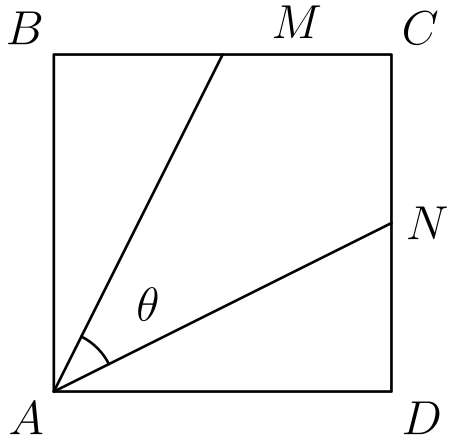
$ABCD$ is a square and $M$ and $N$ are the midpoints of $BC$ and $CD,$ respectively. Then $\sin\theta=$

Question illustration
  1. $\frac{\sqrt5}{5}$
  2. $\frac35$
  3. $\frac{\sqrt{10}}5$
  4. $\frac45$
  5. none of these

Question 15

If $(x,y)$ is a solution to the system $$
\begin{aligned} xy&=6,\\ x^2y+xy^2+x+y&=63, \end{aligned}
$$ find $x^2+y^2.$
  1. $13$
  2. $\frac{1173}{32}$
  3. $55$
  4. $69$
  5. $81$

Question 16

A cryptographer devises the following method for encoding positive integers. First, the integer is expressed in base $5.$ Second, a $1$-to-$1$ correspondence is established between the digits that appear in the expressions in base $5$ and the elements of the set $\{V,W,X,Y,Z\}.$ Using this correspondence, the cryptographer finds that three consecutive integers in increasing order are coded as $VYZ,$ $VYX,$ $VVW,$ respectively. What is the base-$10$ expression for the integer coded as $XYZ?$
  1. $48$
  2. $71$
  3. $82$
  4. $108$
  5. $113$

Question 17

In a mathematics competition, the sum of the scores of Bill and Dick equalled the sum of the scores of Ann and Carol. If the scores of Bill and Carol had been interchanged, then the sum of the scores of Ann and Carol would have exceeded the sum of the scores of the other two. Also, Dick’s score exceeded the sum of the scores of Bill and Carol. Determine the order in which the four contestants finished, from highest to lowest. Assume all scores were nonnegative.
  1. Dick, Ann, Carol, Bill
  2. Dick, Ann, Bill, Carol
  3. Dick, Carol, Bill, Ann
  4. Ann, Dick, Carol, Bill
  5. Ann, Dick, Bill, Carol

Question 18

It takes $A$ algebra books (all the same thickness) and $H$ geometry books (all the same thickness, which is greater than that of an algebra book) to completely fill a certain shelf. Also, $S$ of the algebra books and $M$ of the geometry books would fill the same shelf. Finally, $E$ of the algebra books alone would fill this shelf. Given that $A,$ $H,$ $S,$ $M,$ $E$ are distinct positive integers, it follows that $E$ is
  1. $\frac{AM+SH}{M+H}$
  2. $\frac{AM^2+SH^2}{M^2+H^2}$
  3. $\frac{AH-SM}{M-H}$
  4. $\frac{AM-SH}{M-H}$
  5. $\frac{AM^2-SH^2}{M^2-H^2}$

Question 19

Which of the following is closest to $\sqrt{65}-\sqrt{63}?$
  1. $0.12$
  2. $0.13$
  3. $0.14$
  4. $0.15$
  5. $0.16$

Question 20

Evaluate $$
\begin{aligned} &\log_{10}(\tan1^\circ)\\ &\quad+\log_{10}(\tan2^\circ)\\ &\quad+\log_{10}(\tan3^\circ)+\cdots\\ &\quad+\log_{10}(\tan88^\circ)\\ &\quad+\log_{10}(\tan89^\circ). \end{aligned}
$$
  1. $0$
  2. $\frac12\log_{10}\left(\frac{\sqrt3}{2}\right)$
  3. $\frac12\log_{10}2$
  4. $1$
  5. none of these