Skip to content / Đến nội dung
ThichHocToan.com

1975 AMC 12

Question 1

The value of $$
\frac{1}{2-\dfrac{1}{2-\dfrac{1}{2-\frac12}}}
$$ is
  1. $\frac34$
  2. $\frac45$
  3. $\frac56$
  4. $\frac67$
  5. $\frac65$

Question 2

For which real values of $m$ are the simultaneous equations $$
\begin{aligned} y&=mx+3,\\ y&=(2m-1)x+4 \end{aligned}
$$ satisfied by at least one pair of real numbers $(x,y)?$
  1. all $m$
  2. all $m\ne0$
  3. all $m\ne\frac12$
  4. all $m\ne1$
  5. no values of $m$

Question 3

Which of the following inequalities are satisfied for all real numbers $a,$ $b,$ $c,$ $x,$ $y,$ $z$ which satisfy $x\lt a,$ $y\lt b,$ and $z\lt c?$

I. $xy+yz+zx\lt ab+bc+ca$

II. $x^2+y^2+z^2\lt a^2+b^2+c^2$

III. $xyz\lt abc$
  1. None are satisfied.
  2. $\mathrm{I}$ only
  3. $\mathrm{II}$ only
  4. $\mathrm{III}$ only
  5. All are satisfied.

Question 4

If the side of one square is the diagonal of a second square, what is the ratio of the area of the first square to the area of the second?
  1. $2$
  2. $\sqrt2$
  3. $\frac12$
  4. $2\sqrt2$
  5. $4$

Question 5

The polynomial $(x+y)^9$ is expanded in decreasing powers of $x.$ The second and third terms have equal values when evaluated at $x=p$ and $y=q,$ where $p$ and $q$ are positive numbers whose sum is one. What is the value of $p?$
  1. $\frac15$
  2. $\frac45$
  3. $\frac14$
  4. $\frac34$
  5. $\frac89$

Question 6

The sum of the first eighty positive odd integers subtracted from the sum of the first eighty positive even integers is
  1. $0$
  2. $20$
  3. $40$
  4. $60$
  5. $80$

Question 7

For which nonzero real numbers $x$ is $\frac{|x-|x||}{x}$ a positive integer?
  1. for negative $x$ only
  2. for positive $x$ only
  3. only for $x$ an even integer
  4. for all nonzero real numbers $x$
  5. for no nonzero real numbers $x$

Question 8

If the statement “All shirts in this store are on sale.” is false, then which of the following statements must be true?

I. All shirts in this store are at non-sale prices.

II. There is some shirt in this store not on sale.

III. No shirt in this store is on sale.

IV. Not all shirts in this store are on sale.

*Note: Originally, statement I read: All shirts in this store are not on sale.*
  1. $\mathrm{II}$ only
  2. $\mathrm{IV}$ only
  3. $\mathrm{I}$ and $\mathrm{III}$ only
  4. $\mathrm{II}$ and $\mathrm{IV}$ only
  5. $\mathrm{I},$ $\mathrm{II}$ and $\mathrm{IV}$ only

Question 9

Let $a_1,$ $a_2,$ $\ldots$ and $b_1,$ $b_2,$ $\ldots$ be arithmetic progressions such that $a_1=25,$ $b_1=75,$ and $a_{100}+b_{100}=100.$ Find the sum of the first one hundred terms of the progression $a_1+b_1,$ $a_2+b_2,$ $\ldots.$
  1. $0$
  2. $100$
  3. $10{,}000$
  4. $505{,}000$
  5. not enough information given to solve the problem

Question 10

The sum of the digits in base ten of $\left(10^{4n^2+8}+1\right)^2,$ where $n$ is a positive integer, is
  1. $4$
  2. $4n$
  3. $2+2n$
  4. $4n^2$
  5. $n^2+n+2$

Question 11

Let $P$ be an interior point of circle $K$ other than the center of $K.$ Form all chords of $K$ which pass through $P,$ and determine their midpoints. The locus of these midpoints is
  1. a circle with one point deleted
  2. a circle if the distance from $P$ to the center of $K$ is
    less than one half the radius of $K;$ otherwise a circular arc of
    less than $360^\circ$
  3. a semicircle with one point deleted
  4. a semicircle
  5. a circle

Question 12

If $a\ne b,$ $a^3-b^3=19x^3,$ and $a-b=x,$ which of the following conclusions is correct?
  1. $a=3x$
  2. $a=3x$ or $a=-2x$
  3. $a=-3x$ or $a=2x$
  4. $a=3x$ or $a=2x$
  5. $a=2x$

Question 13

The equation $x^6-3x^5-6x^3-x+8=0$ has
  1. no real roots
  2. exactly two distinct negative roots
  3. exactly one negative root
  4. no negative roots, but at least one positive
    root
  5. none of these

Question 14

If the whatsis is so when the whosis is is and the so and so is is $\cdot$ so, what is the whosis $\cdot$ whatsis when the whosis is so, the so and so is so $\cdot$ so, and the is is two (whatsis, whosis, is and so are variables taking positive values)?
  1. whosis $\cdot$ is $\cdot$ so
  2. whosis
  3. is
  4. so
  5. so and so

Question 15

In the sequence of numbers $1,$ $3,$ $2,$ $\ldots,$ each term after the first two is equal to the term preceding it minus the term preceding that. The sum of the first one hundred terms of the sequence is
  1. $5$
  2. $4$
  3. $2$
  4. $1$
  5. $-1$

Question 16

If the first term of an infinite geometric series is a positive integer, the common ratio is the reciprocal of a positive integer, and the sum of the series is $3,$ then the sum of the first two terms of the series is
  1. $\frac13$
  2. $\frac23$
  3. $\frac83$
  4. $2$
  5. $\frac92$

Question 17

A man can commute either by train or by bus. If he goes to work on the train in the morning, he comes home on the bus in the afternoon; and if he comes home in the afternoon on the train, he took the bus in the morning. During a total of $x$ working days, the man took the bus to work in the morning $8$ times, came home by bus in the afternoon $15$ times, and commuted by train (either morning or afternoon) $9$ times. Find $x.$
  1. $19$
  2. $18$
  3. $17$
  4. $16$
  5. not enough information given to solve the problem

Question 18

A positive integer $N$ with three digits in its base ten representation is chosen at random, with each three-digit number having an equal chance of being chosen. The probability that $\log_2N$ is an integer is
  1. $0$
  2. $\frac3{899}$
  3. $\frac1{225}$
  4. $\frac1{300}$
  5. $\frac1{450}$

Question 19

Which positive numbers $x$ satisfy the equation $(\log_3x)(\log_x5)=\log_35?$
  1. $3$ and $5$ only
  2. $3,$ $5$ and $15$ only
  3. only numbers of the form $5^n\cdot3^m,$ where $n$ and $m$
    are positive integers
  4. all positive $x\ne1$
  5. none of these

Question 20

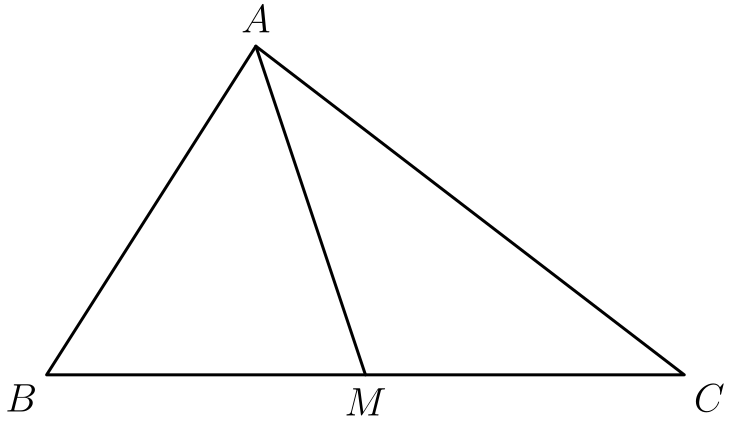
In the adjoining figure triangle $ABC$ is such that $AB=4$ and $AC=8.$ If $M$ is the midpoint of $BC$ and $AM=3,$ what is the length of $BC?$

Question illustration
  1. $2\sqrt{26}$
  2. $2\sqrt{31}$
  3. $9$
  4. $4+2\sqrt{13}$
  5. not enough information given to solve the problem