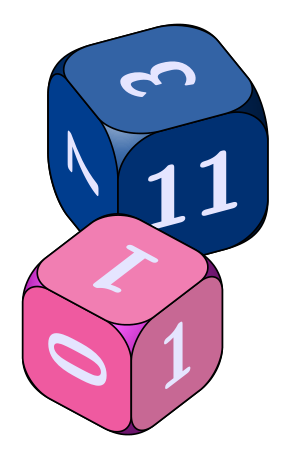
The smaller of these dice has three zeroes and three ones on its faces and the larger has the numbers 1,3,5,7,9 and 11 on its faces. Both dice are rolled once and the numbers showing on top are added. What is the probability of obtaining a sum of 12?
The operation $\divideontimes$ is defined by $p\divideontimes q=2p-q$. Each of $p$ and $q$ is an integer from $-6$ to $+6$. How many pairs of values $(p,q)$ will have $p\divideontimes q=q\divideontimes p$?
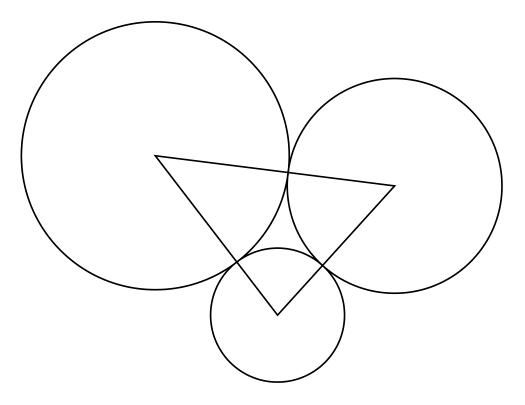
In the diagram, the lengths of the sides of the triangle are 8,9 and 13 centimetres. The centres of the circles are at the vertices of the triangle and the circles just touch. The radius, in centimetres, of the largest circle is
The four integers 3,4,8,11 have their mean and range calculated. A fifth integer is then included that is different from the other four. This doesn’t change the range, but the mean is now an integer. What is this new mean?
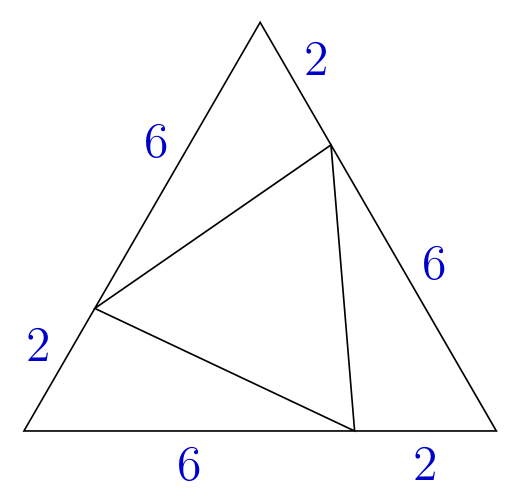
A small equilateral triangle sits inside a larger equilateral triangle as shown. What is the ratio of the areas of the smaller and larger equilateral triangles?
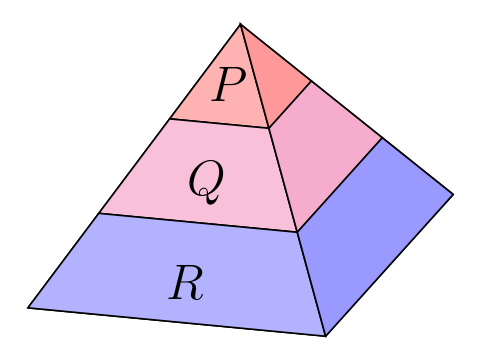
The square pyramid shown is divided into 3 pieces, $P,Q,R$, by two planes that are parallel to the square base. Each of the 3 pieces has the same height. The volume of the piece $P$ is $5\text{ cm}^3$. What is the volume of piece $R$, in $\text{cm}^3$?
A sequence of values $a_1,a_2,\ldots,a_{100}$ is calculated as follows: $a_1=1$, $a_2=2$, $a_3=\frac{a_2+1}{a_1}$, $\ldots$, $a_n=\frac{a_{n-1}+1}{a_{n-2}}$, $\ldots$, $a_{100}=\frac{a_{99}+1}{a_{98}}$. What is $a_{100}$?
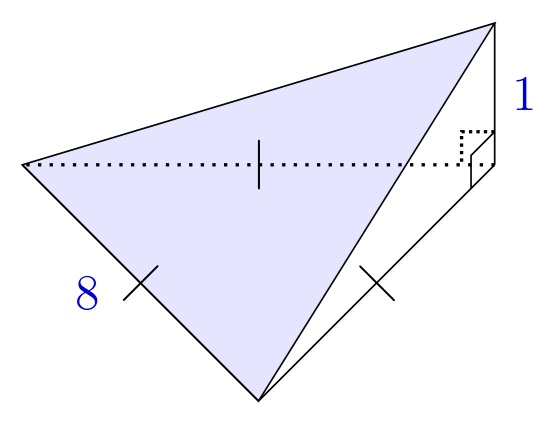
A triangular ramp is in the shape of a right-angled tetrahedron. The horizontal base is an equilateral triangle with sides 8 metres. The apex is 1 metre directly above one corner of the base, so that two faces are vertical. In square metres, what is the area of the sloping face?