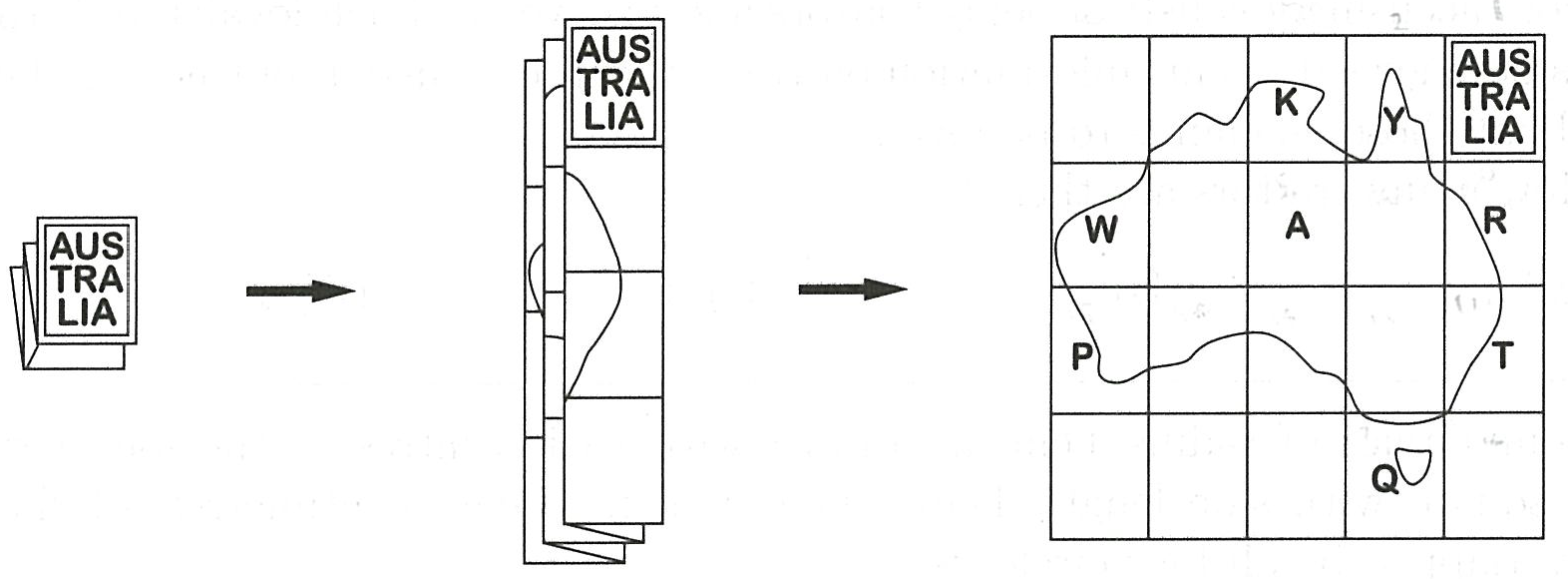
On a string of beads, the largest bead is in the centre and the smallest beads are on the ends. The size of the beads increases from the ends to the centre as shown in the diagram.
The smallest beads cost \$1 each, the next smallest beads cost \$2 each, the next smallest \$3 each, and so on. How much change from \$200 would there be for the beads on a string with 25 such beads?
In a school of 1000 students, 570 are girls. One-quarter of the students travel to school by bus and 313 boys do not go by bus. How many girls travel to school by bus?
A box in the dressing shed of a sporting team contains 6 green and 3 red caps. The probability that the first 2 caps taken at random from the box will be the same colour is
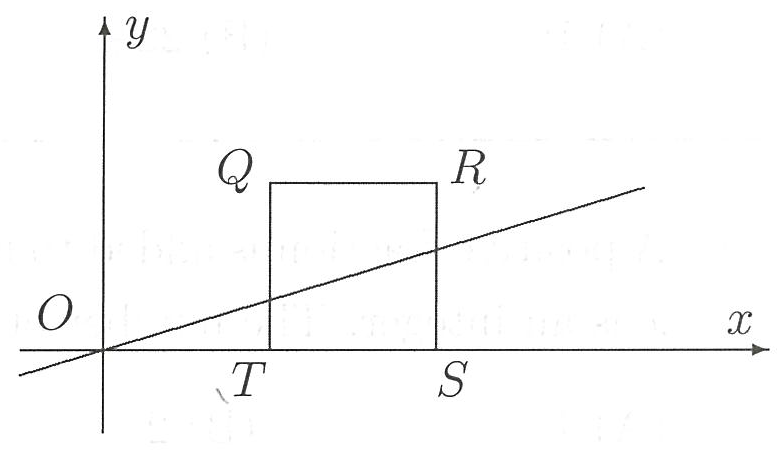
$QRST$ is a square with $T$ at $(1,0)$ and $S$ at $(2,0)$. Which of the following is an equation of the line through the origin which bisects the area of the square?
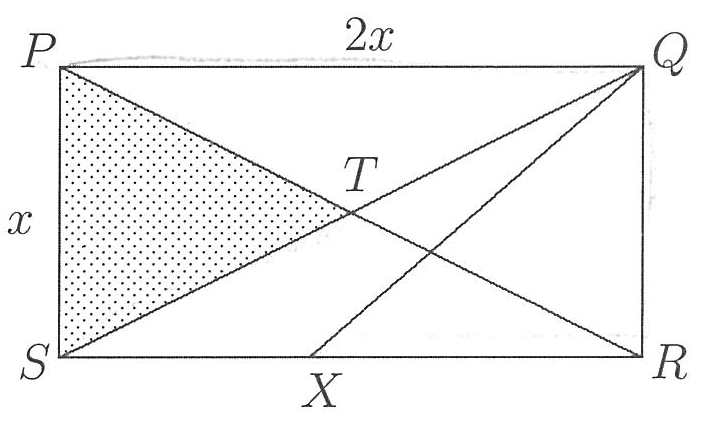
A rectangle $PQRS$ has $PQ=2x$ cm and $PS=x$ cm. The diagonals $PR$ and $QS$ meet at $T$. $X$ lies on $RS$ so that $QX$ divides the pentagon $PQRST$ into two sections of equal area. The length, in centimetres, of $RX$ is
The solution to the equation $5^x-5^{x-2}=120\sqrt5$ is a rational number of the form $\frac ab$, where $b\ne0$ and $a$ and $b$ are positive and have no common factors. What is the value of $a+b$?
An eyebrow is an arrangement of the numbers 1, 2, 3, 4 and 5 such that the second and fourth numbers are each bigger than both their immediate neighbours. For example, $(1,3,2,5,4)$ is an eyebrow and $(1,3,4,5,2)$ is not.
A positive fraction is added to its reciprocal. The sum is $\frac x{60}$ in lowest terms, where $x$ is an integer. The number of possible values of $x$ is
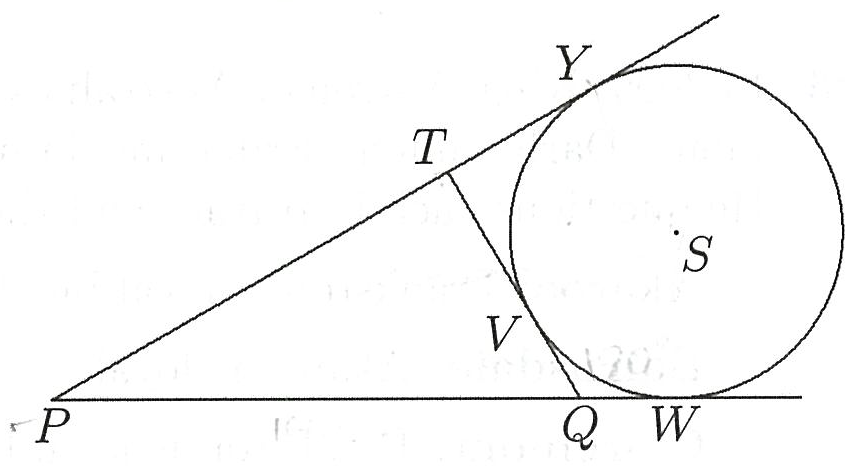
In $\triangle PQT$, $PQ=10$ cm, $QT=5$ cm and $\angle PQT=60^\circ$. $PW,PY$ and $TQ$ are tangents to the circle with centre $S$ at $W,Y$ and $V$ respectively. The radius of the circle, in centimetres, is