How many positive integers less than or equal to $2022$ cannot be expressed as $$\lfloor2x+1\rfloor+\lfloor5x+1\rfloor$$ for some real number $x$? Here, $\lfloor x\rfloor$ denotes the greatest integer less than or equal to $x$. For example, $\lfloor-2.1\rfloor=-3$, $\lfloor3.9\rfloor=3$.
Suppose $$y=\frac{\tan^2x-\tan x+\sqrt{33}}{\tan^2x+\tan x+1},$$ where $-90^\circ\lt x\lt 90^\circ$. Find the maximum possible value of $\sqrt{33}(y-5)$.
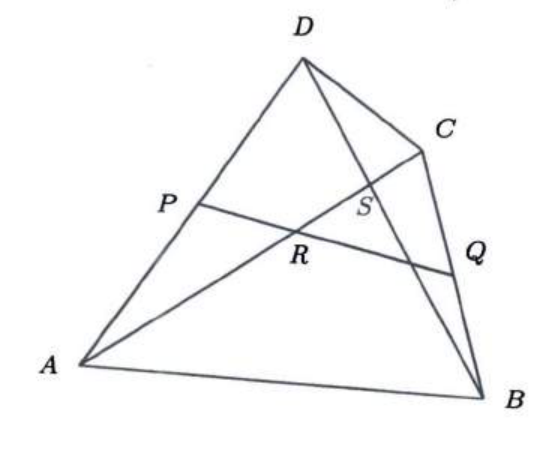
The figure below shows a quadrilateral $ABCD$ such that $AC=BD$ and $P$ and $Q$ are the midpoints of the sides $AD$ and $BC$ respectively. The lines $PQ$ and $AC$ meet at $R$ and the lines $BD$ and $AC$ meet at $S$. If $\angle PRC=130^\circ$, find the angle $\angle DSC$ (in $^\circ$).
Find the smallest odd integer $N$, where $N\gt 2022$, such that when $1808$, $2022$ and $N$ are each divided by a positive integer $p$, where $p\gt 1$, they all leave the same remainder.
Suppose
$$\cos x-\cos y=\frac12,\qquad\sin x-\sin y=-\frac13.$$
If $\sin(x+y)=\dfrac mn$, where $\dfrac mn$ is expressed as a fraction in its lowest terms, find the value of $m+n$.
For some positive integer $n$, the number $n^3-3n^2+3n$ has a units digit of $6$. Find the product of the last two digits of the number $7(n-1)^{12}+1$.