In a strange island, there are only two types of inhabitants: truth-tellers who only tell the truth and liars who only tell lies. One day, you meet two such inhabitants $A$ and $B$. $A$ said: “Exactly one of us is a truth-teller.” $B$ kept silent. Which of the following must be true?
Let $x,y$ and $z$ be positive integers satisfying $$x^2+y^2+z^2=2(xy+1)\qquad\text{and}\qquad x+y+z=2022.$$ If $x_1$ and $x_2$ are two distinct solutions for $x$, what is the value of $x_1+x_2$?
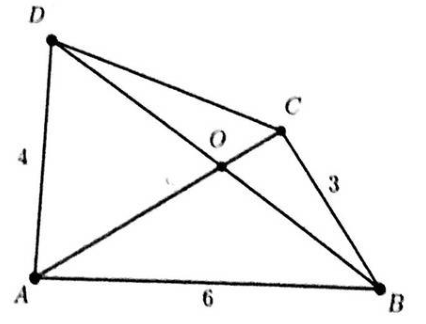
In a quadrilateral $ABCD$, the diagonals $AC$ and $BD$ intersect at the point $O$. Suppose that $\angle BAD+\angle ACB=180^\circ$, $|BC|=3$, $|AD|=4$, $|AC|=5$ and $|AB|=6$. What is the value of $\frac{|OD|}{|OB|}$?
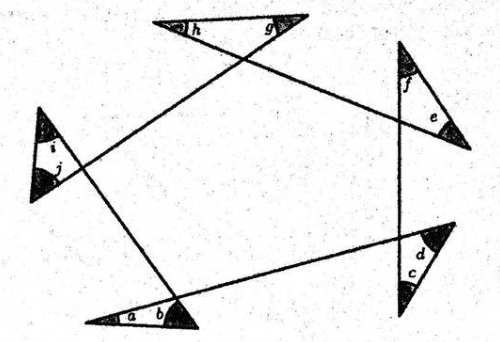
In the following diagram, all lines are straight. What is the value (in degrees) of $\angle a+\angle b+\angle c+\angle d+\angle e+\angle f+\angle g+\angle h+\angle i+\angle j$?
Let $x$ be a positive integer. Suppose that the highest common factor of $x$ and $80$ is $40$ and the highest common factor of $x$ and $252$ is $12$. What is the minimum value of $x$?
A teacher spent 77 dollars to purchase 25 gifts for her class. There were three different types with respective unit prices 2 dollars, 4 dollars, and 5 dollars. If she bought more than three gifts of each type, how many of the 2-dollar gifts did she buy?
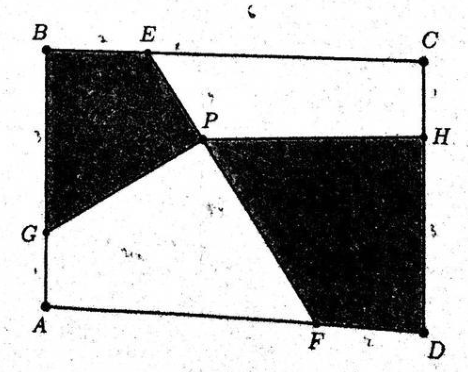
In the following diagram, $ABCD$ is a rectangle with $|AB|=4$ and $|BC|=6$. Points $E$ and $F$ lie on the sides $BC$ and $AD$ respectively such that $|BE|=|FD|=2$. Points $G$ and $H$ lie on the sides $AB$ and $CD$ respectively such that $|AG|=|CH|=1$. Suppose $P$ lies on $EF$, such that the quadrilateral $BGPE$ has area 5. What is the area of the quadrilateral $FDHP$?
Two boxes A and B contain an equal number of toys. If one of the toys, with value 5 dollars, is transferred from A to B, the average value of the toys in box A will decrease by 1 dollar, while the average value of the toys in box B will increase by 1 dollar. Suppose every toy has a positive value, what is the total value (in dollars) of the toys in the two boxes?
A student wrote the following 99 numbers on the board:
$$1,-2,3,-4,5,-6,\ldots,-98,99.$$
She arbitrarily picked two of these numbers, say $a$ and $b$, and replaced them by the sum $a+b$. For example, if she had picked 37 and $-24$, she would erase those two numbers and add the number 13 to the board. Suppose that she repeated the process, and after 98 replacements, there was one number left on the board. What is the largest possible value of this number?
A five-digit positive integer $x$ has the following properties:
(i) $x$ has distinct digits which are from $\{1,2,3,4,5\}$;
(ii) $x>23456$.
How many possible values can $x$ take?
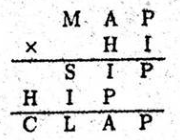
In the figure below, each distinct letter represents a unique digit such that the arithmetic holds. What digit does the letter $L$ represent?
$$\begin{array}{rrrr}&M&A&P\\\times&&H&I\\\hline&S&I&P\\H&I&P&\\\hline C&L&A&P\end{array}$$