Andrew, Catherine, Michael, Nick and Sally ordered different items for lunch. These are (in no particular order): cheese sandwich, chicken rice, duck rice, noodles and steak. Find out what Catherine had for lunch if we are given the following information:
1. Nick sat between his friend Sally and the person who ordered steak.
2. Michael does not like noodles.
3. The person who ate noodles is Sally's cousin.
4. Neither Catherine, Michael nor Nick likes rice.
5. Andrew had duck rice.
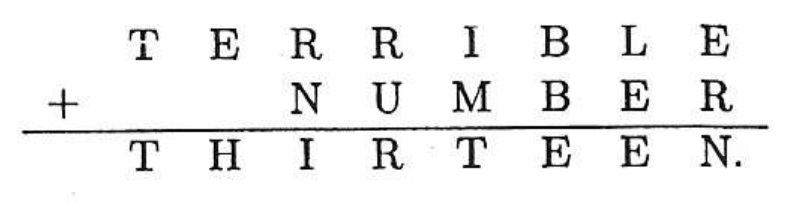
In the figure below, each distinct letter represents a unique digit such that the arithmetic sum holds. If the letter L represents 9, what is the digit represented by the letter T?
A regular cube is to have 2 faces coloured red, 2 faces coloured blue and 2 faces coloured orange. We consider two colourings to be the same if one can be obtained by a rotation of the cube from another. How many different colourings are there?
In $\triangle ABC$, $AB=AC$, $\angle BAC=120^\circ$, $D$ is the midpoint of $BC$, and $E$ is a point on $AB$ such that $DE$ is perpendicular to $AB$. Find the ratio $AE:BD$.
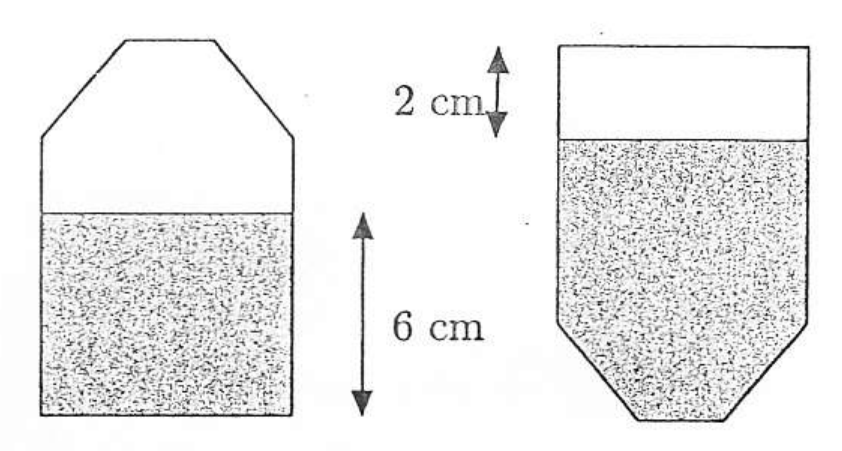
The diagram below shows the front view of a container, with a rectangular base. The container is filled with water up to a height of 6 cm. If the container is turned upside down, the height of the empty space is 2 cm. Given that the total volume of the container is 28 cm$^3$, find the volume of the water in cm$^3$.
Let $D$ be the absolute value of the difference of the two roots of the equation $3x^2-10x-201=0$. Find $\lfloor D\rfloor$. (Throughout this paper, $\lfloor x\rfloor$ denotes the greatest integer less than or equal to $x$.)
If $m$ and $n$ are positive real numbers satisfying the equation $m+4\sqrt{mn}-2\sqrt m-4\sqrt n+4n=3$, find the value of $\frac{\sqrt m+2\sqrt n+2014}{4-\sqrt m-2\sqrt n}$.
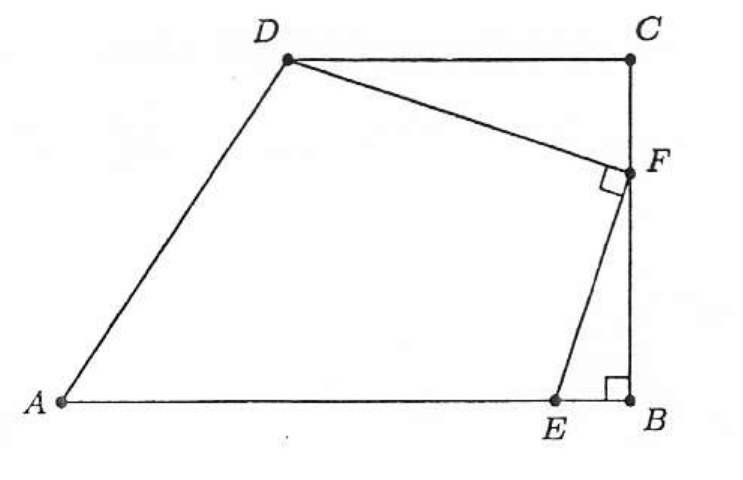
In the diagram below, $ABCD$ is a trapezium with $AB\parallel DC$ and $\angle ABC=90^\circ$. Points $E$ and $F$ lie on $AB$ and $BC$ respectively such that $\angle EFD=90^\circ$. If $CD+DF=BC=4$, find the perimeter of $\triangle BFE$.
John received a box containing some marbles. Upon inspecting the marbles, he immediately discarded 7 that were chipped. He then gave one-fifth of the marbles to his brother. After adding the remaining marbles to his original collection of 14, John discovered that he could divide his marbles into groups of 6 with exactly 2 left over or he could divide his marbles into groups of 5 with none left over. What is the smallest possible number of marbles that John received from the box?
Let $N$ be a 4-digit number with the property that when all the digits of $N$ are added to $N$ itself, the total equals 2019. Find the sum of all the possible values of $N$.