Let $x_1,x_2,\ldots,x_n$ be positive real numbers, and let $S=x_1+x_2+\cdots+x_n$. Prove that
$$(1+x_1)(1+x_2)\cdots(1+x_n)\le 1+S+\frac{S^2}{2!}+\frac{S^3}{3!}+\cdots+\frac{S^n}{n!}.$$
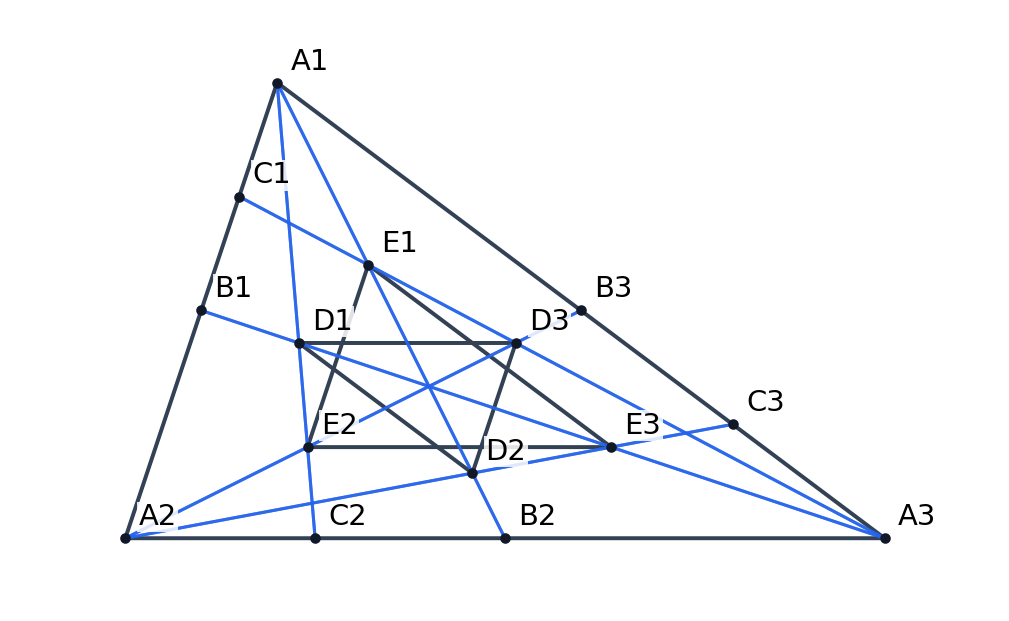
Let $A_1,A_2,A_3$ be three points in the plane, and for convenience let $A_4=A_1$, $A_5=A_2$. For $n=1,2,3$, let $B_n$ be the midpoint of $A_nA_{n+1}$ and $C_n$ the midpoint of $A_nB_n$. Suppose $A_nC_{n+1}$ and $B_nA_{n+2}$ meet at $D_n$, and $A_nB_{n+1}$ and $C_nA_{n+2}$ meet at $E_n$. Calculate the ratio of the area of triangle $D_1D_2D_3$ to that of triangle $E_1E_2E_3$.
Editorial clarification: assume the three initial points are noncollinear, so the requested area ratio is defined. The source omits this condition; its original wording is retained above.
Let $S$ be a set consisting of $m$ pairs $(a,b)$ of positive integers with $1\le a\lt b\le n$. Show that there are at least
$$\frac{4m\left(m-\frac{n^2}{4}\right)}{3n}$$
triples $(a,b,c)$ such that $(a,b),(a,c),(b,c)$ belong to $S$.
Determine all functions $f:\mathbb R\to\mathbb R$ for which (1) $f(x)$ is strictly increasing, and (2) $f(x)+g(x)=2x$ for every real $x$, where $g$ is the composition inverse of $f$. (Thus $f(g(x))=x$ and $g(f(x))=x$ for every real $x$.)