Skip to content / Đến nội dung
ThichHocToan.com

Bebras 2022 - Level 5

Question 1

There are three islands in the sea (the dark grey regions).
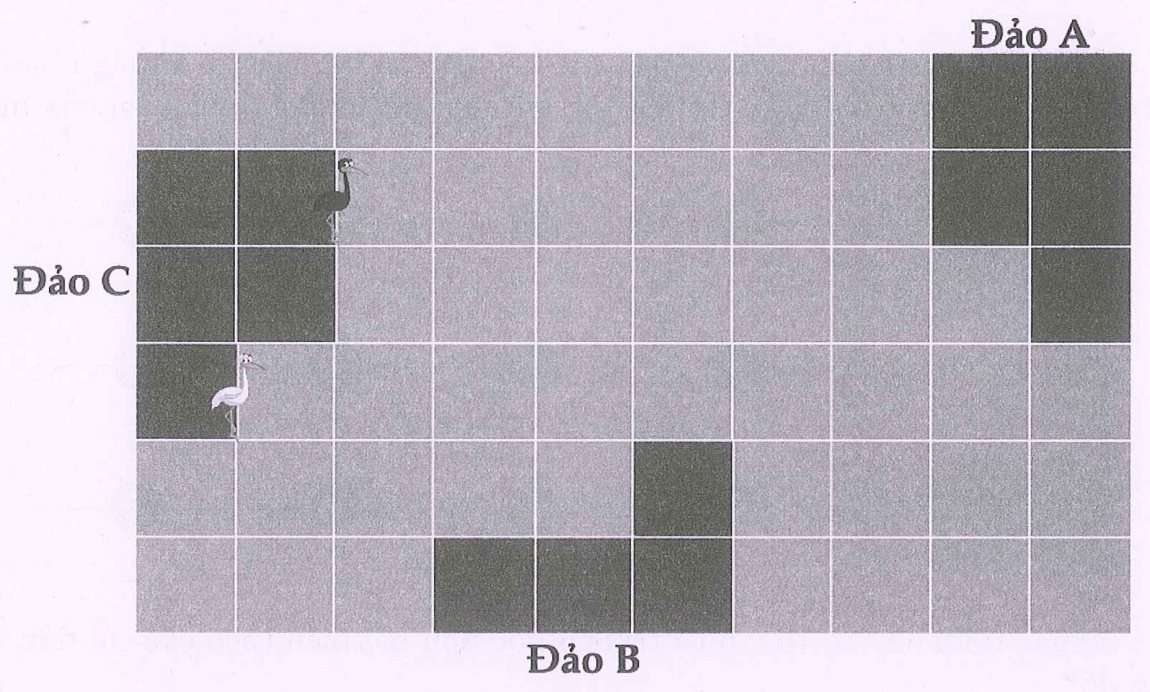
Question illustration

Two birds are on island C and want to reach island A. We know that:
- The birds can move through cells only up, down, left or right, and always take the fastest route.
- The black bird can fly over 2 sea cells per hour and must rest on land for 1 hour after flying over 4 cells.
- The white bird can fly over 4 sea cells per hour and must rest on land for 2 hours after flying over 4 cells.
- On land, both birds walk at 1 cell per hour.

If they set out at the same time, which bird reaches island A sooner?

  1. The black bird arrives 1 hour before the white bird.
  2. The white bird arrives 1 hour before the black bird.
  3. The black bird arrives 2 hours before the white bird.
  4. The white bird arrives 2 hours before the black bird.

Question 2

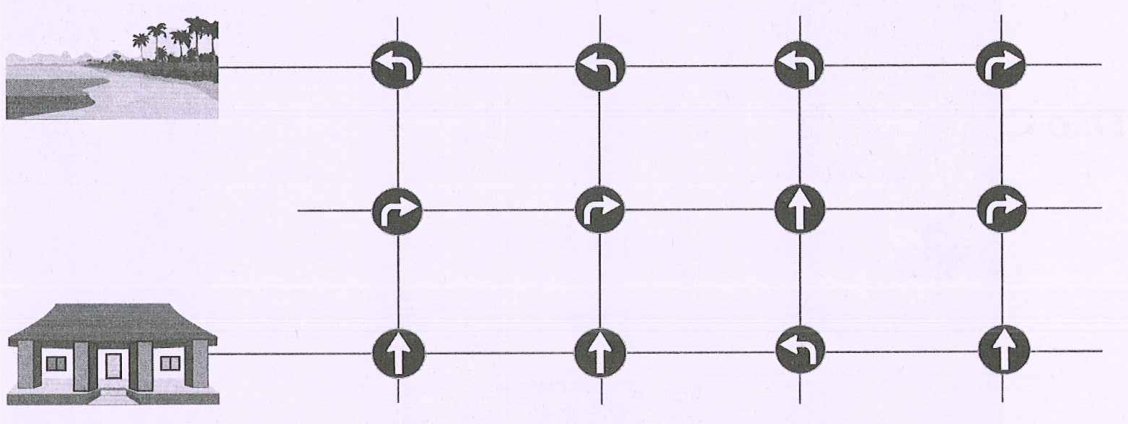
A company is testing self-driving cars. It has installed three types of road signs:

Question illustration

| Sign | ↑ | Right turn | Left turn |
|---|---|---|---|
| Meaning | Continue straight | Turn right here | Turn left here |

The cars still have faults because they are being tested. When a car fails to recognize a sign, it ignores it and continues in the same direction.

Question illustration

Which of the following cars can travel from the school to the beach by following the signs on the map?
  1. Car A fails to recognize the 3rd sign on its journey.
  2. Car B fails to recognize the 4th sign on its journey.
  3. Car C fails to recognize the 5th sign on its journey.
  4. Car D fails to recognize the 6th sign on its journey.

Question 3

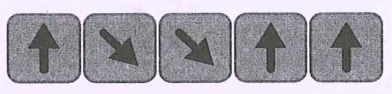
Emma can control a robot by pressing buttons showing directional arrows. For example, pressing the arrows in this order

Question illustration

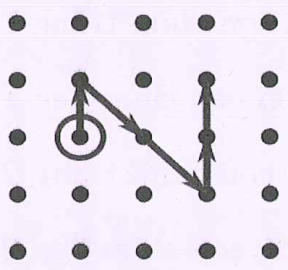
makes the robot move as shown below:

Question illustration

How will the robot move when Emma presses the following buttons?

Question illustration
  1. Question illustration
  2. Question illustration
  3. Question illustration
  4. Question illustration

Question 4

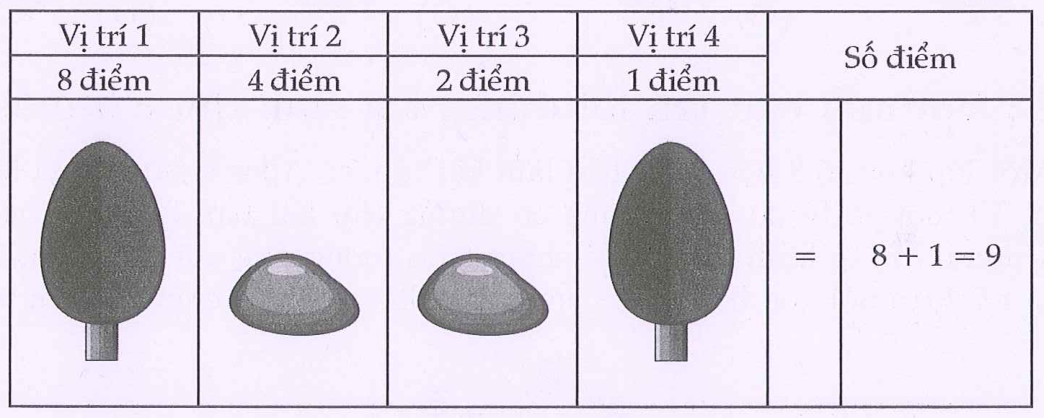
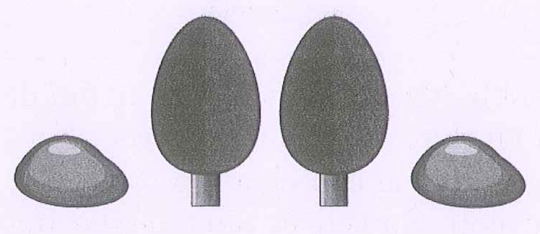
Mr Quantik records test scores in a special way. The maximum score is 15, and each score is represented by a sequence of trees and stones.

The table shows an example of how to calculate the score. We count only the values at positions occupied by trees.

Question illustration

| Position | Position 1 | Position 2 | Position 3 | Position 4 | Score |
|---|---|---|---|---|---|
| Value | 8 points | 4 points | 2 points | 1 point | |
| Symbol | Tree | Stone | Stone | Tree | $8+1=9$ |

What score does the following sequence represent?

Question illustration
  1. 3
  2. 6
  3. 9
  4. 12

Question 5

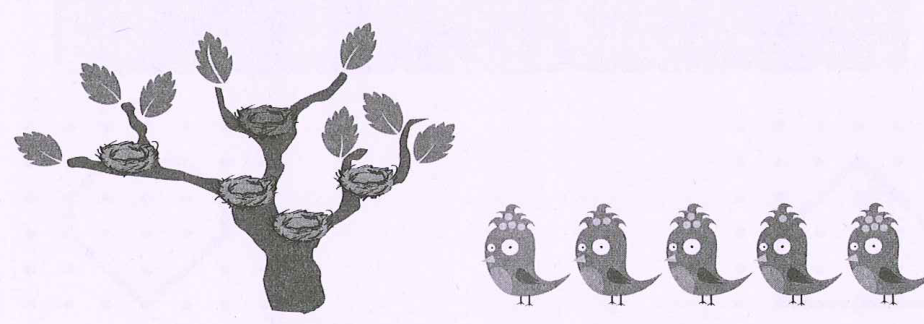
Five birds are queuing to go to nests in a tree (see the illustration). The birds are distinguished by the number of spots on their heads.

Question illustration

On its turn, each bird starts at the root and follows these instructions:
- Go upward until reaching a nest.
- If the nest is empty, enter it and stay there.
- If another bird is already there, choose a branch and continue:
- If you have fewer spots than that bird, go left.
- Otherwise, go right.

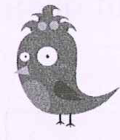
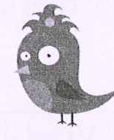
With this ordering, which bird will live in the highest nest?
  1. Question illustration
  2. Question illustration
  3. Question illustration
  4. Question illustration

Question 6

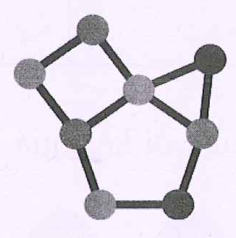
A class has 8 students. Alice usually divides the class into groups for exercises. For various reasons, some pairs of students do not like being in the same group. In the figure, each circle represents a student. Two circles are joined when the corresponding students do not like being in the same group.

Question illustration

Alice therefore needs at least 3 groups to keep everyone happy. However, she notices that she could persuade two students to agree to work together and then divide the class into just two groups. How many choices are there for the pair of students she should persuade?
  1. 0
  2. 1
  3. 2
  4. 3

Question 7

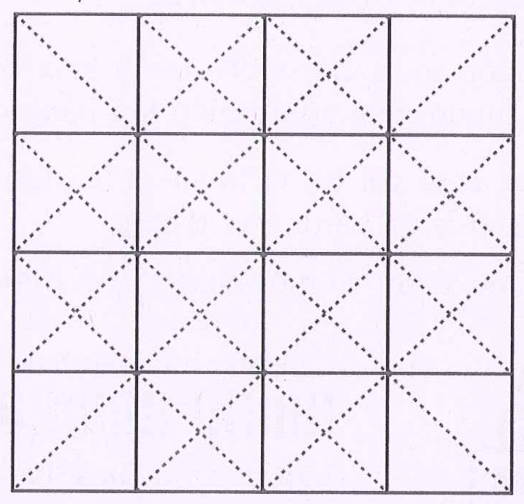
Alex has a garden divided into a $4\times4$ square grid. He wants to choose some cells in which to plant trees, following these three rules:
- At most one tree may be planted in each cell.
- Each row and each column may contain at most one tree.
- Each diagonal shown by a dashed line below may contain at most one cell with a tree.

Question illustration

What is the greatest number of trees Alex can plant, and in how many ways can he do so?
  1. At most 3 trees, in more than 2 ways
  2. At most 4 trees, in exactly one valid arrangement
  3. At most 4 trees, in 2 valid arrangements
  4. At most 4 trees, in more than 2 ways

Question 8

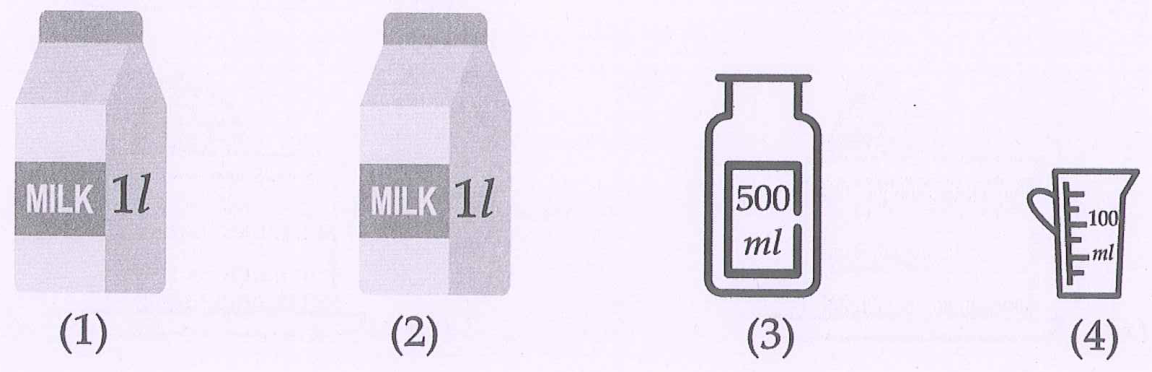
Bruna the beaver has two 1-liter milk cartons, each containing a little more than 500 ml of milk. She wants exactly 700 ml for baking. She also has an empty 500 ml bottle and a 100 ml cup.

Question illustration

We can give the beaver pouring instructions. For example, (2) → (3) means pour milk from carton 2 into bottle 3 until bottle 3 is full or carton 2 is empty. Which instruction sequence below lets Bruna obtain exactly 700 ml of milk in the fewest steps?
  1. (1) → (4); (1) → (3); (1) → (2); (3) → (1); (4) → (1); (2) → (4); (4) → (1)
  2. (1) → (2); (2) → (3); (3) → (4); (4) → (2); (3) → (4); (4) → (2)
  3. (2) → (3); (2) → (1); (3) → (2); (1) → (4); (4) → (2); (1) → (4); (4) → (2)
  4. (1) → (4); (4) → (2); (1) → (4); (4) → (2)

Question 9

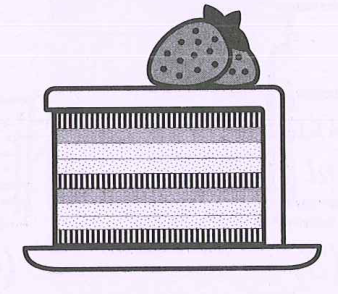
Alex and Julia want to buy a cake for a birthday. The cake they want has alternating layers of biscuit and cream.

The shop has three cream flavors: chocolate, strawberry and vanilla. There are two kinds of biscuit: chocolate and egg biscuits.

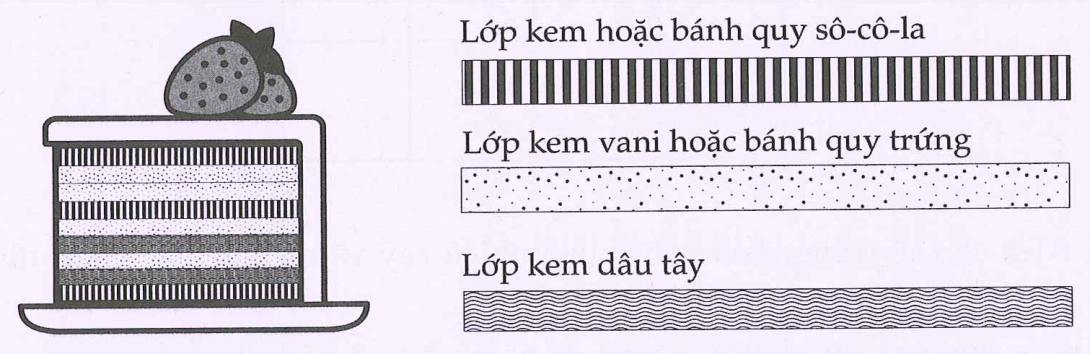
The following figure shows an example of a cake made according to these rules.

Question illustration

Figure legend: chocolate cream or chocolate biscuit; vanilla cream or egg biscuit; strawberry cream.

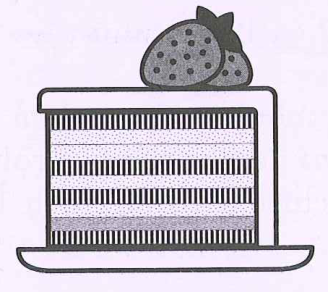
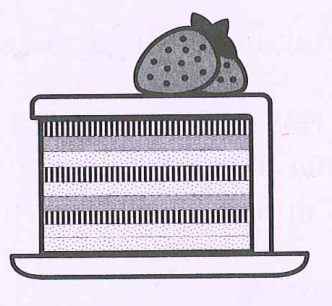
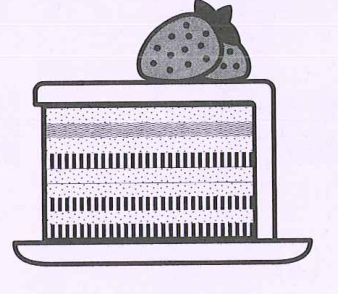
Only four cakes remain in the shop. Because they do not like it, Alex and Julia decide not to buy a cake containing chocolate cream.

Which cake below will they buy?
  1. Question illustration
  2. Question illustration
  3. Question illustration
  4. Question illustration

Question 10

Anna, Bella and Lena the beavers make bracelets representing their names. They use ♥ and ♦ beads to represent letters, and ○ beads to separate letters. Anna and Bella have made the following bracelets:

- Anna:

Question illustration

- Bella:

Question illustration

Which bracelet below belongs to Lena?
  1. Question illustration
  2. Question illustration
  3. Question illustration
  4. Question illustration

Question 11

Beavers use beads to make decorations. To communicate conveniently, they describe these shapes with symbols: S represents a star, T a triangle, R a rectangle and L a line segment.

They have three rules for shortening a description:
- Consecutive identical beads can be shortened by putting their number first. For example, 4S means four consecutive star beads.
- If a group of beads repeats, write the repetition count followed by a description of the group in parentheses.
- Otherwise, simply write the letter representing the bead.

For example, the bead string below can be written as S 3(TR) 3S L. It has 9 characters, ignoring spaces.

Question illustration

What is the smallest number of characters needed to describe the following bead string?

Question illustration
  1. 12
  2. 13
  3. 14
  4. 15

Question 12

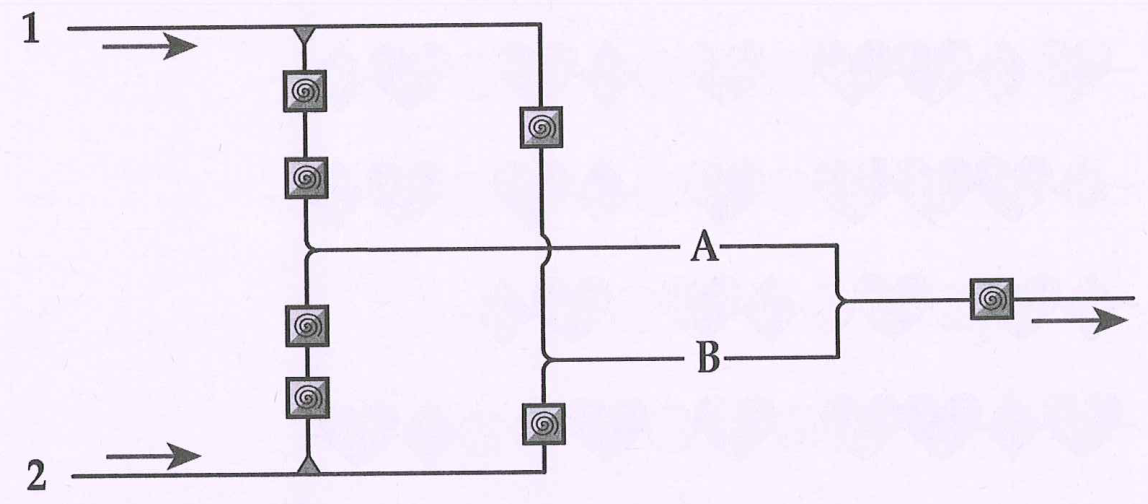
The beavers have an ice-cream machine. Chocolate and strawberry ingredients can be supplied at positions 1 and 2. They flow through the pipes from left to right.

Question illustration

The machine has special devices with the following functions:

Question illustration Question illustration Question illustration

- Spiral device: changes chocolate to strawberry or strawberry to chocolate.
- Triangle device: chocolate passing through it must move in the arrow's direction. Other ingredients continue without changing direction.
- Pipe-crossing symbol: the pipes at this position do not join.

Today, only one kind of ingredient is available, and it is supplied to both pipes 1 and 2. At which of A and B should flavor-changing devices be placed so that the output is chocolate ice cream regardless of which ingredient is supplied?
  1. Position A
  2. Position B
  3. Both A and B
  4. It is impossible using only positions A and B

Question 13

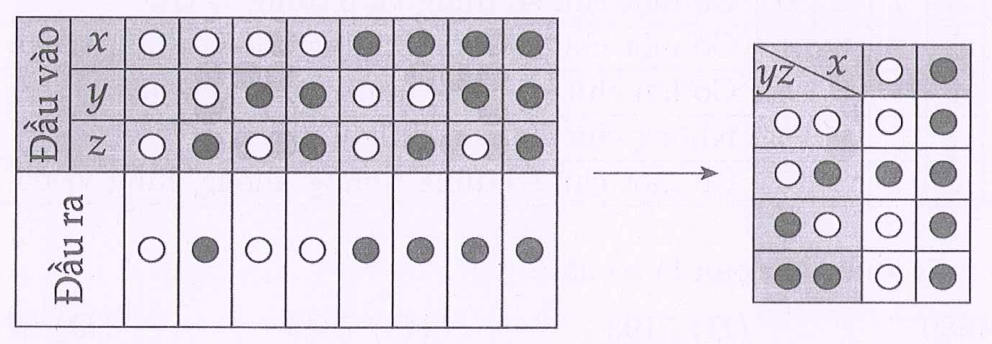
A truth table produces a white or black circle as output based on one or more input values. In the left-hand figure below, a table describes the input values of $x,y,z$ and the corresponding output.

Question illustration

A simpler representation is possible using the table on the right. For example, if input $x$ is black, the output must be black. If $x$ is white and inputs $y-z$ are white–black, the output is black.

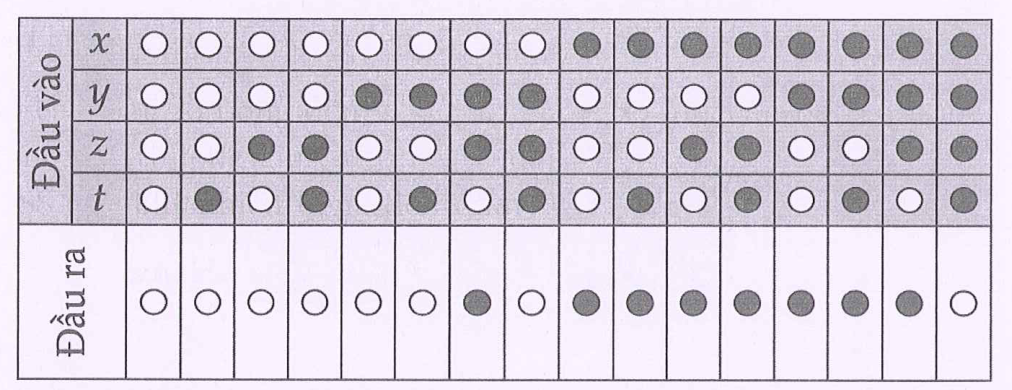
The following table describes inputs $(x,y,z,t)$ and the output.

Question illustration

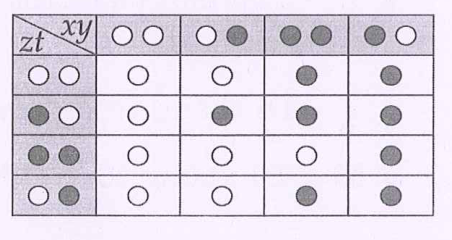
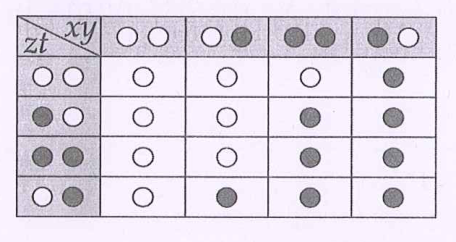
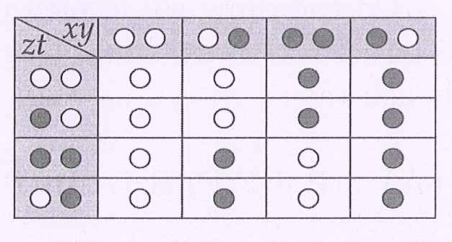
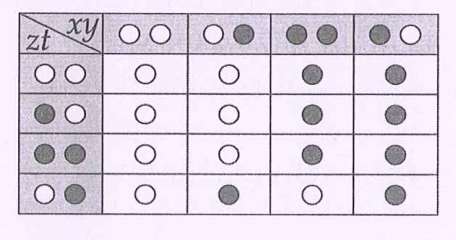
Which simplified table below agrees with the given table?

Editable data: 0 = white circle, 1 = black circle.

Example truth table:

| x | y | z | Output |
|---|---|---|---|
| 0 | 0 | 0 | 0 |
| 0 | 0 | 1 | 1 |
| 0 | 1 | 0 | 0 |
| 0 | 1 | 1 | 0 |
| 1 | 0 | 0 | 1 |
| 1 | 0 | 1 | 1 |
| 1 | 1 | 0 | 1 |
| 1 | 1 | 1 | 1 |

Simplified example:

| yz / x | 0 | 1 |
|---|---|---|
| 00 | 0 | 1 |
| 01 | 1 | 1 |
| 10 | 0 | 1 |
| 11 | 0 | 1 |

Target truth table:

| x | y | z | t | Output |
|---|---|---|---|---|
| 0 | 0 | 0 | 0 | 0 |
| 0 | 0 | 0 | 1 | 0 |
| 0 | 0 | 1 | 0 | 0 |
| 0 | 0 | 1 | 1 | 0 |
| 0 | 1 | 0 | 0 | 0 |
| 0 | 1 | 0 | 1 | 0 |
| 0 | 1 | 1 | 0 | 1 |
| 0 | 1 | 1 | 1 | 0 |
| 1 | 0 | 0 | 0 | 1 |
| 1 | 0 | 0 | 1 | 1 |
| 1 | 0 | 1 | 0 | 1 |
| 1 | 0 | 1 | 1 | 1 |
| 1 | 1 | 0 | 0 | 1 |
| 1 | 1 | 0 | 1 | 1 |
| 1 | 1 | 1 | 0 | 1 |
| 1 | 1 | 1 | 1 | 0 |
  1. Question illustration

    | zt / xy | 00 | 01 | 11 | 10 |
    |---|---|---|---|---|
    | 00 | 0 | 0 | 1 | 1 |
    | 10 | 0 | 0 | 1 | 1 |
    | 11 | 0 | 0 | 1 | 1 |
    | 01 | 0 | 1 | 0 | 1 |
  2. Question illustration

    | zt / xy | 00 | 01 | 11 | 10 |
    |---|---|---|---|---|
    | 00 | 0 | 0 | 1 | 1 |
    | 10 | 0 | 1 | 1 | 1 |
    | 11 | 0 | 0 | 0 | 1 |
    | 01 | 0 | 0 | 1 | 1 |
  3. Question illustration

    | zt / xy | 00 | 01 | 11 | 10 |
    |---|---|---|---|---|
    | 00 | 0 | 0 | 0 | 1 |
    | 10 | 0 | 0 | 1 | 1 |
    | 11 | 0 | 0 | 1 | 1 |
    | 01 | 0 | 1 | 1 | 1 |
  4. Question illustration

    | zt / xy | 00 | 01 | 11 | 10 |
    |---|---|---|---|---|
    | 00 | 0 | 0 | 1 | 1 |
    | 10 | 0 | 0 | 1 | 1 |
    | 11 | 0 | 1 | 0 | 1 |
    | 01 | 0 | 1 | 0 | 1 |

Question 14

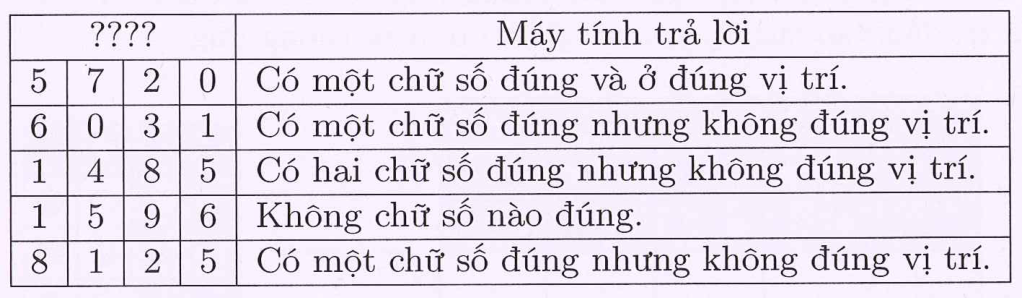
George is playing a number-guessing game with a computer. The computer randomly chooses a four-digit number with distinct digits. George then makes several guesses. For each guess, the computer tells him how many digits it shares with the chosen number and whether they are in the correct positions.

George's guesses and the computer's replies are shown below.

Question illustration

| ???? | Computer reply |
|---|---|
| 5720 | One digit is correct and in the correct position. |
| 6031 | One digit is correct but in the wrong position. |
| 1485 | Two digits are correct but in the wrong positions. |
| 1596 | No digit is correct. |
| 8125 | One digit is correct but in the wrong position. |

Which number did the computer choose?
  1. 4580
  2. 5193
  3. 7845
  4. 3748

Question 15

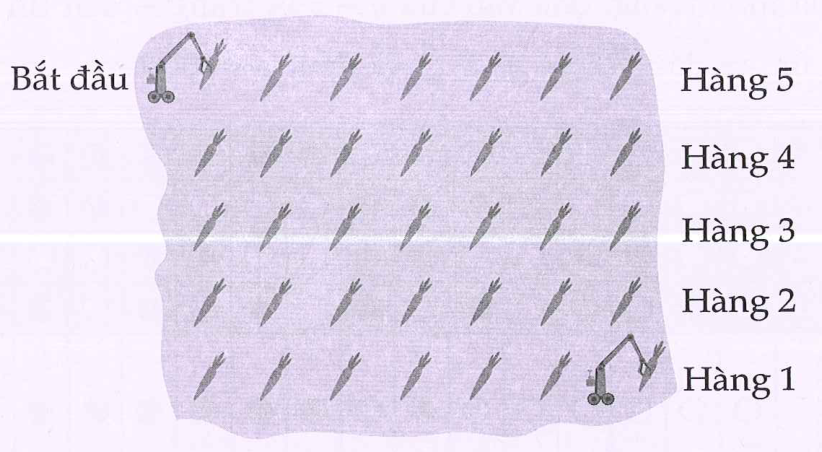
On Beaver Island, carrots grow in 5 rows with 7 carrots in each row, as shown below.

Question illustration

The beavers use a robot to harvest the carrots with these instructions:
- P – Find a carrot in the same row and harvest it.
- F – Go straight along the same row.
- D – Go down to the next row.
- U – Go up to the next row.
- R – Turn right by 90 degrees.
- L – Turn left by 90 degrees.

Numbers can represent repeated instructions. For example, 3P means harvest 3 carrots in the same row. Which of the following instructions can make the robot harvest all the carrots?
  1. 2(P 6(F P) R D R) (P 6(F P) L D L) 7P
  2. R 3(P 4(D P)L F L)(P 4(U P) R F R)
  3. 2(P 6(F P) R D R P 6(F P) L D L) P 6(F P)
  4. 5 (7P D) 7P