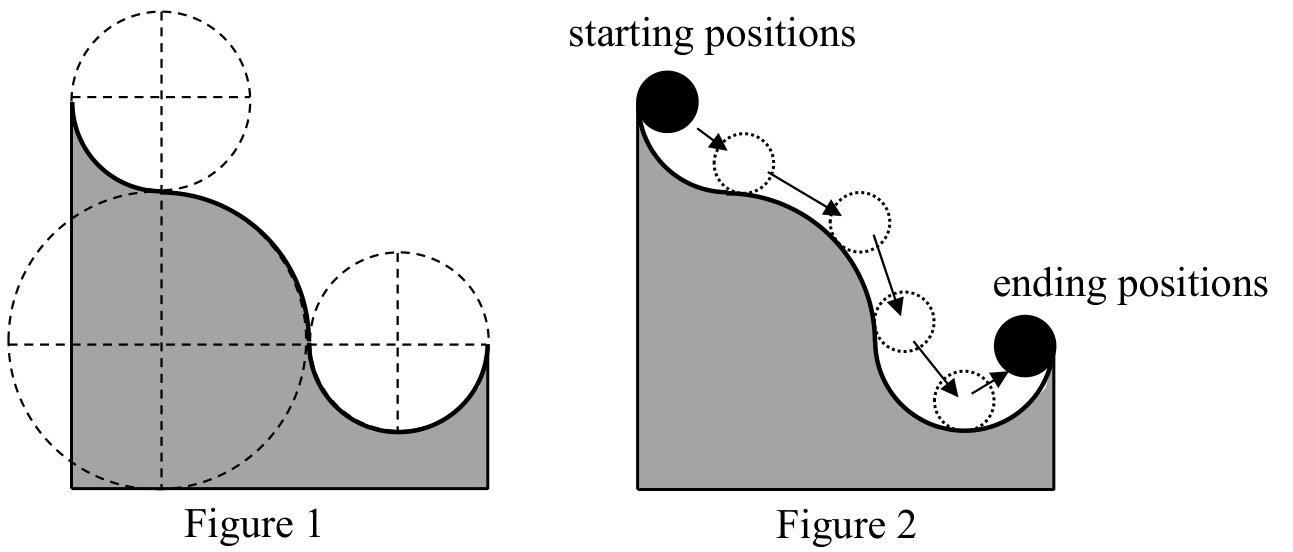
As shown in Figure 1, there are three different slopes which are formed from three mutually tangent circular arcs: a quarter-circle of radius $21$ cm, followed by a quarter-circle of radius $35$ cm, followed by a semicircle of radius $21$ cm. As shown in Figure 2, a disk of radius $7$ cm rolls along the slope from the left endpoint to the right endpoint, without slipping and always remaining tangent to the slope. What is the total area, in $\mathrm{cm}^2$, of the region covered by the disk as it rolls along the slope? (Note: Take $\pi=\frac{22}{7}$.)
Figure 1 is on the left; Figure 2 is on the right. The solid disks mark the starting and ending positions.
Alex begins by writing down the number $100$ on a piece of paper. Starting from the second number onward, each number written on the paper is the sum of the previous number and its largest prime factor. For example, the second number is $100+5=105$ since the largest prime factor of $100$ is $5$, and the third number is $105+7=112$ since the largest prime factor of $105$ is $7$. What is the smallest possible number written by Alex that is greater than or equal to $2026$?
A palindrome is a word that is spelled the same forwards and backwards. When using the letters from the word NAADAM, nine different palindromes can be formed, which are:
A, D, M, N, AA, AAA, ADA, AMA, ANA.
How many different palindromes can be formed by using the $11$ letters of MONGOLIA IMC?
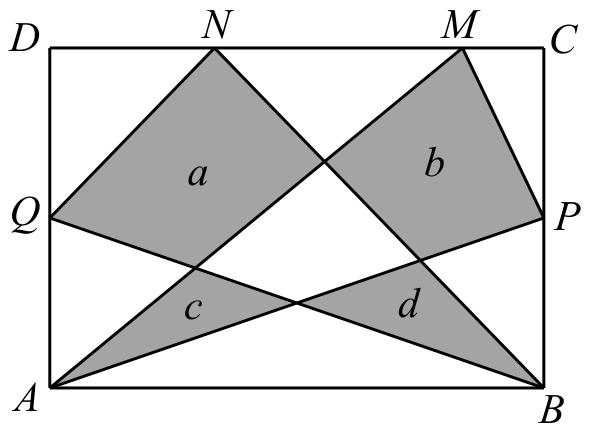
As shown in the diagram below, the area of rectangle $ABCD$ is $408\ \mathrm{cm}^2$. Points $M$ and $N$ lie on side $CD$, such that $DN:NM:MC=2:3:1$. Points $P$ and $Q$ are the midpoints of sides $BC$ and $AD$, respectively. If the areas of the four shaded regions are $a$, $b$, $c$ and $d\ \mathrm{cm}^2$, respectively, what is the value of $(a+d)-(b+c)$?
Let $A$, $B$, $C$ and $D$ be four distinct positive integers such that
$$\frac1A+\frac1B+\frac1C+\frac1D=\frac{21}{22}.$$
What are all possible values of $A+B+C+D$?
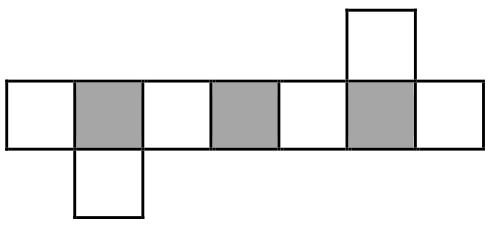
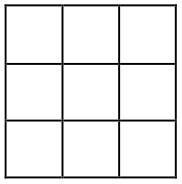
Place the digits $1,2,3,4,5,6,7,8,9$ into each of the nine squares shown in the diagram below, using each digit exactly once.
The digit in each shaded square must be at least $3$ greater than the digit in every square sharing a side with it.
For example, if a shaded square contains the digit $9$, all squares sharing a side with it may contain any of the digits $1,2,3,4,5$ or $6$ but not $7$ or $8$.
In how many ways can the digits be placed in the diagram?
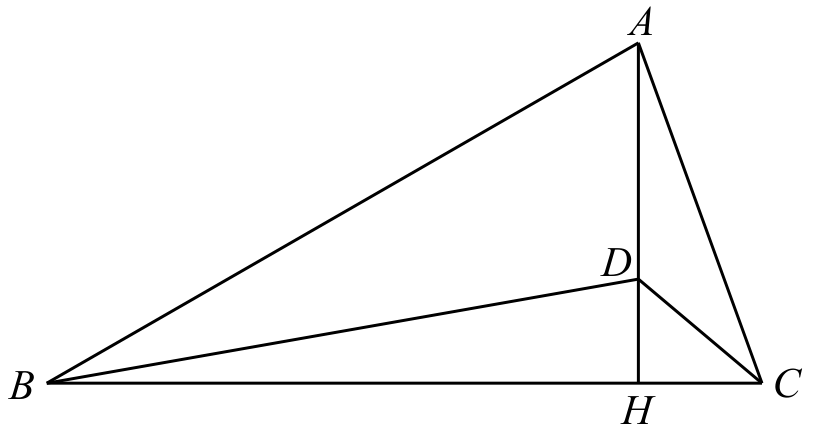
As shown in the diagram below, triangle $ABC$ is acute and $AH$ is the altitude from $A$ to side $BC$. Point $D$ lies on segment $AH$, where $\angle DBA=\angle DAC=20^\circ$ and $\angle DBC=10^\circ$. What is the measure, in degrees, of $\angle DCB$?
A Mongolian yak herdsman manages two different grazing areas: Pasture A and Pasture B. In each pasture, the grass grows at a constant daily rate, although the growth rates may differ between the two pastures. Each yak consumes grass at the same constant rate.
Through years of experience, the herdsman has made the following observations:
For Pasture A:
- $29$ yaks can completely consume all the grass in exactly $7$ days,
- $17$ yaks can completely consume all the grass in exactly $28$ days.
For Pasture B:
- $41$ yaks can completely consume all the grass in exactly $6$ days,
- $21$ yaks can completely consume all the grass in exactly $26$ days.
The herdsman currently owns $32$ yaks, all of which must graze every day. On any given day, he may divide the yaks between the two pastures in any way he chooses, and the allocation of yaks may vary from day to day.
What is the maximum number of days the $32$ yaks can continue grazing before the grass in both pastures is completely consumed?