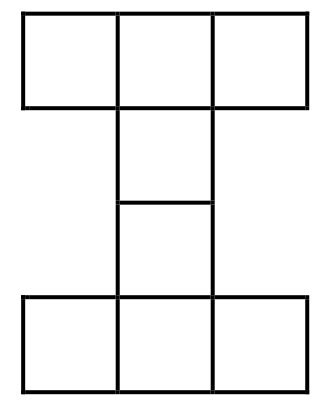
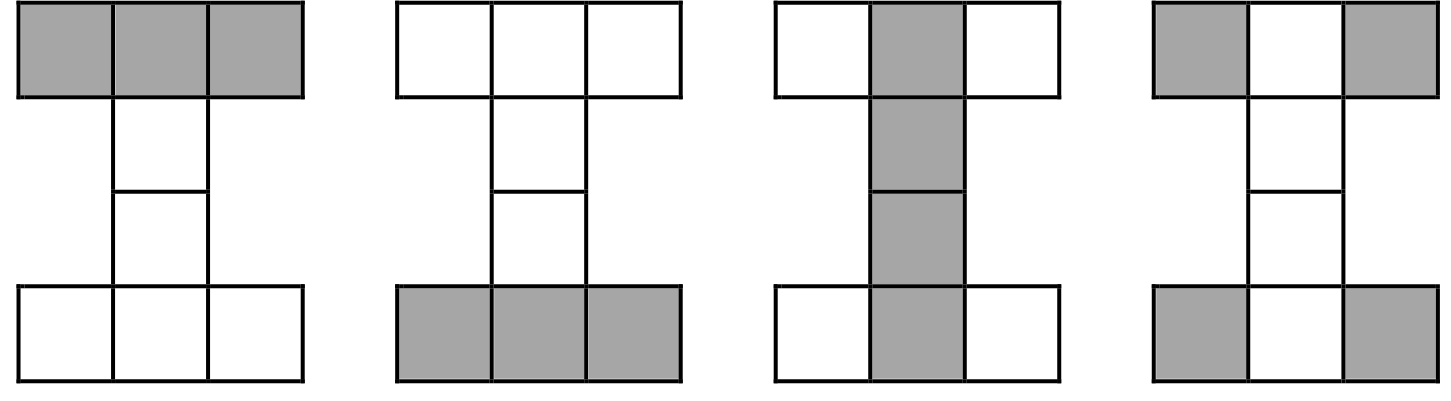
Each square is filled with exactly one number from the following eight numbers $-1,-1,-1,0,0,1,1,1$ such that the sum of the numbers in each of the rows, column and four corners are all the same. How many ways are there to fill the diagram?
Let $x$ and $y$ be real numbers such that:
$$\begin{cases}x^2+5xy+y^2=7,\\x^2y+xy^2=2,\\x+y\ne2.\end{cases}$$
Find all possible values of $x^2+y^2$. Show your full solution.
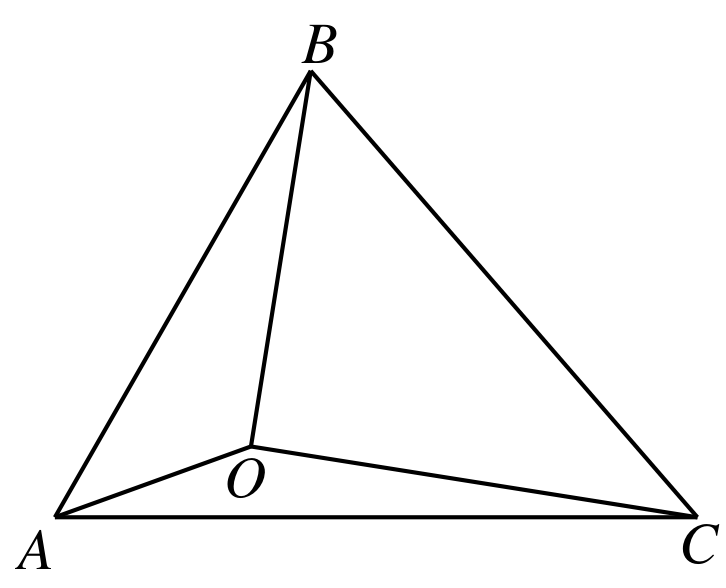
Let $ABC$ be a triangle and $O$ be a point in its interior such that $\angle ABO=\angle CAO$, $\angle BAO=\angle BCO$ and $\angle BOC=90^\circ$, as shown in the diagram below. If $AC=2$ cm, then find the length, in cm, of $OC$.
Find all four-digit integers $m$ that are less than $2021$ for which there exists a positive integer $n$ such that $m-n$ is a positive prime number and $m\times n$ is a perfect square. Show your full solution.
Points $A_1,A_2,\ldots,A_{100}$ are on a line, in this order, such that $A_1A_2=\frac1{1\times2}$ cm, $A_2A_3=\frac1{2\times3}$ cm, $A_3A_4=\frac1{3\times4}$ cm, ..., $A_{99}A_{100}=\frac1{99\times100}$ cm. If the segment $A_mA_n$, where $1\leq m<n\leq100$, has a length of $\frac1{15}$ cm, then what is the largest possible value of $m+n$ that satisfies the given conditions?
Using four different colours, in how many ways can we paint the integers $1,2,3,\ldots,10$ such that every pair of integers whose difference is a prime number must have different colours?
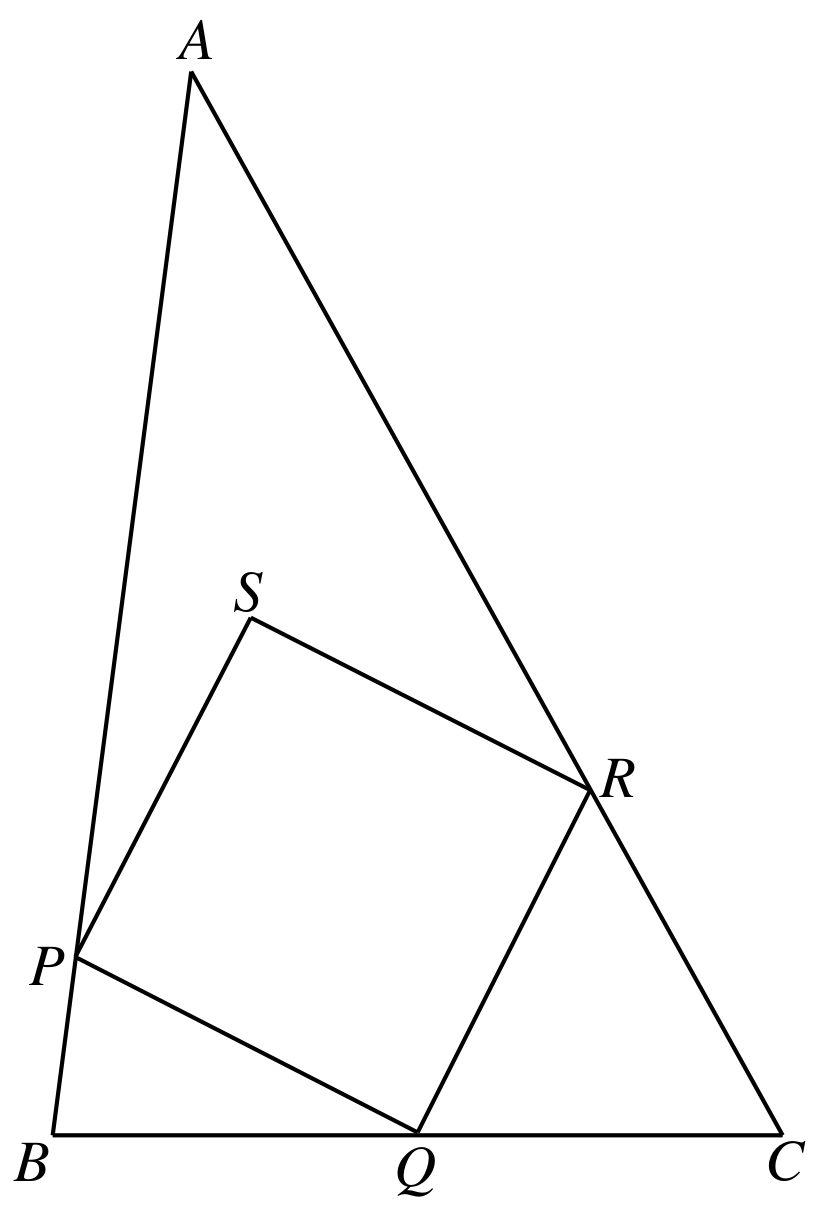
In the diagram below, $ABC$ is a triangle where $AB=60$ cm and $AC=68$ cm. $PQRS$ is a square where $AP=50$ cm, $AR=46$ cm and $Q$ is the mid-point of $BC$. What is the ratio of the area of $PQRS$ to the area of $ABC$?
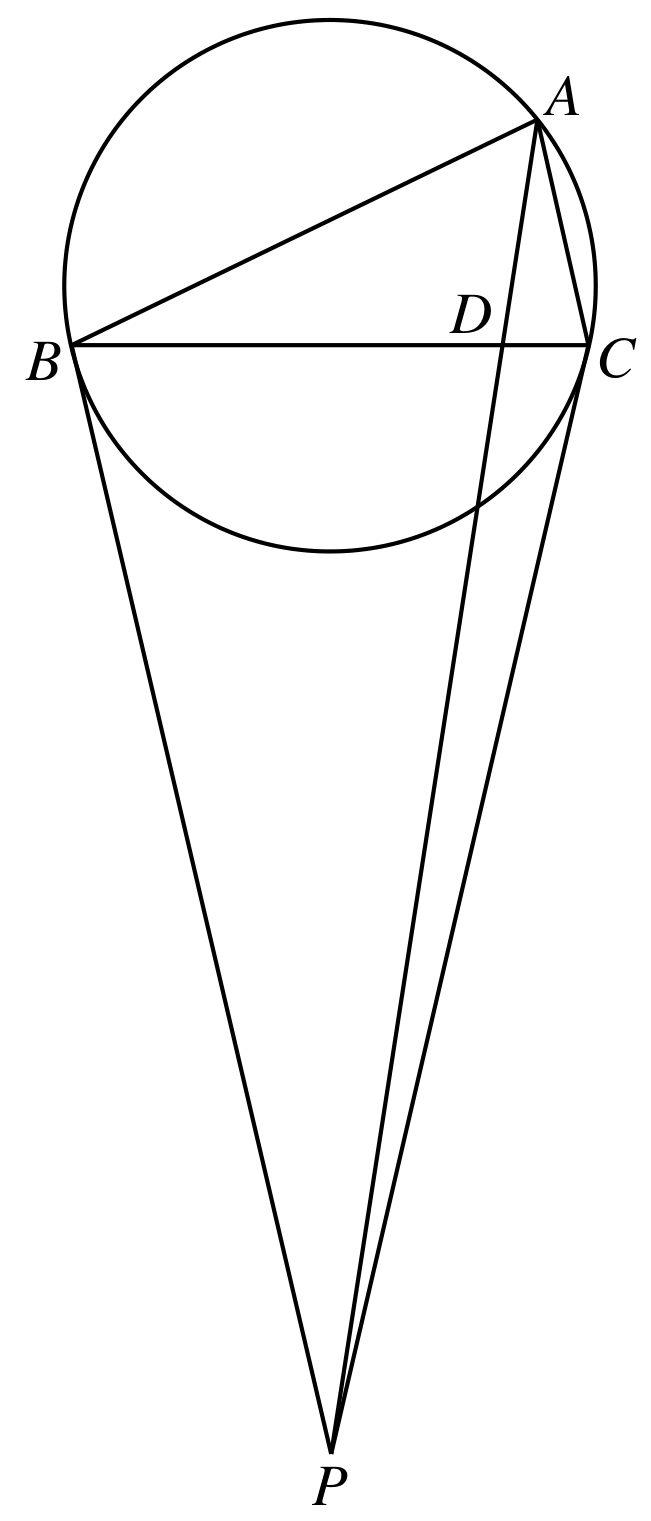
Let triangle $ABC$ be an acute triangle inscribed inside circle $O$. Let $P$ be a point outside $O$ such that $PB$ and $PC$ are both tangent to $O$. If $AP$ and $BC$ intersect at $D$ and $\frac{BD}{CD}=5$, then what is the value of $\frac{AB}{AC}$?
In how many different ways can we express $2021$ as a sum using the numbers $1,2,4,8,16,32,64,128,256,512,1024$, where it is only allowed to have up to two occurrences of any of these eleven numbers? The order of summation does not matter. For example, $2+1+1$ and $1+2+1$ are considered the same way to express $4$. Show your full solution.