The numbers $1,2,3,\ldots,20$ are written in a line, in some random order. If there are $18$ sums that are obtained by adding each number (except first number and last number) with both its neighboring numbers (that is three consecutive numbers), what is the largest possible number of odd sums that could be obtained?
Monika has $5$ different kinds of tiles, called tetrominoes, which look like this:
Each tile is composed of four identical squares with side length of $1$ cm. Using the same number of tiles of each kind, Monika wants to form a rectangle. What is the smallest possible perimeter, in cm, of the rectangle?
Two digits are to be added to the number $2021$, one on the left and one on the right, to form a six-digit number $N$. For example, we obtain the number $820219$ if we add $8$ to the left and $9$ to the right. If we know that $N$ is a multiple of $28$, what is the smallest possible value of the sum of the digits of $N$?
A fraction is in its simplest form. If $22$ is added to its numerator, then the fraction becomes $\frac{1}{47}$. If $5$ is subtracted from its denominator, then the fraction becomes $\frac{1}{96}$. What is the value of the original fraction?
Town $A$ and Town $B$ are connected by a single road. A red bus departs from Town $A$ at 6:20 am and arrives in Town $B$ at 11:50 am. A blue bus departs from Town $B$ at 3:35 am and arrives in Town $A$ at 9:20 am. If each bus moves at a constant speed without stopping, at what time will the two buses meet?
A nature photographer is walking through the jungle when she sees a rare fox that is $100$ meters away. Immediately, the fox starts running away from the photographer at a speed of $6$ meters per second, while the photographer starts running towards the fox at a speed of $10$ meters per second.
The photographer can stop and get out her camera at any time, but it will take her $5$ seconds after stopping to set up her camera and take a photo (during which the fox will continue running). If she must be within $50$ meters of the fox when she takes the photo to get a good shot, then what is the shortest amount of time, in seconds, after which she can take a good photo of the fox?
A tour group of $48$ members are about to check-in at a hotel. Apart from the $5$ rooms that are booked by a different party, all the other rooms were vacant. By taking all the remaining rooms, it was possible to assign no more than $5$ members in any room. Suddenly, the other party cancelled their booking and the $5$ rooms are now made available to the group. However, it was still necessary to assign at least $4$ members in some room(s). How many rooms did the hotel have altogether?
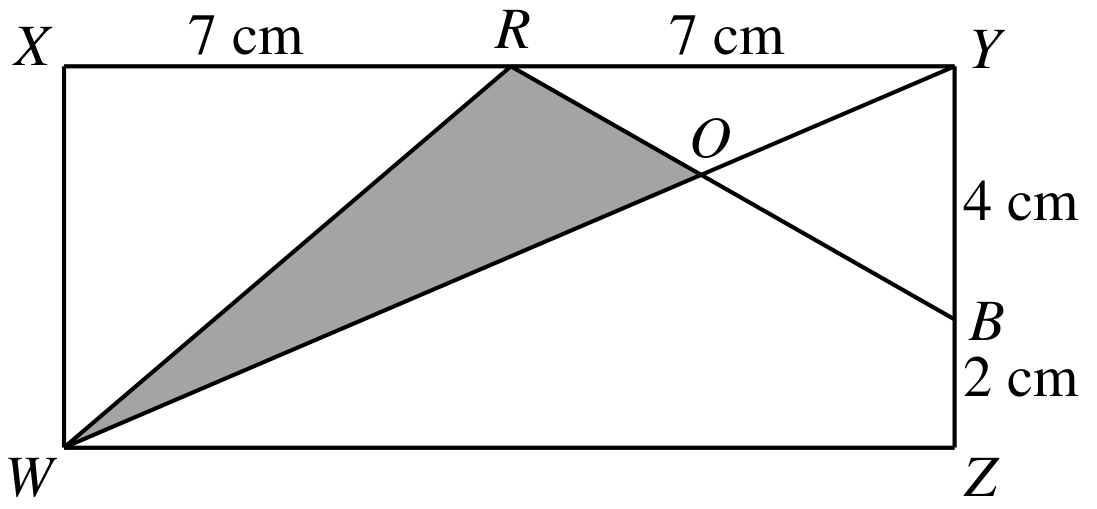
In the diagram below, $WXYZ$ is a rectangle where point $R$ is on $XY$ such that $XR=RY=7$ cm and point $B$ is on $YZ$ such that $YB=4$ cm and $BZ=2$ cm. If point $O$ is the intersection of $RB$ and $YW$, then what is the area, in $\mathrm{cm}^2$, of triangle $ROW$?
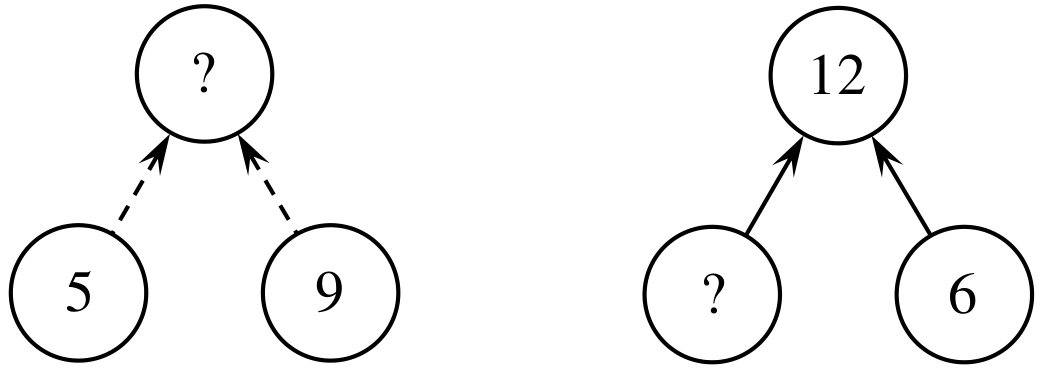
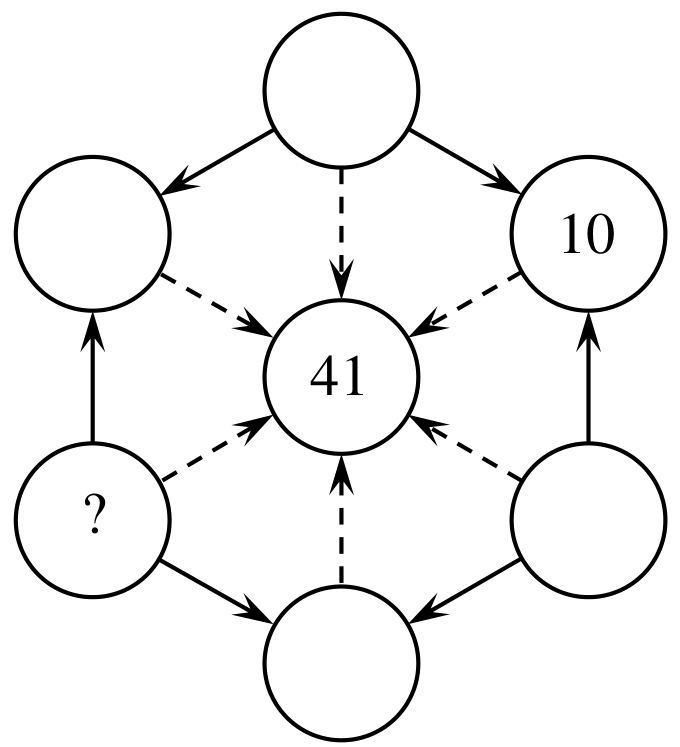
The puzzle below is composed of circles and arrows. A dashed arrow indicates addition, while a solid arrow indicates multiplication. For example, the solution to the diagram on the left is a number whose sum is $5+9$, which is $14$. The solution to the diagram on the right is a number that, when multiplied by $6$, gives us $12$, which by working backwards, leads us to a solution of $2$. Note that there could be more than $2$ arrows pointing to a circle, in which case there is one operation (addition or multiplication) with more than $2$ numbers involved.
In the following puzzle below, if all the circles must contain positive integers, what number must be placed in the circle with the question mark?
The number “$11$” has a curious property where it can be expressed as the sum of a positive integer power of $2$ and a positive integer power of $3$ in two different ways, namely $11=2^3+3^1=8+3$ and $11=2^1+3^2=2+9$.
What is the smallest three-digit integer that has this curious property?
(Note: the positive integer powers of $2$ are $2^1=2$, $2^2=4$, $2^3=8$, $\ldots$, while the positive integer powers of $3$ are $3^1=3$, $3^2=9$, $3^3=27$, $\ldots$.)
A $24\times60$ rectangle is divided into unit squares by drawing the grid lines. If one of its diagonals is also drawn into the figure, then how many parts will the resulting figure have?
There are $55$ students that participated in a math competition which has rules that state that every participant gets a “※” for each correct answer, a “☆” for each incorrect answer and a “○” for each unanswered problem. Assuming no two participants have the same number of “※”s as well as the same number of “☆”s, what is the minimum number of problems that this competition can have?
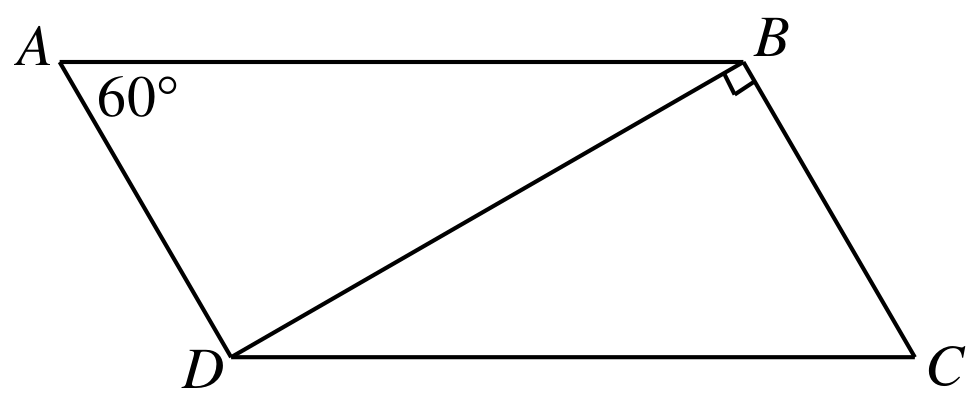
In the diagram below, $ABCD$ is a parallelogram where its perimeter is $54$ cm, $\angle DAB=60^\circ$ and $\angle DBC=90^\circ$. What is the length, in cm, of $AB$?
A regular $n$-gon $A_1A_2A_3\ldots A_n$ is inscribed in a circle with centre $O$. If $\angle A_1OA_{16}=135^\circ$, what is the sum of all the possible values of $n$?
Starting from a positive integer $I$, we first re-arrange its digits and then subtract $1$ from it to get $M$. Now, we again re-arrange the digits of $M$ and add $1$ to it to get $C$. For example, if $I=2358$, we may have $C=2259$, $2358$ and $4284$ among other values. How many different integers $C$ can be obtained if $I=2267$?