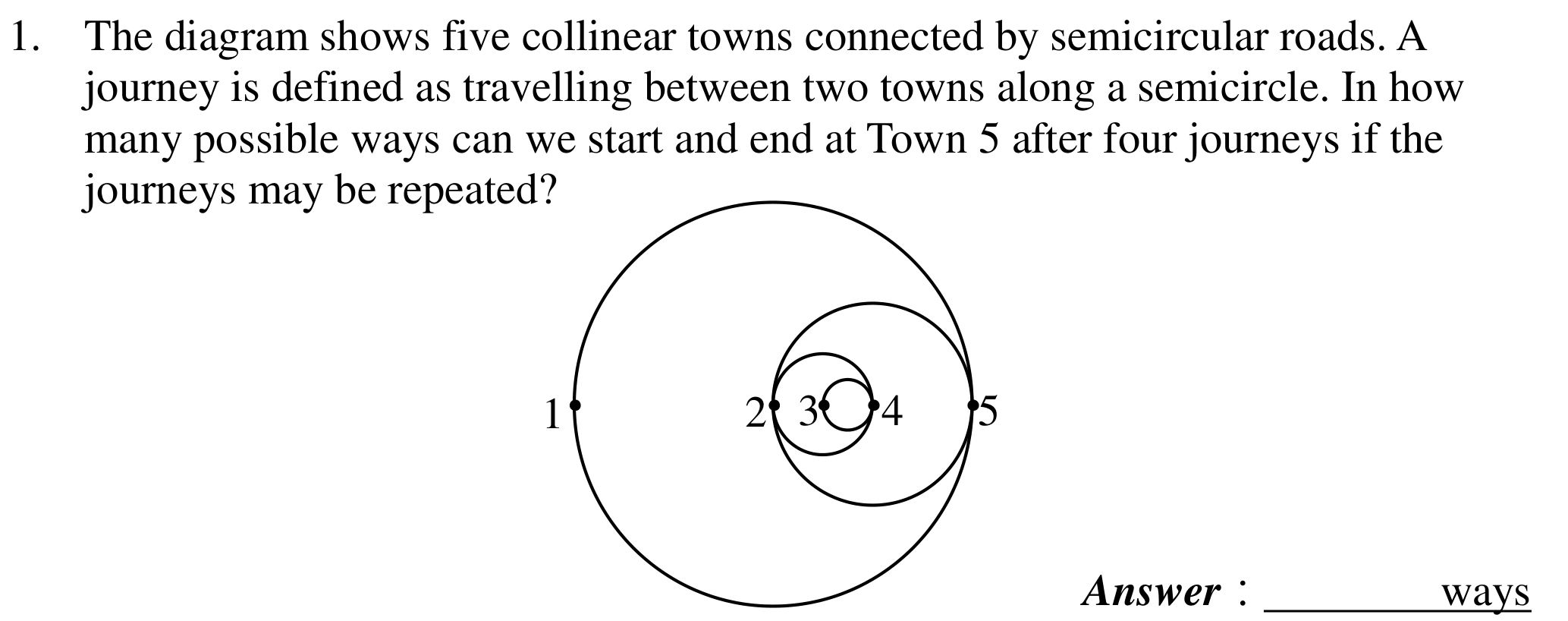
The diagram shows five collinear towns connected by semicircular roads. A journey is defined as travelling between two towns along a semicircle. In how many possible ways can we start and end at Town 5 after four journeys if the journeys may be repeated?
Ann tosses a fair coin twice while Bob tosses the same coin three times. The probability that they obtain the same number of heads at the end of the game is expressed as an irreducible fraction. What is the sum of its numerator and its denominator?
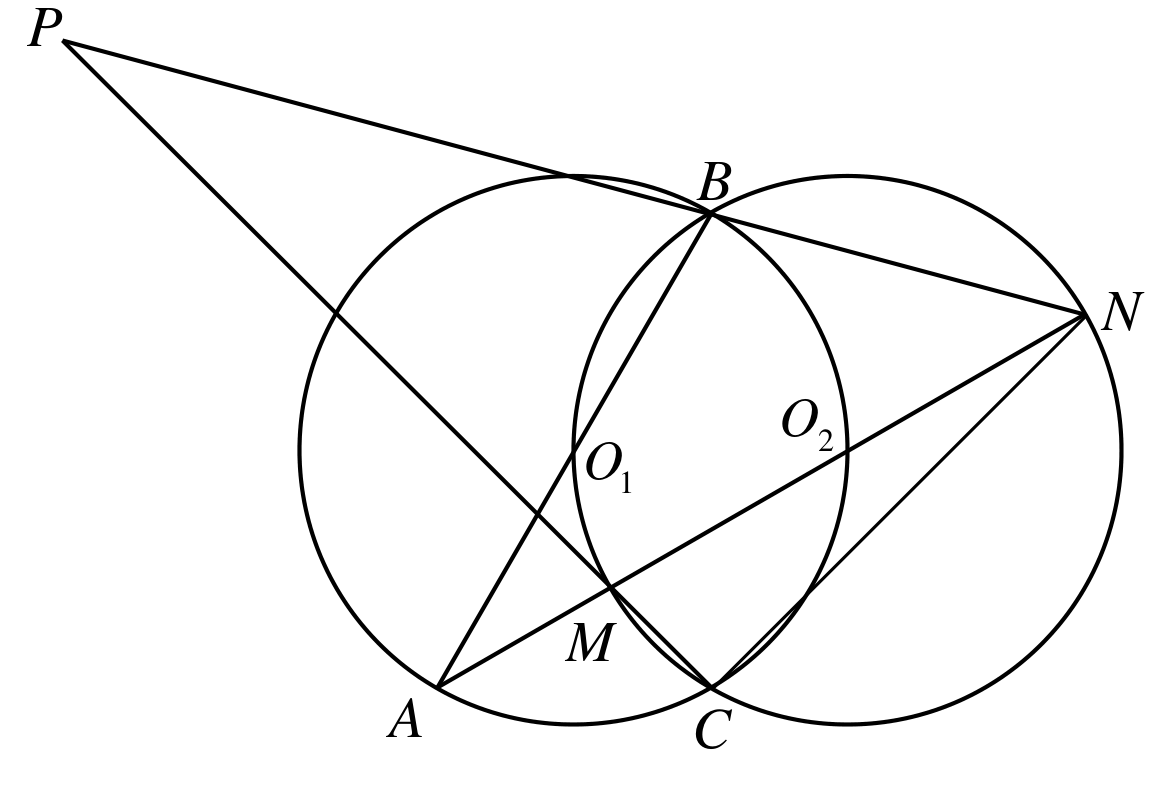
Two circles $k_1$ and $k_2$ with the same radius intersect at points $B$ and $C$. The center $O_1$ of $k_1$ lies on $k_2$ and the center $O_2$ of $k_2$ lies on $k_1$. $AB$ is a diameter of $k_1$, and $AO_2$ intersects $k_2$ at points $M$ and $N$, with $M$ between $A$ and $O_2$. The extensions of $CM$ and $NB$ intersect at point $P$. Find $CP:CN$.
Answer: ______ : ______
Entry format: enter an exact ratio, using sqrt(...) for a square root.
Let $P(x)=x^4+ax^3+bx^2+cx+d$, where $a,b,c$ and $d$ are real constants. Suppose $P(1)=7$, $P(2)=52$ and $P(3)=97$. Find the value of $\dfrac{P(9)+P(-5)}4$.
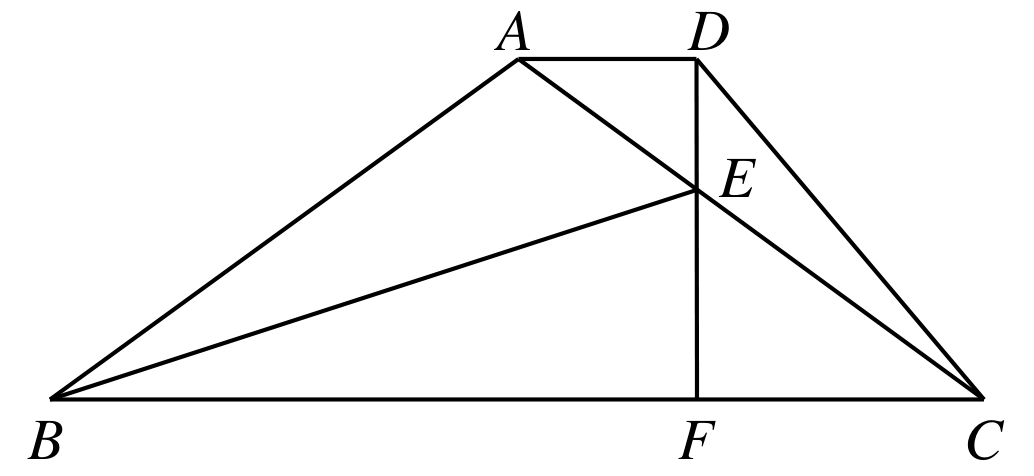
In quadrilateral $ABCD$, $AD$ is parallel to $BC$ and $AB=AC$. $F$ is a point on $BC$ such that $DF$ is perpendicular to $BC$. $AC$ intersects $DF$ at $E$. If $BE=2DF$ and $BE$ bisects $\angle ABC$, find the measure, in degrees, of $\angle BAD$.
Arrange the numbers 1, 2, 3, 4, 5, 6 and 7 in a row such that none of the first number, the sum of the first two numbers, the sum of the first three numbers, and so on, up to the sum of all seven numbers, is divisible by 3. In how many ways can this be done?
An equilateral triangle and a regular 7-sided polygon are inscribed in the same circle of circumference 84 cm, divided by the vertices into ten arcs. What is the maximum possible length, in cm, of the shortest arc?
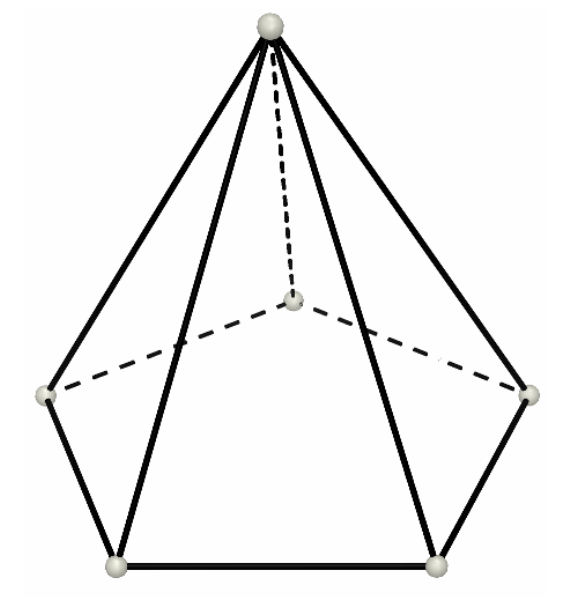
In how many ways can you paint the six vertices of a regular pentagonal pyramid using at most six different colours, such that two vertices connected by an edge have different colours? If the result of one way of painting may be obtained by rotation from the result of another way of painting, only one of them will be counted.
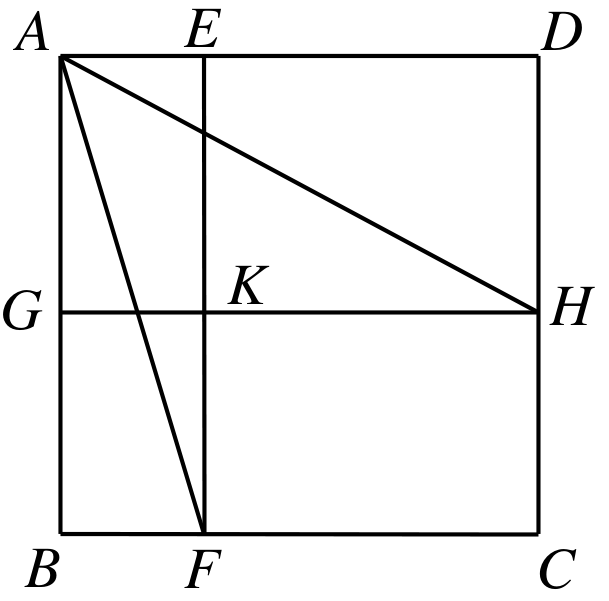
Let $ABCD$ be a square. $E$ and $F$ are points on $AD$ and $BC$ respectively such that $EF\parallel AB$. $G$ and $H$ are points on $AB$ and $DC$ respectively such that $GH\parallel AD$. $EF$ and $GH$ intersect at $K$. If the area of $KFCH$ is equal to twice that of $AGKE$, find the measure, in degrees, of $\angle FAH$.