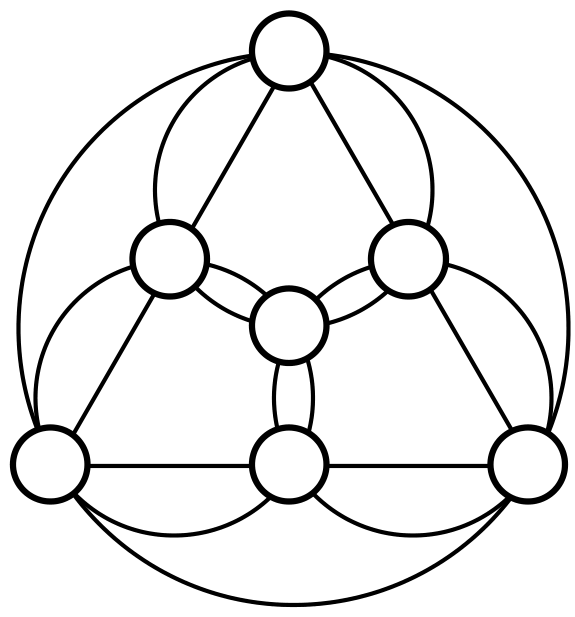
Suppose we want to insert the integers $1$ through $7$ into the $7$ little circles in the diagram below in such a way that the sum of the numbers written on each of the circumferences of the large and mid-sized circles equals a multiple of $6$. What is the number to be inserted into the small circle in the center?
All digits of the positive integer $a$ are distinct. The number $b$ is obtained from $a$ by rearranging its digits. If every digit of the difference $a-b$ is a $1$, what is the largest value of this difference?
The largest of $21$ distinct integers is $2015$ and one of the other numbers is $101$. The sum of any $11$ of them is greater than the sum of the other $10$. Find the middle number, that is, the one which is greater than $10$ others and smaller than the remaining $10$.
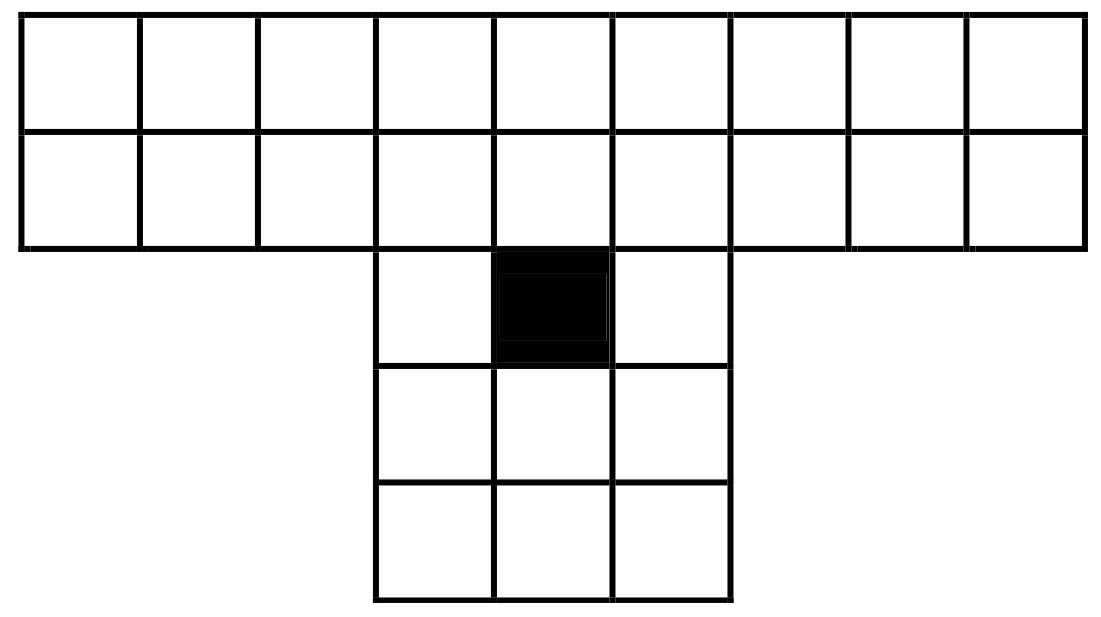
The diagram below consists of $26$ squares around a black hole. How many different rectangles are there which consist of some of these $26$ squares? The black hole must not be a part of any rectangle.
Some potatoes are being transported from the farm by a truck at a speed of $65$ kph while the rest are being transported by an ox-cart at a speed at $5$ kph. After a while, a horse-cart with speed $13$ kph takes the potatoes off the truck, allowing the truck to go back and take the potatoes from the ox-cart. The transfer of potatoes from the ox-cart into the truck takes no time. The horse-cart and the truck arrive simultaneously in the city, which is $100$ km from the farm. For how many hours have the potatoes been on the road?
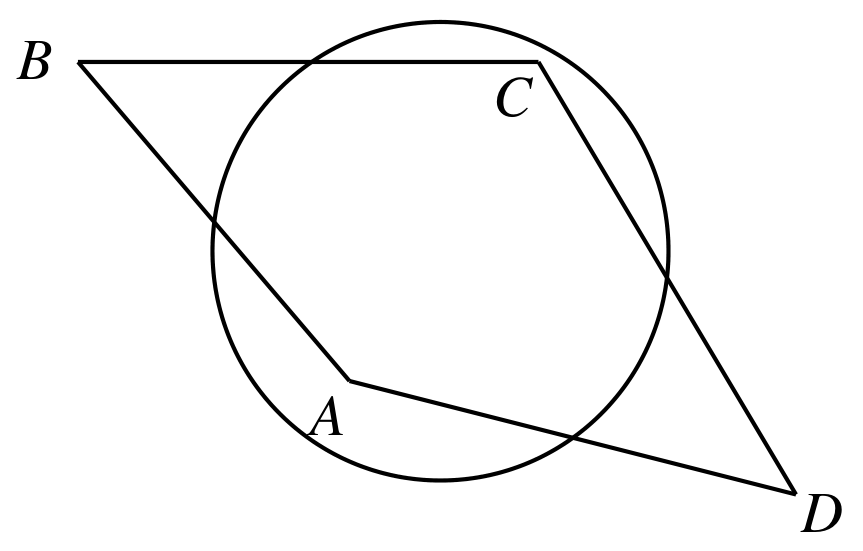
The midpoints of the sides $AB$, $BC$, $CD$, $DA$ of a convex quadrilateral $ABCD$ lie on the same circle. If $AB=10$ cm, $BC=11$ cm and $CD=12$ cm, determine, in cm, the length of the side $DA$.
Answer-entry note: give an exact value; a square root may be entered as sqrt(...), without units.
The three two-digit numbers $\overline{ab}$, $\overline{cd}$ and $\overline{ad}$ are such that $(\overline{ab})^2+(\overline{cd})^2=(\overline{ad})^2$. Find the minimum value of the four-digit number $\overline{abcd}$.
Each $1\times1$ tile has a red side opposite a yellow side, and a blue side opposite a green side. An $8\times8$ chessboard is formed from $64$ of these tiles, which may be turned around or turned over. When two tiles meet, the edges that come together must be of the same colour. How many different chessboards can be formed? Turning the chessboard around or turning the chessboard over is not allowed.
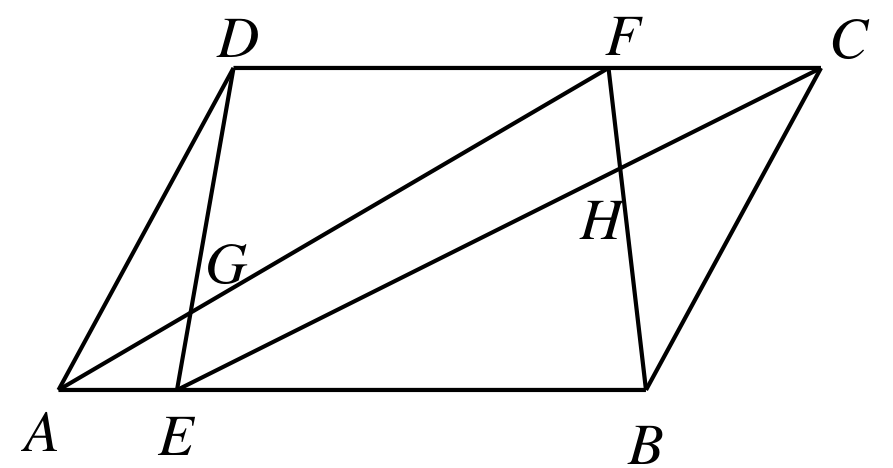
$ABCD$ is a parallelogram. $E$ is a point on the segment $AB$ such that $\frac{AE}{EB}=\frac14$. $F$ is a point on the segment $DC$, $AF$ and $DE$ intersect at $G$, while $CE$ and $BF$ intersect at $H$. If the area of $ABCD$ is $1$ cm$^2$ and the area of triangle $BHC$ is $\frac18$ cm$^2$, find the area, in cm$^2$, of triangle $ADG$.
Five different positive integers are such that if we take any two of them, possibly the same number twice, exactly nine different sums may be obtained. Find the largest positive integer which can divide the sum of any five such numbers.
A number consists of three distinct digits chosen at random from $1,2,3,4,5,6,7,8$ and $9$ and then arranged in descending order. A second number is constructed in the same way except that the digit $9$ may not be used. What is the probability that the first number is strictly greater than the second number?
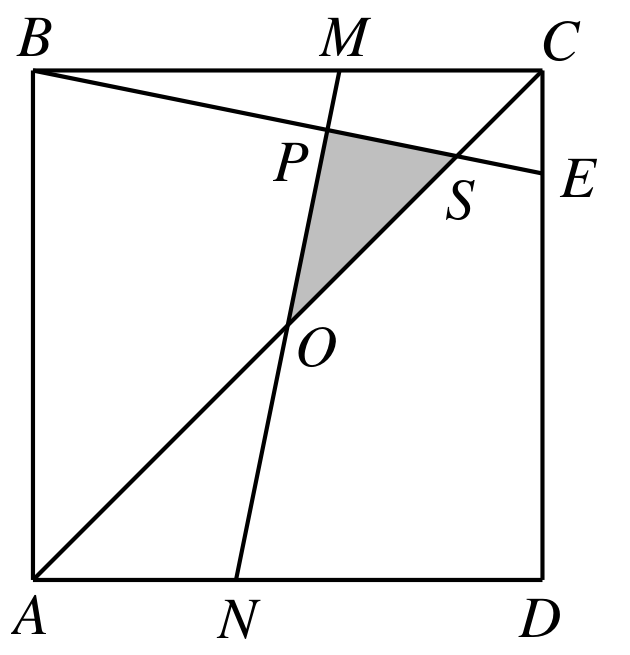
$E$ and $N$ are points on the sides $DC$ and $DA$ of the square $ABCD$ such that $AN:ND:DE=2:3:4$. The line through $N$ perpendicular to $BE$ cuts $BE$ at $P$ and $BC$ at $M$. $AC$ cuts $MN$ at $O$ and $BE$ at point $S$. What fraction of the area of $ABCD$ is the area of triangle $OPS$?