Clockwise tolls on a circular highway are bridge $1$, tunnel $3$, dam $5$ dollars. Starting between dam and bridge, a car drives clockwise until it has paid $130$. What is the next toll?
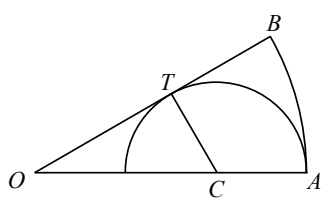
Sector $OAB$ has $OA=OB$ and angle $30^\circ$. A semicircle through $A$ has centre $C$ on $OA$ and is tangent to $OB$ at $T$. Find semicircle-area : sector-area.
Each girl has one or two mutual friends. In the morning, two-friend girls wear red and one-friend girls blue; every friend pair has opposite colours. Ten red girls change to blue and twelve blue girls to red, once each. Now every friend pair has the same colour. How many girls are there?
The shown lattice has $7\times7$ dots at unit spacing. Four congruent squares have vertices among the dots and no two share even a point. Find the maximum area of one square in cm$^2$.
Contestants sit on a $6\times6$ grid. Neighbours are adjacent horizontally, vertically or diagonally. A contestant wins a prize if at most one neighbour has score greater than or equal to theirs. Find the maximum number of winners.
Every student from schools A and B earns gold, silver or bronze. Gold counts are equal; gold percentages A:B are $5:6$. Silver counts A:B are $9:2$ and silver medalists are $20\%$ of the combined students. Half of A earn bronze. What percentage of B earns gold?
Start from $5/6$. Each move either adds $6$ to the numerator or adds $5$ to the denominator, not both. What is the minimum positive number of moves restoring value $5/6$?
Five consecutive two-digit numbers have some three summing to a multiple of $37$, and some three summing to a multiple of $71$. Find the largest of the five.
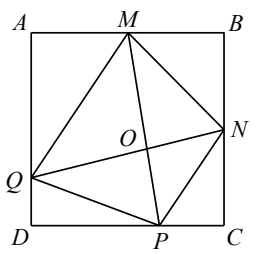
In square $ABCD$, $M,N$ are midpoints of $AB,BC$. On $CD$, $CP=4$, $PD=8$ cm; on $DA$, $DQ=3$ cm. Lines $MP,NQ$ meet at $O$. Find the largest absolute area difference among pairs $(QOM,QAM),(MON,MBN),(NOP,NCP),(POQ,PDQ)$.
Just before Carol\'s birth, Eric\'s age equalled the sum of Alice, Ben, Debra ages; the four averaged $19$. In $2010$, Debra was $8$ older than Ben and Carol combined and all five averaged $35.2$. In $2012$, Ben, Carol, Debra, Eric averaged $39.5$. Find Ben\'s age in $2012$.