Peter donates $144$ books to four schools A, B, C, D. Their pairwise differences satisfy $|A-B|=4$, $|B-C|=3$, $|C-D|=2$. A receives the most books, fewer than $40$. (a) How many valid allocations to B and D are possible? (b) How many books do B and D receive?
Quadrilateral $ABCD$ has area $6174\text{ cm}^2$. E and F are the midpoints of $AB$ and $CD$. G lies on $BC$ with $CG=2GB$, and H lies on $AD$ with $AH=2HD$. Find $[EGFH]$.
Alloy M contains $95\%$ bronze, $4\%$ tin and $1\%$ zinc. Alloy N contains only bronze and tin. The source says M and N are mixed “in equal proportion”; the result contains $86\%$ bronze, $13.6\%$ tin and $0.4\%$ zinc. Find the percentage of bronze in N. (An alloy is a mixture of metals.)
An uncovered water tank holds $43.12\text{ m}^3$, with inner diameter $2.8$ m and uniform wall and base thickness $10$ cm. Painting costs $80$ baht per square metre. Find the cost of painting the total surface area, including every surface. Use $\pi=22/7$ and round to two decimal places.
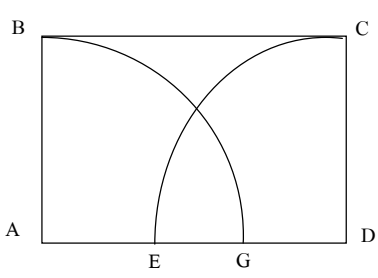
$ABCD$ is a rectangle with $AB=4$ cm. Its area equals the area of a semicircle of radius $AB$. The original figure contains arcs of radius $AB$ centred at A and D, meeting $AD$ at G and E respectively. Find $EG$, using $\pi=3.14$.
A box has $12$ differently coloured crayons, exactly one black. In how many ways can a teacher give a student a selection containing the black crayon? The student may receive from $1$ to $12$ crayons.