In triangle $ABC$, $BC=1$ cm, $\angle A=30^\circ$, $\angle C=90^\circ$. Find and justify the maximum area in cm$^2$ of an equilateral triangle whose vertices lie on the sides of $ABC$.
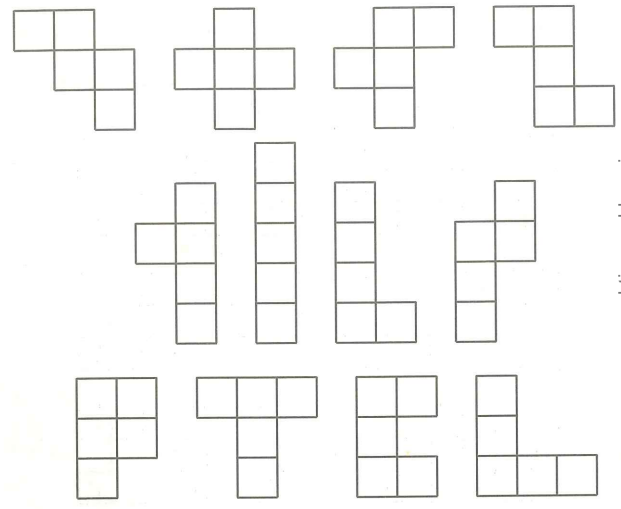
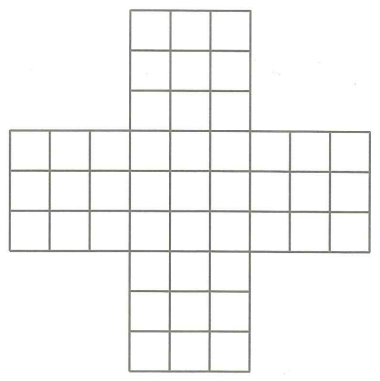
A pentomino consists of five edge-connected unit squares. The twelve pentominoes are shown. Place four on the cross-shaped board so that none of the remaining eight can be placed. Rotations and reflections are allowed; pieces must follow grid lines and cannot overlap.
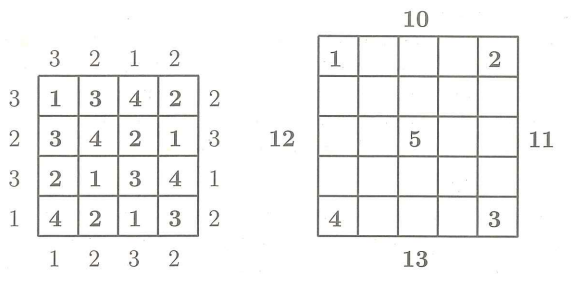
An $n\times n$ city has building heights from one to $n$, with no repeated height in a row or column. A building is visible from a side exactly when all preceding buildings in that row or column are shorter. The left diagram illustrates a $4\times4$ city with individual visibility counts. In the right $5\times5$ city, five heights are given. Total visible counts are north ten, east eleven, south thirteen, west twelve. Determine the remaining heights.
A building has eleven elevators. Each stops on exactly three floors, not necessarily consecutive; not all start at the first floor. For every pair of floors some elevator stops on both. Find the maximum number of floors.
Every pair of soccer teams plays once. A win gives two points in the old system and three in the new; a loss gives zero and a draw one per team in both. The new-system winner would finish last under the old system. Find the minimum number of teams and give every game result for an example.
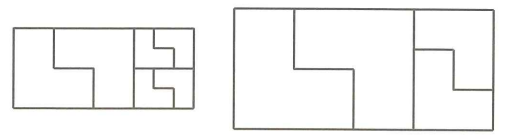
A polyomino consists of unit squares joined along whole edges. It has standard size if no smaller similar polyomino exists. Replacing each unit square by an $n\times n$ square gives size $n$. Construct ten pairwise nonsimilar rectangles under these rules:
(i) Use at most ten copies of a chosen polyomino. (ii) It is not rectangular. (iii) Every copy has integer size. (iv) At least one has standard size. (v) At least one has larger size. Rotations and reflections are allowed, without overlap or gaps. The left example is a $9\times4$ rectangle made with six copies and satisfies all rules. The right example is $13\times6$ with four copies of the same polyomino but fails rule (iv).