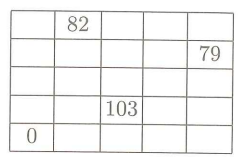
Four nonnegative integers have been entered in the following $5\times5$ table. Fill its remaining $21$ spaces with positive integers so that every row and every column has the same sum.
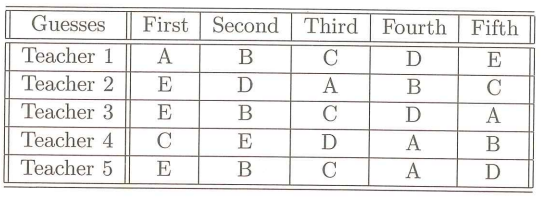
Five teachers predict the finish order of five classes $A,B,C,D,E$ in an examination, as in the table below. There are no ties. Two teachers each correctly predict exactly two classes’ ranks; the other three correctly predict none. Find the finish order.
| Teacher | First | Second | Third | Fourth | Fifth |
|---|---|---|---|---|---|
| 1 | A | B | C | D | E |
| 2 | E | D | A | B | C |
| 3 | E | B | C | D | A |
| 4 | C | E | D | A | B |
| 5 | E | B | C | A | D |
There are $50$ square cardboard pieces and $50$ equilateral-triangular cardboard pieces, all with side length $1$ cm. Construct a set of different convex polyhedra using these pieces as faces. Polyhedra with the same numbers of vertices, edges, square faces and triangular faces are not considered different. Use as many of the $100$ pieces as possible.