Question 16
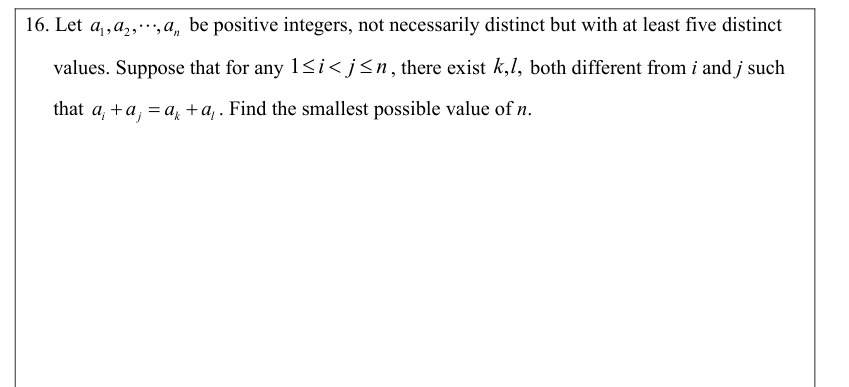
Let $a_1,a_2,\ldots,a_n$ be positive integers, not necessarily distinct but with at least five distinct values. Suppose that for any $1\leq i<j\leq n$, there exist k, l, both different from i and j such that $a_i+a_j=a_k+a_l$. Find the smallest possible value of n.