Question 77
We define a grid of type $(n_1, n_2, ..., n_m)$, $n_1 \ge n_2 \ge ... \ge n_m$ in the following way: we put $n_1$ squares horizontally, one next to each other, then we put $n_2$ squares horizontally under the first $n_1$ squares. We repeat the procedure until we get a grid of squares having $n_1$ squares in the first row, $n_2$ in the second, $n_i$ in the $i$-th row, so that in the end $n = n_1 + n_2 + ... + n_m$ squares are formed. The rows are left-aligned, as in the example. We fill out this grid with the numbers from 1 to $n$ in such a way that the numbers form an increasing sequence in each row (from the leftmost square to rightmost square) and in each column (from the uppermost square to the lowermost square). An example for such a grid of type (5,4,2,1) filled out in one possible way is:
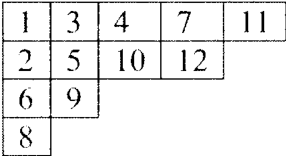
Find the number of possibilities to fill out a grid of type (4,3,2)!
Find the number of possibilities to fill out a grid of type (4,3,2)!