Question 33
Consider the $8 \times 8 \times 8$ Rubik's cube below. Each face is painted with a different color, and it is possible to turn any layer, as you can with smaller Rubik's cubes. Let $X$ denote the move that turns the shaded layer shown (indicated by arrows going from the top to the right of the cube) clockwise by $90$ degrees, about the axis labeled $X$. When move $X$ is performed, the only layer that moves is the shaded layer. Likewise, define move $Y$ to be a clockwise $90$-degree turn about the axis labeled $Y$, of just the shaded layer shown (indicated by the arrows going from the front to the top, where the front is the side pierced by the $X$ rotation axis). Let $M$ denote the move "perform $X$, then perform $Y$."
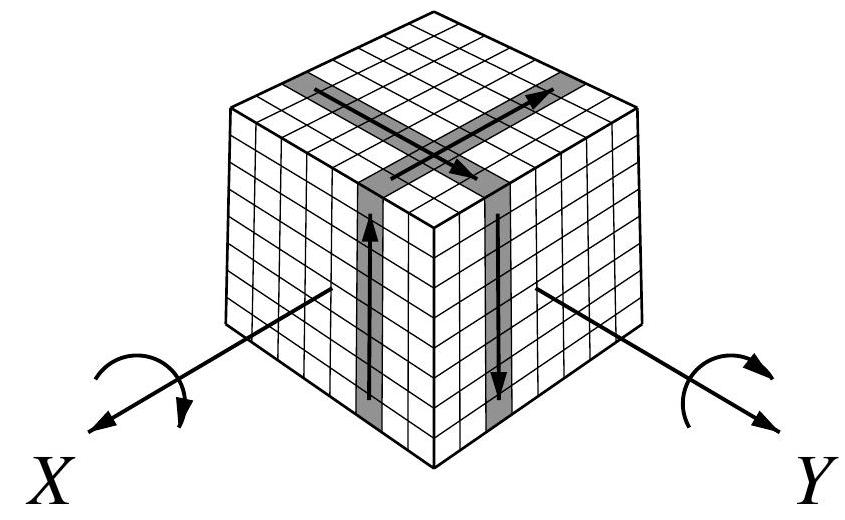
Imagine that the cube starts out in "solved" form (so each face has just one color), and we start doing move $M$ repeatedly. What is the least number of repeats of $M$ in order for the cube to be restored to its original colors?
Imagine that the cube starts out in "solved" form (so each face has just one color), and we start doing move $M$ repeatedly. What is the least number of repeats of $M$ in order for the cube to be restored to its original colors?