Question 19
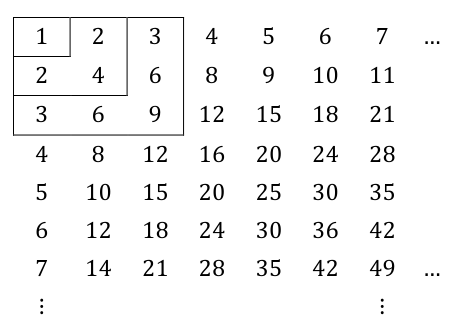
In the array below, define $S_i$ to be the sum of the entries lying in the $i$th row or $i$th column of the upper-left $i\times i$ square, counting their intersection once. For example, $S_1=1$, $S_2=8$ and $S_3=27$. Evaluate $S_{21}$.
Source correction for answering: the original second row prints 9, 10, 11 in columns 5, 6, 7, inconsistent with the multiplication pattern. Use the intended rule that entry (r,c) equals r times c, so those three entries should be 10, 12, 14. The original array is shown unchanged; without a continuation rule, the finite array alone does not determine S21.
Source correction for answering: the original second row prints 9, 10, 11 in columns 5, 6, 7, inconsistent with the multiplication pattern. Use the intended rule that entry (r,c) equals r times c, so those three entries should be 10, 12, 14. The original array is shown unchanged; without a continuation rule, the finite array alone does not determine S21.