Question 108
An "L-shape" is any of the following four pieces, each consisting of three unit squares:
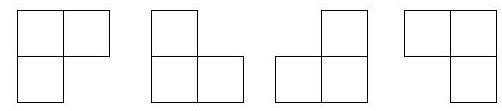
We are given: a $5 \times 5$ board consisting of $25$ unit squares, a nonzero natural number $k \leq 25$, and an unlimited collection of "L-shapes".
Two players, $A$ and $B$, play the following game: starting with $A$, they alternately mark one unit square that was not marked before, until there are $k$ marked squares on the board.
A placement of some "L-shapes" on the squares that remain unmarked on the board is called good if each piece covers exactly three unmarked unit squares and no two pieces overlap.
Player $B$ wins if every good placement of "L-shapes" leaves at least three unmarked unit squares uncovered. Determine the minimum value of $k$ for which $B$ has a winning strategy.