Question 155
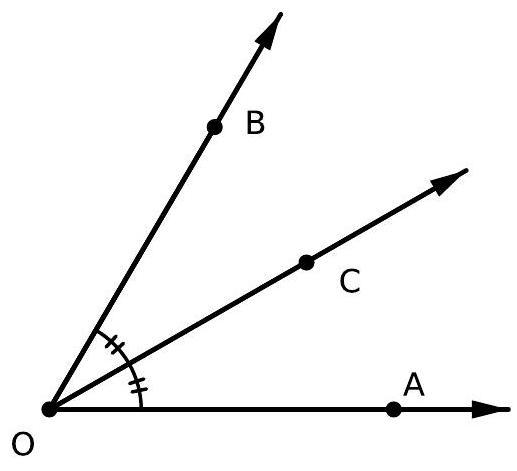
The bisector of an angle is a ray with origin at the vertex of the angle that divides it into two other congruent angles. For example, in the drawing below, the ray $OC$ is the bisector of the angle $\angle AOB$.
a) The difference between two consecutive but non-adjacent angles is $100^\circ$. Determine the angle formed by their bisectors.
Remark: Remember that two angles are consecutive if they have the same vertex and at least one side in common, and that two angles are adjacent if they have no interior points in common.
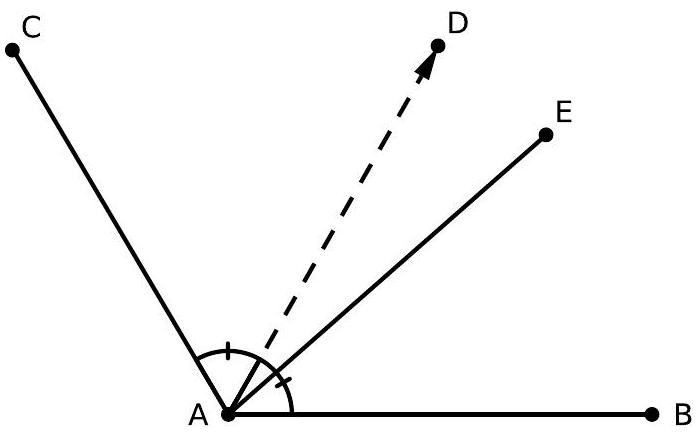
b) In the drawing below, $DA$ is the bisector of the angle $\angle CAB$. Determine the value of the angle $\angle DAE$, knowing that $\angle CAB+\angle EAB=120^\circ$ and $\angle CAB-\angle EAB=80^\circ$.
a) The difference between two consecutive but non-adjacent angles is $100^\circ$. Determine the angle formed by their bisectors.
Remark: Remember that two angles are consecutive if they have the same vertex and at least one side in common, and that two angles are adjacent if they have no interior points in common.
b) In the drawing below, $DA$ is the bisector of the angle $\angle CAB$. Determine the value of the angle $\angle DAE$, knowing that $\angle CAB+\angle EAB=120^\circ$ and $\angle CAB-\angle EAB=80^\circ$.