Question 152
a) Every real number squared is greater than or equal to $0$, and it equals $0$ only if the number being squared is $0$ itself. Consequently, for any real numbers $a$ and $b$ we have $(a-b)^2 \geq 0$. Prove that
$$
\frac{a^2+b^2}{2} \geq a b
$$
with equality occurring only when $a=b$.
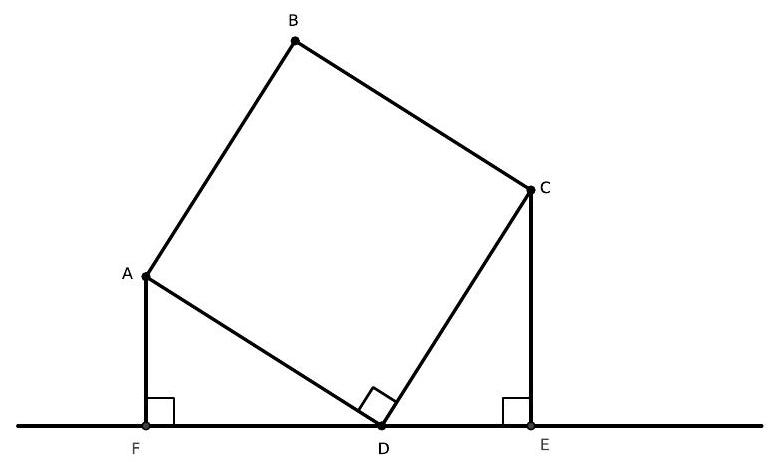
b) The following figure shows a square of side $1$ with a vertex on a horizontal line. Considering all the positions in which the square "touches" the line with only one of its vertices, what is the largest possible area of the pentagon $A B C E F$, where $E$ and $F$ are the orthogonal projections of the vertices $A$ and $C$ onto the horizontal line?
$$
\frac{a^2+b^2}{2} \geq a b
$$
with equality occurring only when $a=b$.
b) The following figure shows a square of side $1$ with a vertex on a horizontal line. Considering all the positions in which the square "touches" the line with only one of its vertices, what is the largest possible area of the pentagon $A B C E F$, where $E$ and $F$ are the orthogonal projections of the vertices $A$ and $C$ onto the horizontal line?