Question 151
The page of João's drawing notebook is a huge square-grid Cartesian plane. One of his favorite drawings is creating little snakes by covering the sides of the small squares with his pen. Basically, a snake is a sequence of $2n$ distinct points $P_{1}, P_{2}, \ldots, P_{2n}$ chosen at the vertices of the small squares of the grid so that points with consecutive indices lie on the side of the same small square of the grid. For example, in the figure below, we have a snake joining the following points of the Cartesian plane:
$$
\begin{aligned}
& P_{1}=(0,0), \quad P_{2}=(1,0), \quad P_{3}=(1,1), \quad P_{4}=(1,2), \quad P_{5}=(2,2), \quad P_{6}=(2,3) \\
& P_{7}=(3,3), \quad P_{8}=(4,3), \quad P_{9}=(4,4), \quad P_{10}=(5,4), \quad P_{11}=(6,4), \quad P_{12}=(6,5)
\end{aligned}
$$
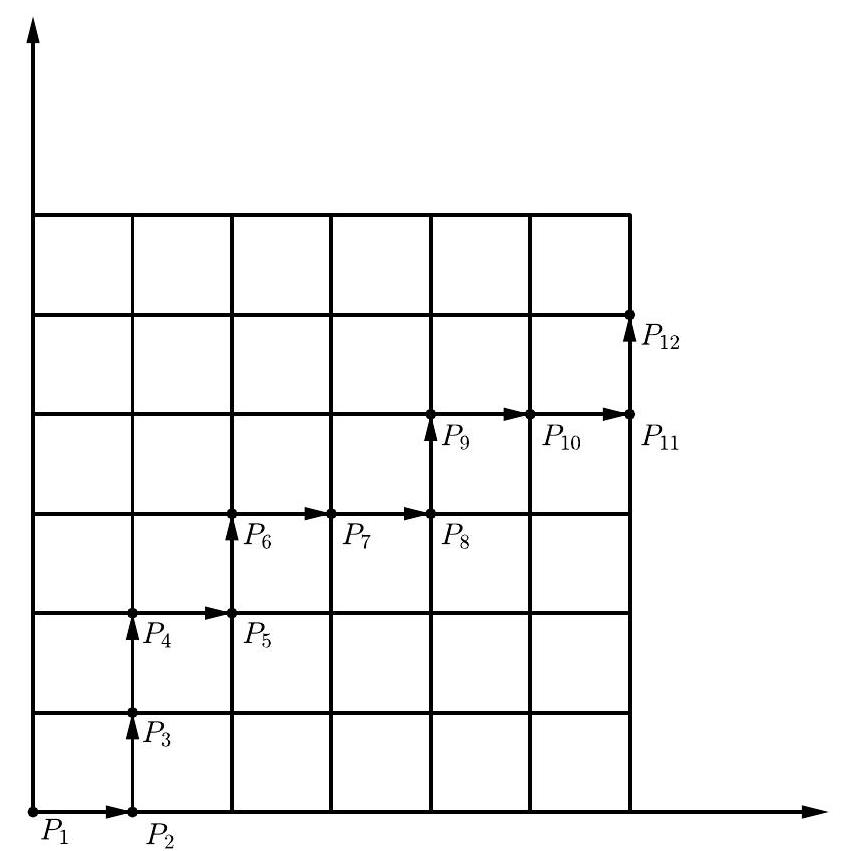
After drawing snakes on the grid, João likes to compute the sum of the coordinates of the points with odd indices, that is, of the points $P_{1}, P_{3}, \ldots, P_{2n-1}$, and to subtract from this number the result of the sum of the coordinates of the points with even indices, that is, of the points $P_{2}, P_{4}, \ldots, P_{2n}$.
a) For $n=3$, that is, with 6 points, draw "snakes" for which the result obtained by João is $-1, -3$, $1$ and $3$.
b) Depending on $n$, which values can João obtain?
Remark: The "snake" may also contain points with negative coordinates; it suffices that it "moves" to the left of the $y$-axis or below the $x$-axis.
$$
\begin{aligned}
& P_{1}=(0,0), \quad P_{2}=(1,0), \quad P_{3}=(1,1), \quad P_{4}=(1,2), \quad P_{5}=(2,2), \quad P_{6}=(2,3) \\
& P_{7}=(3,3), \quad P_{8}=(4,3), \quad P_{9}=(4,4), \quad P_{10}=(5,4), \quad P_{11}=(6,4), \quad P_{12}=(6,5)
\end{aligned}
$$
After drawing snakes on the grid, João likes to compute the sum of the coordinates of the points with odd indices, that is, of the points $P_{1}, P_{3}, \ldots, P_{2n-1}$, and to subtract from this number the result of the sum of the coordinates of the points with even indices, that is, of the points $P_{2}, P_{4}, \ldots, P_{2n}$.
a) For $n=3$, that is, with 6 points, draw "snakes" for which the result obtained by João is $-1, -3$, $1$ and $3$.
b) Depending on $n$, which values can João obtain?
Remark: The "snake" may also contain points with negative coordinates; it suffices that it "moves" to the left of the $y$-axis or below the $x$-axis.