Question 120
Francisco has just learned in his solid geometry class Euler's Relation for convex polyhedra:
$$
V+F=A+2
$$
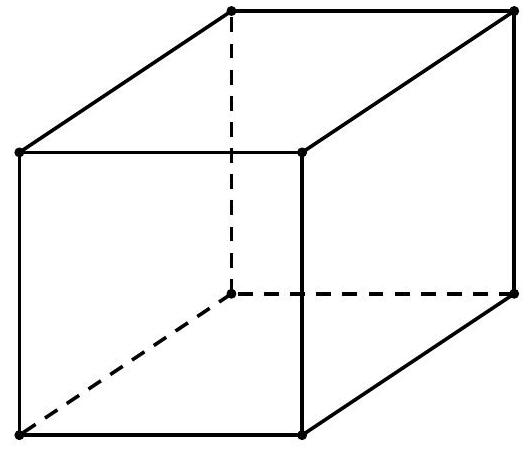
In the equation above, $V$, $A$ and $F$ represent the number of vertices, edges and faces of the polyhedron, respectively. We can verify that Euler's Relation holds for the cube below, since it has 6 faces, 12 edges, 8 vertices and
$$
V+F=8+6=12+2=A+2
$$
João decided to verify Euler's Relation on another polyhedron obtained from a wooden cube. He marked the midpoints of each edge and, on each face, joined them forming squares, as shown in the figure below. Then he cut off the 8 pyramids formed around each vertex, obtaining a new polyhedron. Determine:
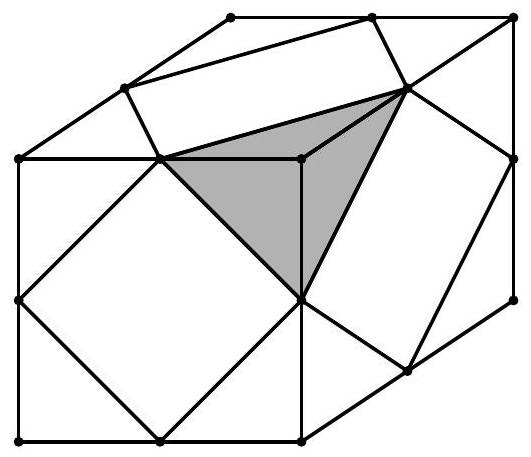
a) the new number of vertices;
b) the new number of edges;
c) the new number of faces.
$$
V+F=A+2
$$
In the equation above, $V$, $A$ and $F$ represent the number of vertices, edges and faces of the polyhedron, respectively. We can verify that Euler's Relation holds for the cube below, since it has 6 faces, 12 edges, 8 vertices and
$$
V+F=8+6=12+2=A+2
$$
João decided to verify Euler's Relation on another polyhedron obtained from a wooden cube. He marked the midpoints of each edge and, on each face, joined them forming squares, as shown in the figure below. Then he cut off the 8 pyramids formed around each vertex, obtaining a new polyhedron. Determine:
a) the new number of vertices;
b) the new number of edges;
c) the new number of faces.