Question 20
The diagram below is an example of a rectangle tiled by squares:
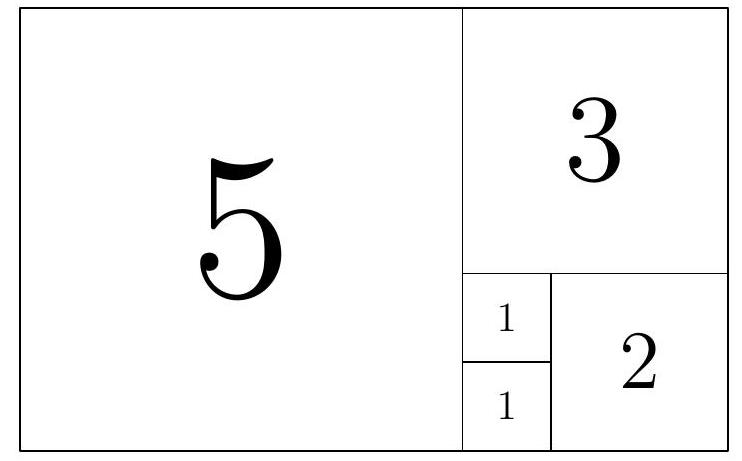
Each square has been labeled with its side length. The squares fill the rectangle without overlapping.
In a similar way, a rectangle can be tiled by nine squares whose side lengths are $2$, $5$, $7$, $9$, $16$, $25$, $28$, $33$, and $36$. Sketch a possible arrangement of those squares. They must fill the rectangle without overlapping. Label each square in your sketch by its side length, as in the picture above.