Question 8
Original source text (the original panel preserves all diagram labels, tables and choices):
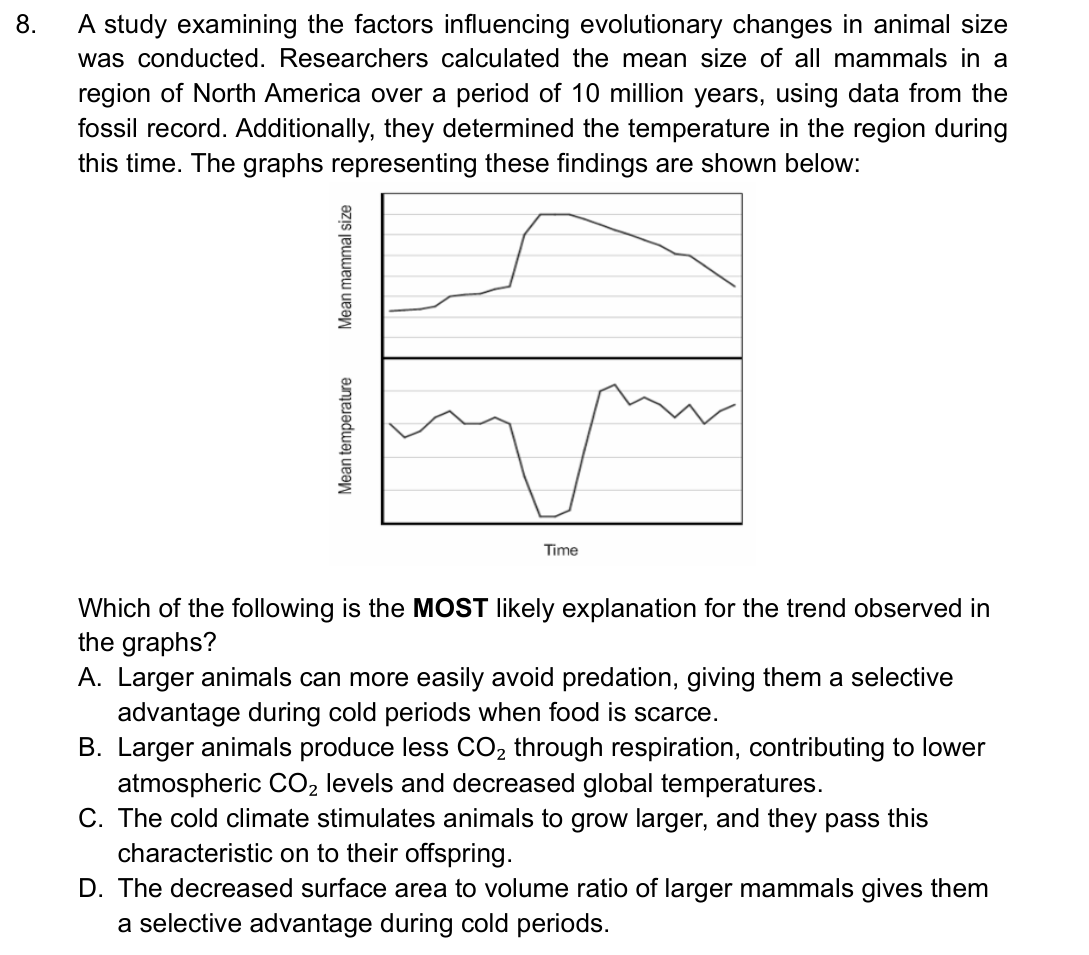
A study examining the factors influencing evolutionary changes in animal size
was conducted. Researchers calculated the mean size of all mammals in a
region of North America over a period of 10 million years, using data from the
fossil record. Additionally, they determined the temperature in the region during
this time. The graphs representing these findings are shown below:
Which of the following is the MOST likely explanation for the trend observed in
the graphs?
A. Larger animals can more easily avoid predation, giving them a selective
advantage during cold periods when food is scarce.
B. Larger animals produce less CO₂ through respiration, contributing to lower
atmospheric CO₂ levels and decreased global temperatures.
C. The cold climate stimulates animals to grow larger, and they pass this
characteristic on to their offspring.
D. The decreased surface area to volume ratio of larger mammals gives them
a selective advantage during cold periods.
A study examining the factors influencing evolutionary changes in animal size
was conducted. Researchers calculated the mean size of all mammals in a
region of North America over a period of 10 million years, using data from the
fossil record. Additionally, they determined the temperature in the region during
this time. The graphs representing these findings are shown below:
Which of the following is the MOST likely explanation for the trend observed in
the graphs?
A. Larger animals can more easily avoid predation, giving them a selective
advantage during cold periods when food is scarce.
B. Larger animals produce less CO₂ through respiration, contributing to lower
atmospheric CO₂ levels and decreased global temperatures.
C. The cold climate stimulates animals to grow larger, and they pass this
characteristic on to their offspring.
D. The decreased surface area to volume ratio of larger mammals gives them
a selective advantage during cold periods.