Question 1
21st International Mathematics and Science Olympiad (IMSO)
Group and Individual Experiment Test · Wenzhou, China · 04 October 2024
Instructions (source cover)
1\. Do not turnover this page until you are told to do so.
2\. Write your ID Number and Seat Number on the space provided.
3\. Follow all the instructions carefully.
4\. Write your answer only on the separate answer sheet. There are 5 pages in the answer sheet.
5\. There are two experiments in this test. Make sure to answer BOTH papers to get full points.
6\. For the group experiment: ONLY the procedure of the experiment is done by group. The paper must be answered individually.
7\. Complete all the sections in English. There are Section I, II and III for the Group Experiment and Section I and II for the individual experiment.
8\. The marks awarded for each section or question is shown in brackets, [ ].
9\. There are 5 printed pages in this booklet, excluding this cover page.
10\. You have 120 minutes to complete this test.
Editorial navigation: the 120 minutes cover both experiments together. Vietnamese is a study translation; the original instruction to answer in English is preserved. No candidate ID or work is included.
GROUP EXPERIMENT · Finding the Mass of the Ruler
Objective: To determine the unknown mass of a wooden ruler using the principle of moments.
Materials
A. half-meter ruler
B. retort stand
C. 12 pcs. paper clips
D. scissors
E. ball of string
F. electronic mass balance
G. small plastic container
Section I: To find the mass of a paper clip
Procedures:
1\. Use the electronic mass balance to measure the mass of the 10 paper clips.
2\. Calculate the average mass of 1 paper clip, m.
Section II: To find the mass of a wooden ruler
Diagram of Set-Up:
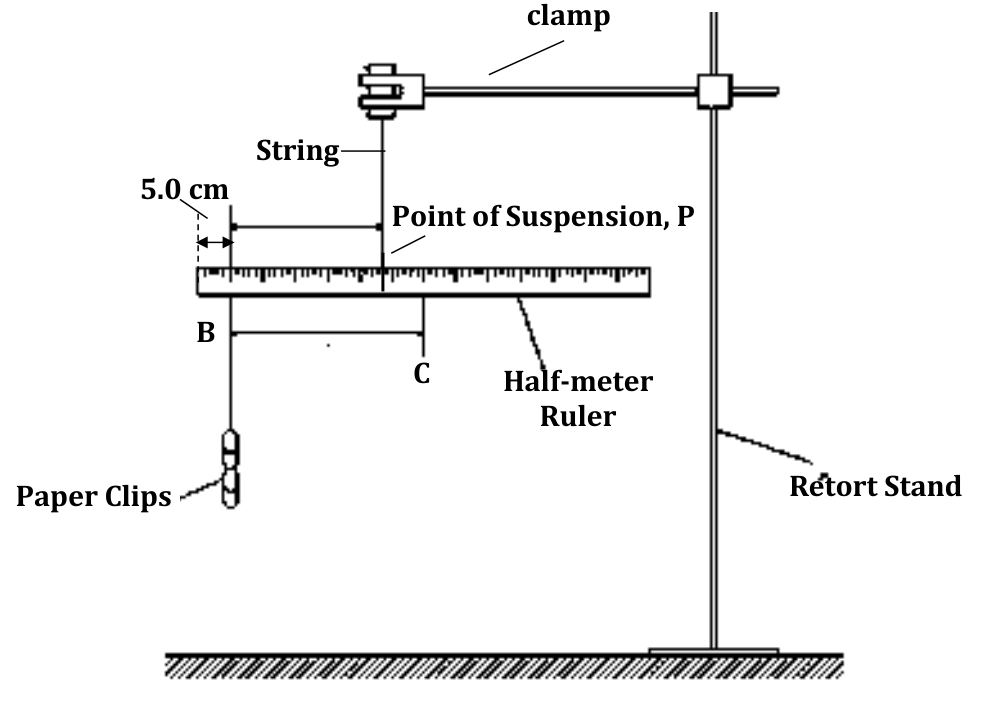
Procedures:
IMPORTANT NOTE: You will work as a group ONLY in doing the procedure of this experiment. You must answer your papers individually!
1\. Tie the half-meter ruler using a string and suspend the ruler as shown on the retort stand by tying it to a suitable location on the clamp.
2\. Adjust the point of suspension P until the ruler is horizontally balanced at point C. Record the position of C on the answer sheet.
3\. Suspend 2 paper clips at 5.0 cm from the left end of the ruler at position B.
4\. Measure and record the length, L from B to C on the answer sheet.
5\. Adjust the point of suspension, P of the ruler until the ruler balance. Measure and record the distance a from B to the point of suspension of the ruler on the table provided on the answer sheet.
6\. Calculate the value of (L − a) and record the reading on the table provided on the answer sheet.
7\. Calculate the value of (n × a) by multiplying the number of paper clips (n) to distance a and record the reading on the table provided on the answer sheet.
8\. By increasing the numbers of paper clips, n, in intervals of two at a time, repeat steps 3 to 7 for 5 further values of a. (Keep the position of B constant at all times).
9\. Plot a graph of (n × a) in cm against (L − a) in cm on the graph paper provided and answer the rest of the questions.
Section I: To find the mass of a paper clip
Records of Measurements:
Mass of 10 paper clips = __________ g
Mass of 1 paper clip, m = __________ g [1 mark]
Section II: To find the mass of a Ruler
Records of Measurements:
Position of C = __________ cm
Distance of B to C, L = __________ cm [1 mark]
Table of Readings:
| Number of paper clips, n | a (cm) | (L − a) (cm) | (n × a) (cm) |
| --- | --- | --- | --- |
| 2 | | | |
| 4 | | | |
| 6 | | | |
| 8 | | | |
| 10 | | | |
| 12 | | | |
[4 marks]
Section III: Guide Questions
1\. Plot a graph of (n × a) against (L − a) on the grid provided. [3 marks]
2\. From the graph, calculate the slope of the graph in the space below. [3 marks]
3\. The mass of the ruler can be deduced using the formula below: Mass of the ruler = m × slope. Using your slope and mass of one paper clip, m, what is the approximate mass of the ruler? [1 mark]
4\. Identify two possible sources of errors for this experiment. [2 marks]
THIS IS NOT YET THE END OF YOUR EXPERIMENT TEST. TURN TO PAGE 4 FOR THE INDIVIDUAL EXPERIMENT.
Group and Individual Experiment Test · Wenzhou, China · 04 October 2024
Instructions (source cover)
1\. Do not turnover this page until you are told to do so.
2\. Write your ID Number and Seat Number on the space provided.
3\. Follow all the instructions carefully.
4\. Write your answer only on the separate answer sheet. There are 5 pages in the answer sheet.
5\. There are two experiments in this test. Make sure to answer BOTH papers to get full points.
6\. For the group experiment: ONLY the procedure of the experiment is done by group. The paper must be answered individually.
7\. Complete all the sections in English. There are Section I, II and III for the Group Experiment and Section I and II for the individual experiment.
8\. The marks awarded for each section or question is shown in brackets, [ ].
9\. There are 5 printed pages in this booklet, excluding this cover page.
10\. You have 120 minutes to complete this test.
Editorial navigation: the 120 minutes cover both experiments together. Vietnamese is a study translation; the original instruction to answer in English is preserved. No candidate ID or work is included.
GROUP EXPERIMENT · Finding the Mass of the Ruler
Objective: To determine the unknown mass of a wooden ruler using the principle of moments.
Materials
A. half-meter ruler
B. retort stand
C. 12 pcs. paper clips
D. scissors
E. ball of string
F. electronic mass balance
G. small plastic container
Section I: To find the mass of a paper clip
Procedures:
1\. Use the electronic mass balance to measure the mass of the 10 paper clips.
2\. Calculate the average mass of 1 paper clip, m.
Section II: To find the mass of a wooden ruler
Diagram of Set-Up:
Procedures:
IMPORTANT NOTE: You will work as a group ONLY in doing the procedure of this experiment. You must answer your papers individually!
1\. Tie the half-meter ruler using a string and suspend the ruler as shown on the retort stand by tying it to a suitable location on the clamp.
2\. Adjust the point of suspension P until the ruler is horizontally balanced at point C. Record the position of C on the answer sheet.
3\. Suspend 2 paper clips at 5.0 cm from the left end of the ruler at position B.
4\. Measure and record the length, L from B to C on the answer sheet.
5\. Adjust the point of suspension, P of the ruler until the ruler balance. Measure and record the distance a from B to the point of suspension of the ruler on the table provided on the answer sheet.
6\. Calculate the value of (L − a) and record the reading on the table provided on the answer sheet.
7\. Calculate the value of (n × a) by multiplying the number of paper clips (n) to distance a and record the reading on the table provided on the answer sheet.
8\. By increasing the numbers of paper clips, n, in intervals of two at a time, repeat steps 3 to 7 for 5 further values of a. (Keep the position of B constant at all times).
9\. Plot a graph of (n × a) in cm against (L − a) in cm on the graph paper provided and answer the rest of the questions.
Section I: To find the mass of a paper clip
Records of Measurements:
Mass of 10 paper clips = __________ g
Mass of 1 paper clip, m = __________ g [1 mark]
Section II: To find the mass of a Ruler
Records of Measurements:
Position of C = __________ cm
Distance of B to C, L = __________ cm [1 mark]
Table of Readings:
| Number of paper clips, n | a (cm) | (L − a) (cm) | (n × a) (cm) |
| --- | --- | --- | --- |
| 2 | | | |
| 4 | | | |
| 6 | | | |
| 8 | | | |
| 10 | | | |
| 12 | | | |
[4 marks]
Section III: Guide Questions
1\. Plot a graph of (n × a) against (L − a) on the grid provided. [3 marks]
2\. From the graph, calculate the slope of the graph in the space below. [3 marks]
3\. The mass of the ruler can be deduced using the formula below: Mass of the ruler = m × slope. Using your slope and mass of one paper clip, m, what is the approximate mass of the ruler? [1 mark]
4\. Identify two possible sources of errors for this experiment. [2 marks]
THIS IS NOT YET THE END OF YOUR EXPERIMENT TEST. TURN TO PAGE 4 FOR THE INDIVIDUAL EXPERIMENT.