Question 3
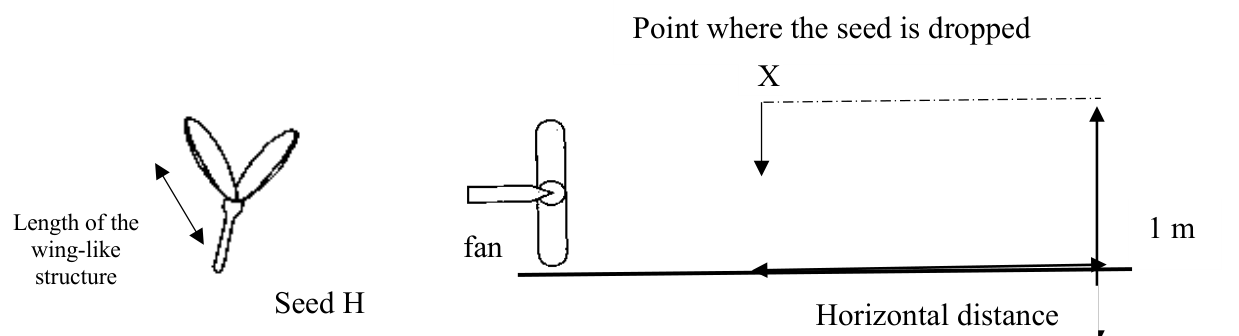
Earl wanted to find out how the wing-like structure of a seed affects the distance it will travel in wind. He cut the length of the wing of Seed H. he dropped it down from a height of 1 m and measured the horizontal distance it traveled as shown in the set-up below.
Based on the result, the following graph was plotted.
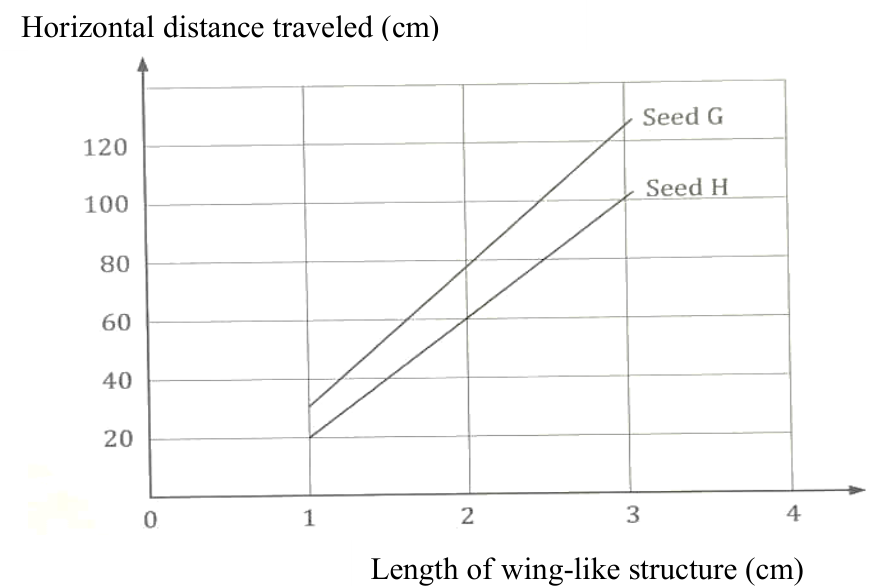
(a) What is the relationship between the length of the wing-like structure of Seed H and the horizontal distance traveled? [1.5 point]
(b) Using the graph, predict the horizontal distance traveled by Seed H when its wing-like structure is less than 1 cm. [1 point]
(c) Earl repeated the experiment with Seed H and Seed J which are obtained from the same plant as Seed H. Seed G was lighter that Seed H and Seed J was the heaviest among the three seeds. The results for Seed G were plotted in the graph above. Plot the result for Seed J on the graph above. [2.5 points]
(d) Other than the length of the wing-like structure, name another factor that has affected the horizontal distance traveled by the seed. [1 point]
Based on the result, the following graph was plotted.
(a) What is the relationship between the length of the wing-like structure of Seed H and the horizontal distance traveled? [1.5 point]
(b) Using the graph, predict the horizontal distance traveled by Seed H when its wing-like structure is less than 1 cm. [1 point]
(c) Earl repeated the experiment with Seed H and Seed J which are obtained from the same plant as Seed H. Seed G was lighter that Seed H and Seed J was the heaviest among the three seeds. The results for Seed G were plotted in the graph above. Plot the result for Seed J on the graph above. [2.5 points]
(d) Other than the length of the wing-like structure, name another factor that has affected the horizontal distance traveled by the seed. [1 point]